Kim’s China visit signals increased economic cooperation as US talks remain on back burner
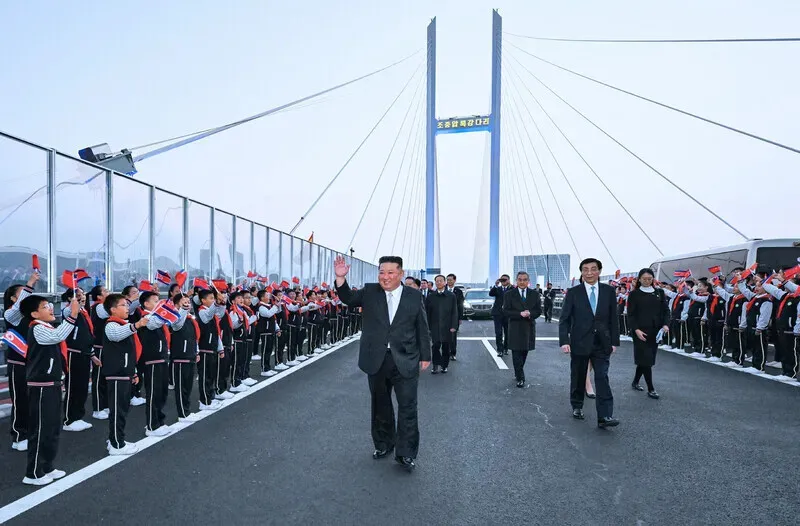
North Korean leader Kim Jong-un walks across the newly opened New Yalu River Bridge connecting North Korea’s Sinuiju and China’s Dandong during an unannounced day trip to China on Oct. 24, 2026. (Xinhua/Yonhap)
North Korean leader Kim Jong-un’s surprise visit to the Chinese border city of Dandong was remarkable for multiple reasons, chief being his unusual choice not to meet Chinese President Xi Jinping.
This marked Kim’s sixth visit to China and his first in over a year, the last being when he attended China’s Victory Day celebrations in Beijing in September 2025.
During his day trip to Dandong, he met with Wang Huning, China’s No. 4 official and chairperson of the National Committee of the Chinese People’s Political Consultative Conference, before returning to Pyongyang via car.
Some analysts see the visit as a signal of Pyongyang’s intent to reaffirm its “blood alliance” with Beijing and lay the groundwork for deeper economic cooperation.
Analysts are divided over whether Kim’s visit to China also signals an opening for renewed talks between North Korea and the United States.
Kim’s visit took place a day before the 76th anniversary of China’s entry into the Korean War; as such, the visit seems to primarily function as a means to showcase the alliance forged with blood and strategic cooperation between the two countries.
Upon his arrival in Dandong, Kim began his visit by stopping by the Memorial Hall of the War to Resist US Aggression and Aid Korea — also known as the Korean War Museum — where he vowed that the North Korean people would “remember and defend forever the excellent history in which the two countries braved ordeals together,” the state-run Korean Central News Agency reported Sunday.
This marks the first time that a North Korean leader has visited the museum.
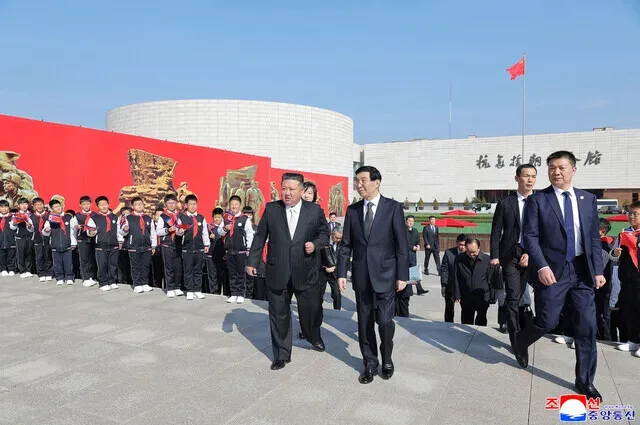
North Korean leader Kim Jong-un walks with Wang Huning, China’s No. 4 official and chairperson of the National Committee of the Chinese People’s Political Consultative Conference, on the grounds of the Memorial Hall of the War to Resist US Aggression and Aid Korea in Dandong, China, on Oct. 24, 2026. (KCNA/Yonhap)
Kim also emphasized the significance of his museum visit while engaging in a conversation with Wang, saying, “It was a moment when we recollected once again the preciousness of the DPRK-China friendship forged with blood.”
North Korea has in effect signaled that its deepening partnership with Russia, as seen in troop deployments to the war with Ukraine, can serve as leverage to further strengthen its ties with China.
Beijing this year is also seeking to curb Moscow’s growing influence on the Korean Peninsula, while striving to restore relations with Pyongyang to maintain and increase its own sway over the region.
The key to restoring the North’s ties with China is stronger economic cooperation. Kim’s trip to the northeastern Chinese city of Dandong, for which he drove across the newly opened New Yalu River Bridge, and his inspection of a bus plant there showed his commitment to bolstering bilateral economic ties.
Linking Dandong to the North’s city of Sinuiju, the bridge was opened on Oct. 15 after remaining closed for 12 years following its completion in 2014.
Kim’s crossing just nine days after the bridge’s opening showed his intent to expand people-to-people exchanges, trade and economic cooperation with China.
Kim was reported as expressing hope that the bridge would “undoubtedly and correctly fulfill its historic mission of linking the two countries and firmly joining the minds of the peoples of the two countries.”
China’s Xinhua News Agency also quoted Wang as saying, “We hope to use the opening of the New Yalu River Bridge as an opportunity to expand bilateral people-to-people exchanges and economic and trade cooperation, in addition to bringing greater benefits to the people of both countries.”
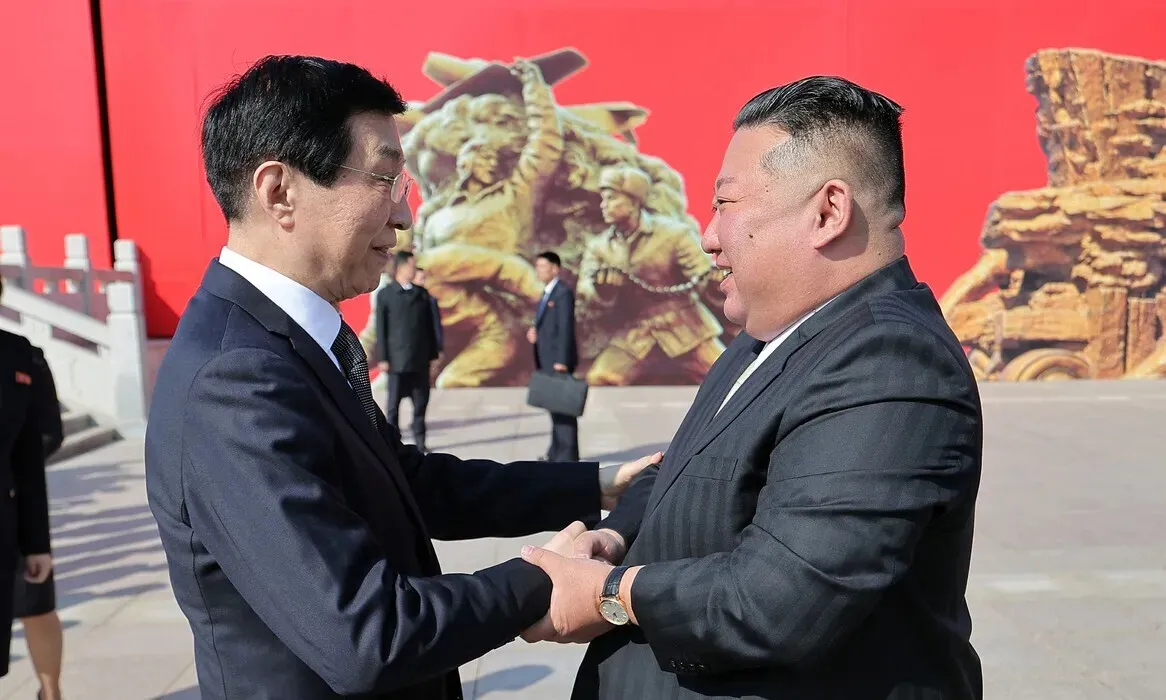
North Korean leader Kim Jong-un (right) shakes hands with Wang Huning, China’s No. 4 official and chairperson of the National Committee of the Chinese People’s Political Consultative Conference, during a visit to Dandong, China, on Oct. 24, 2026. (KCNA/Yonhap)
Opinions are mixed over what message the visit was intended to convey given high interest in the potential resumption of North Korea-US dialogue, coinciding with the upcoming Asia-Pacific Economic Cooperation Summit (APEC) in Shenzhen, China.
“US President Donald Trump has recently played down the prospects of a summit with North Korea, shifting his focus instead to the war in Ukraine and the possibility of trilateral talks with China and Russia,” said Kim Sung-bae, the president of the Seoul-based Institute for National Security Strategy. “Chairman Kim appears to have carefully weighed his options and sent a signal to draw Trump’s attention back to North Korea-US dialogue.”
“The possibility of a Kim-Trump summit on the sidelines of the APEC summit remains open,” he added.
This suggests that Kim was seeking to shift the dynamics as the prospect of a Pyongyang-Washington summit grew dimmer. On Oct. 19, Trump said, “I don’t know” whether the proposed talks would take place by the end of the year, despite raising the possibility several times since August
Hong Min, senior research fellow at the Korea Institute for National Unification in Seoul, called Kim’s trip “a visit to signal a new path of strategic strengthening of the North’s ties with China to expand to economic cooperation,” but added that Beijing could create an opportunity by separately inviting Kim to Shenzhen for the APEC summit.
North Korean Foreign Minister Choe Son-hui accompanied Kim to Dandong and Chinese Foreign Minister Wang Yi was also in attendance, suggesting that the two sides may have discussed diplomatic matters. Yet neither Pyongyang nor Beijing mentioned anything in their announcements about the North’s dialogue with the US or APEC.
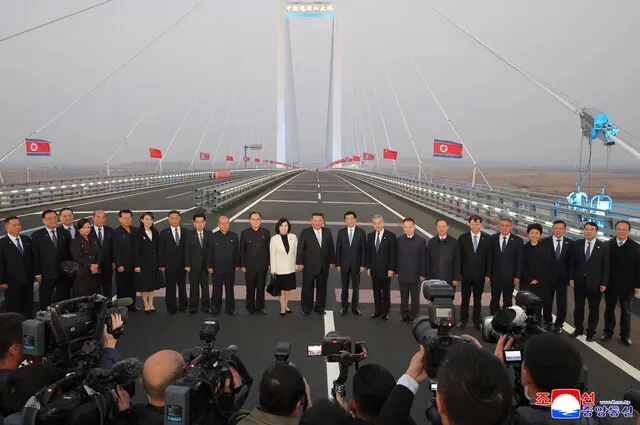
North Korean and Chinese officials stand for a photo on the newly opened New Yalu River Bridge connecting North Korea’s Sinuiju and China’s Dandong during an unannounced day trip to China on Oct. 24, 2026. (KCNA/Yonhap)
Certain observers also say the chances of a Kim Jong-un-Trump summit this year have diminished.
“Kim’s long-term strategy is to boost ties with both China and Russia but also avoid excessive dependence on them through a summit with Trump, but the near absence of communication or preparation between the North and the US makes the chances of a bilateral summit in November low,” said Lee Byong-chul, a professor at the Institute for Far Eastern Studies at Kyungnam University.
“The crux of this visit to China was the deepening of North Korea-China relations, like on-site inspections after the opening of the New Yalu River Bridge,” said Chang Yong-seok, a visiting researcher at the Institute for Peace and Unification Studies at Seoul National University. “This is unlikely to get North Korea and the US to talk.”
A mine explosion in the Demilitarized Zone on Sept. 21 and the North’s moves to resume loudspeaker propaganda broadcasts at the South have reignited tensions on the Korean Peninsula, leaving the Lee administration in Seoul with an increasingly difficult dilemma given Pyongyang’s refusal to hold dialogue with Seoul and clearly demonstrating its intent to bolster ties with Beijing.
On Kim’s visit to Dandong, the Blue House said, “We are closely monitoring related developments while bearing various possibilities in mind.”
By Park Min-hee, senior staff writer; Jang Na-rye, staff reporter
KioskNews shows a cleaned-up reading view extracted from the publisher’s page — the original always lives on their site, not ours.