Toyota orders workers to train humanoid robots but says humans won't be replaced
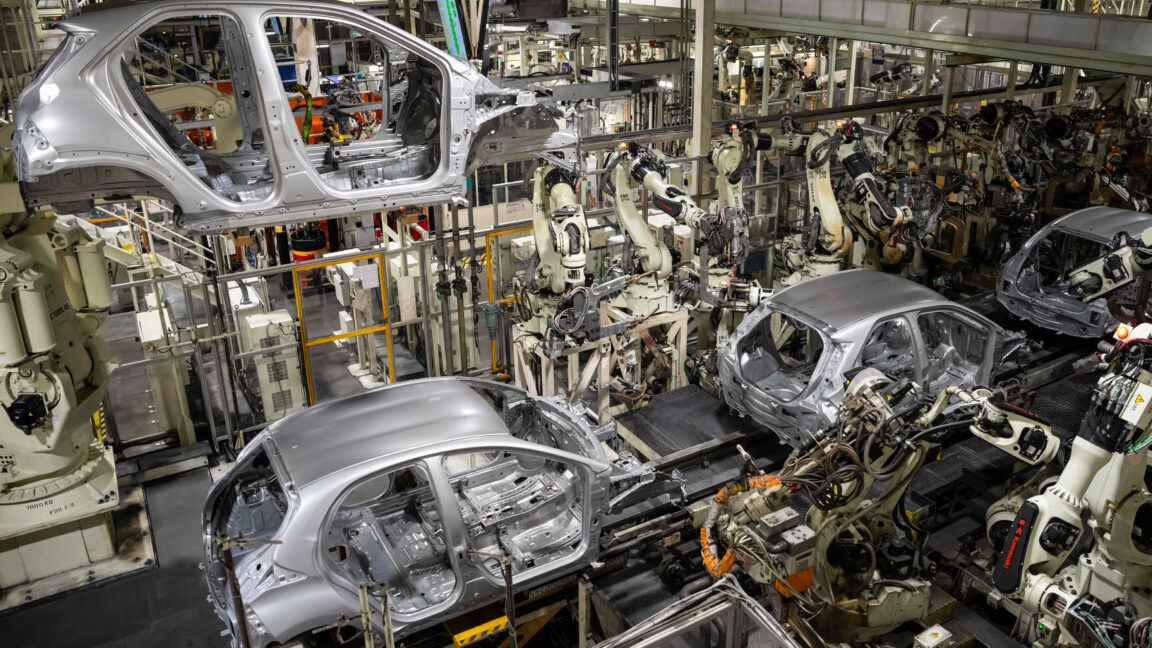
Toyota workers are already helping to train humanoid robots as part of the automaker’s race to eventually deploy 400,000 factory robots—but a Toyota executive said the robotic push is not meant to directly replace humans.
Starting in 2028, the Toyota Motor group aims to start investing $6.42 billion every year in upgrading factories with the new robotic workforce, according to Nikkei Asia. The company wants to put 150,000 robots in its own automotive plants and deploy another 250,000 at group company facilities that produce various components and materials.
Toyota has already begun deploying some of its ELEY humanoid robots across assembly lines to learn from human workers. Nikkei Asia reported that workers are teaching the robots, which roll around on wheels, to perform tasks requiring precise hand movements by wearing “jigs” based on the humanoids’ fingers.
That naturally raises questions about the future of the Japan-based automaker’s human workforce, which has 18,000 veteran workers across 60 factories worldwide, including 11 US manufacturing plants. But Hiroki Nakajima, a Toyota executive vice president, told Nikkei Asia that the company aims for “a world where robots coexist with humans, rather than replacing them.”
It’s unclear how many robots Toyota has already deployed overall or how many of the new robots will be humanoids. But the automotive industry has been a leading adopter of industrial robots for decades, with such robots typically being robotic arms installed at workstations and mobile robots that move components or materials around.
China alone deployed 2 million industrial robots in 2024, with Japan coming in second at 450,500 robots, according to the International Federation of Robotics. The United States and South Korea ranked third and fourth with 34,200 robots and 30,600 robots, respectively.
KioskNews shows a cleaned-up reading view extracted from the publisher’s page — the original always lives on their site, not ours.