China’s comfortable brain-reading device achieves 94% mind-typing accuracy in day-long use
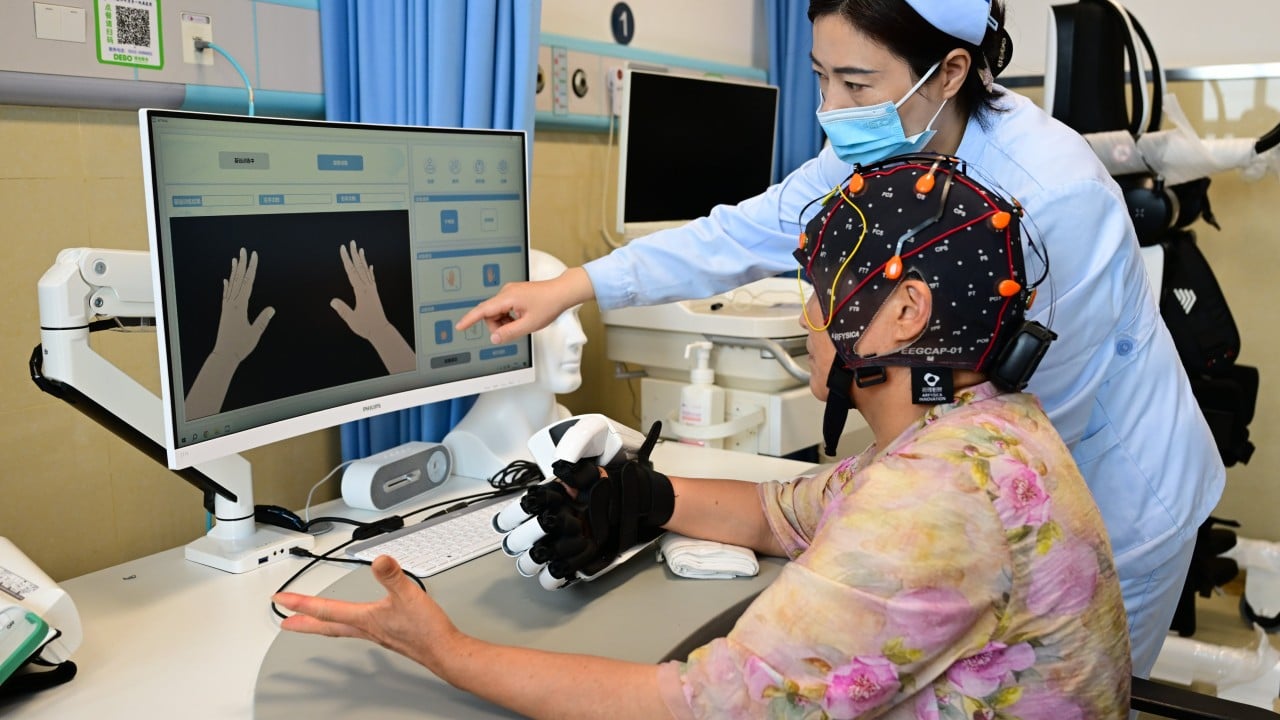
Chinese researchers have created a comfortable electrode for non-invasive brain-computer interfaces (BCIs) that achieved over 94 per cent accuracy in visual mind-typing tests during day-long use.
The gradient electrodes – designed to overcome the current trade-offs of conventional uniformly soft or rigid electrodes – were integrated into a commercial electroencephalogram (EEG) cap and tested during rest over the span of 14 hours.
Furthermore, the electrodes enabled eight hours of stable EEG brain recordings while a human subject engaged in daily activities, which helped overcome key barriers to the real-world deployment of non-invasive BCIs.
“This work demonstrated the potential of gradient-designed hydrogels toward non-invasive BCIs in freely moving practicality,” the team said in a paper published in the peer-reviewed journal NPJ Flexible Electronics last month.
This could make non-invasive BCIs more applicable to real-world scenarios, including daily healthcare, sleep monitoring and providing warnings for conditions like epilepsy.
BCIs are a rapidly developing field of devices that connect activity in the human brain with external digital systems, aiming to translate brain signals into actions like mind-typing and controlling electronics.
Unlike semi-invasive or invasive BCIs that require electrodes to be placed inside the skull or directly implanted in brain tissue, non-invasive BCIs measure and translate brain activity into digital commands using wearable devices equipped with sensors.
The team – led by researchers from Guangxi University, Guangxi Medical University and Tsinghua University – said non-invasive BCIs needed stable, comfortable electrodes for long-term wear.
“Current rigid or uniformly soft electrodes suffer from scalp mismatch, causing motion artefacts and short operation times,” the researchers wrote in their paper.
This can mean that current non-invasive BCIs are suitable for laboratory applications when users are still, but are less stable in real-world ambulatory applications when the user is moving around.
03:28
Researchers in Singapore use AI to read minds through brain scans
Many non-invasive BCIs are based on EEGs, which measure electrical activity in the brain using a cap lined with electrodes that are in contact with the scalp. Conventional non-invasive BCIs often use wet electrodes that consist of a rigid metal covered in wet gel.
These electrodes typically offer stable performance for only two to four hours due to gel dehydration. The mismatch between the rigid electrodes and the soft scalp can also lead to sliding and motion-induced fluctuations in readings.
While alternative strategies such as semi-dry, dry and patch electrodes have been explored, they generally fail to achieve the compatibility needed to suit both the soft scalp and rigid EEG circuitry.
To address this challenge, the team created an adaptive soft-to-rigid hydrogel electrode using a temperature gradient during the production stage.
“This yields an electrode with a gradual stiffness change – soft at the scalp interface and firm at the circuit connection – along with a gradient pore structure for sustained electrolyte release,” they said.
To create the electrode, the team first poured a hydrogel precursor containing a conductive polymer and silver nanosheets into a mould and froze it to form a primary structure.
During subsequent freeze-thaw cycles, they applied a heat source on one side and a cold source on the other in the thawing stage, causing the hydrogel to set in a gradient of both stiffness and pore structure.
“This fabrication process is compatible with large-scale manufacturing, enabling the one-time production of 300 electrodes with customised dimensions tailored to commercial EEG caps,” the team said.
“This manufacturing capability highlights the practical potential for cost-effective and scalable supply, which is essential for translating laboratory prototypes into real-world BCI applications.”
Before testing the electrodes on humans, the team applied them to mice to verify their biocompatibility and found no adverse reactions.
The team then tested the gradient electrodes on humans using an eight-channel electrode cap, which captured brain activity and transmitted it wirelessly to a computer.
The gradient electrodes enabled continuous EEG recording for eight hours while a subject engaged in daily activities like walking, eating, reading and sleeping.
The team also conducted testing over a 14-hour period under resting conditions, where another subject performed hourly steady-state and motion-state tasks.
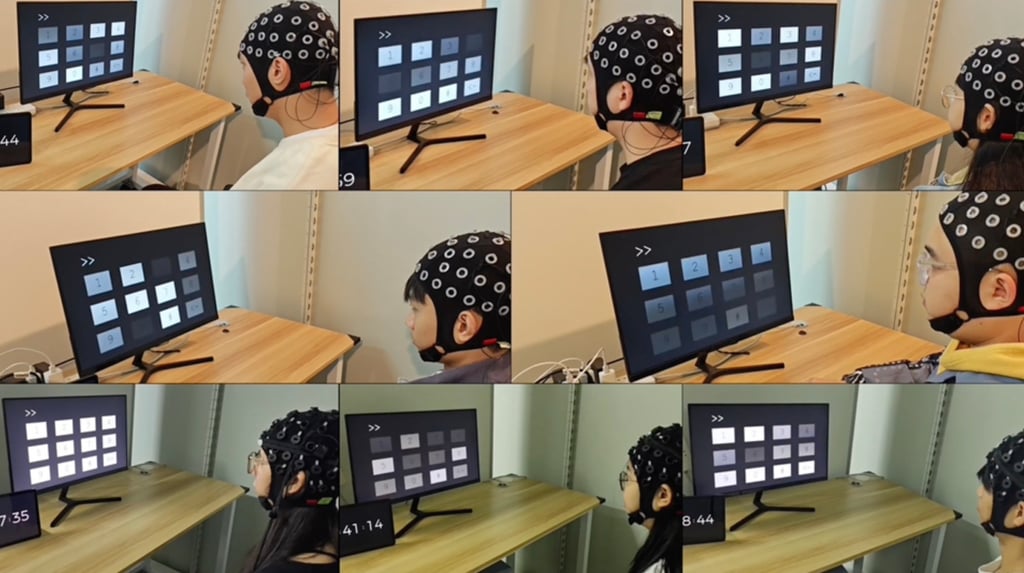
For the steady-state test, subjects typed the sequence one to nine and the date by looking at a flickering virtual keyboard, maintaining a typing accuracy exceeding 94 per cent.
For the motion test, coloured lines swept across an array of virtual boxes while the subjects had to focus on target boxes, with accuracy on this task exceeding 90 per cent.
The researchers also compared their gradient electrodes to commercial gel electrodes, which exhibited “severe performance degradation” over time due to dehydration, with channels becoming nearly unusable within four to five hours.
“Together, these results establish a general skin-mimetic gradient design paradigm for robust, long-duration non-invasive BCIs and advance their practical deployment in ambulatory neuroscience and clinical monitoring,” the team said.
The team said their gradient electrodes could be applied across “diverse BCI paradigms” to enable the recording of high-quality EEG signals.
KioskNews shows a cleaned-up reading view extracted from the publisher’s page — the original always lives on their site, not ours.