US unlikely to cancel arms sales: official
NOT WORRIED: Fears that Taiwan would become a bargaining chip for the US is a recurring theme, but, in reality, Taiwan and the US have grown closer, Alex Huang said
By Chen Yun and Jonathan Chin / Staff reporter, with staff writer


The US would not cancel a proposed US$14 billion arms sale package to Taiwan after US President Donald Trump’s meeting with Chinese President Xi Jinping (習近平) this week, National Security Council adviser Alex Huang (黃重諺) said in a radio interview broadcast yesterday.
Xi is slated to arrive in Washington today, with a planned summit with Trump tomorrow.
Regarding signals from Beijing that Trump would not announce new arms sales to Taiwan ahead of the Trump-Xi summit, Huang said that China has a history of conducting information campaigns ahead of high-level meetings.
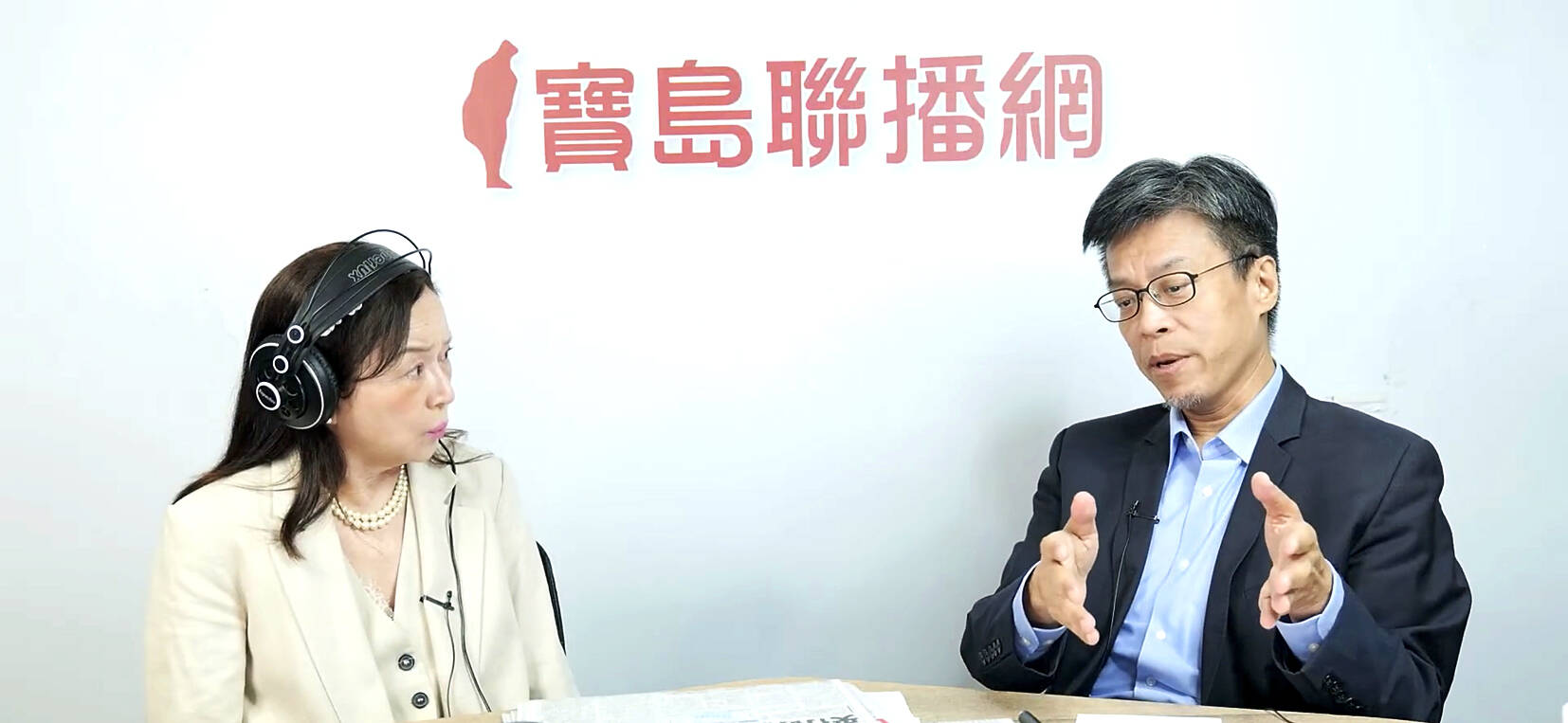
National Security Council adviser Alex Huang, right, speaks in a radio interview with Formosa Radio Network talk show host Clara Chou in Taipei yesterday.
Photo: Screen grab from Bao Dao Radio’s YouTube channel
For example, a think tank article published this month argued that the US should pull back from the First Island Chain, he said, appearing to reference a Sept. 10 article by Jennifer Kavanagh published by Defense Priorities.
Some academics also wrote in May that “the US should pressure Taiwan to accept Beijing’s terms rather than sell weapons to Taiwan,” he said, adding that these academics also attended China’s Xiangshan Forum last week.
US arms sales to Taiwan are proceeding through established procedures, while the two sides continue to maintain close security cooperation, Huang said.
Taiwan and the US also maintain extensive communication on issues including trade, tariffs and the expansion of Taiwan’s high-tech industries in the US, he said, adding that regional security cooperation has grown increasingly close.
From a diplomatic or broader international-relations perspective, many things might not be appropriate to discuss publicly, but what matters more for Taiwan is what new assurances, cooperation or progress it is actually securing, Huang said.
At the same time that the White House announced Xi’s Washington schedule, US Secretary of State Marco Rubio issued a joint statement with the South Korean and Japanese foreign ministers on the importance of maintaining peace in the Taiwan Strait, he said.
The statement showed that the US had already set its geopolitical posture ahead of the meeting, and that Taiwan has been involved in the process, he said.
Fears Taiwan would become a bargaining chip during a US-Chinese leader’s summit is a recurring theme in Taiwanese politics, but nothing like that has happened in the past few decades, Huang said.
In reality, Taiwan and the US have only grown closer, while Taiwan’s national strength has also improved, showing that Taiwan is on the right track and has been preparing for and responding to potential risks, he said.
Huang also referred to comments by American Institute in Taiwan Director Raymond Greene, who told the Resilient Taiwan for Sustainable Democracy International Forum that instead of asking how long Taiwan can hold out in an invasion, the world should ask how long the global economy could function normally without Taiwan.
Greene’s comment illustrates the US’ recognition of Taiwan’s critical importance to global economic interests, and Washington’s intent to convey that through diplomatic channels, Huang said.
From the perspective of US national security strategy, strengthening Taiwan’s defense capabilities is critically important, he said.
While Taiwan should remain cautious, there is no need to be overly concerned about being used as a bargaining chip, he said.
Separately, Ministry of Foreign Affairs spokesman Hsiao Kuang-wei (蕭光偉) yesterday said he was unaware of who the sources were that said the US had asked Taiwanese officials to regulate their US visits.
The New York Times in an article published on Monday quoted former White House National Security Council director for China, Taiwan and Mongolian Affairs Ryan Hass as saying that Taiwanese officials who have traveled to the US have been told by the Trump administration to scale back their visits to research groups in Washington.
Taiwanese officials regularly travel to Washington to participate in events, such as Deputy Minister of Digital Affairs Isabel Hou (侯宜秀), who attended the Pax Silica conference in June, Hsiao said.
The ministry would continue to closely monitor interactions between senior US and Chinese officials and maintain close communication with the US at all levels, he said.
Asked about the New York Times report, Mainland Affairs Council Minister Chiu Chui-cheng (邱垂正) said that US support for Taiwan is a nonpartisan consensus, and Washington often reiterates that its Taiwan policy remains unchanged.
“Our principle is that Taiwan will continue to work with the US and other countries in the alliance of democracies to ensure peace and stability across the Taiwan Strait,” he said.
KioskNews shows a cleaned-up reading view extracted from the publisher’s page — the original always lives on their site, not ours.