Raymond J. de Souza: Terry Fox was ‘a thread stitching the country together’
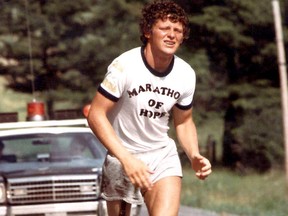
It is something of a golden age for the sports documentary, beginning with ESPN’s 30 for 30 series in 2009 — the first episode was on the Gretzky trade from Edmonton to Los Angeles. A masterpiece of the genre is currently in theatres now. “Run Terry Run” is the story of an originally unknown athlete whose audacious vision and sheer physical courage reminded a country of who it was.
Sign In or Create an Account
I remember Fox’s 1980 run, which happened when I was a boy. We would get updates at elementary school. I doubt I realized then that he was running during the first Quebec referendum, an issue about which the 21-year-old from B.C.’s Fraser Valley only spoke of in passing. Fox was focused on raising money for cancer research. Yet his Marathon of Hope established him as the most heroic of Canadians, a figure of inspiration and unity at a fractured time. Canada exists as a bond stretching across a vastness; the Marathon of Hope was the 1980 equivalent to the Canadian Pacific Railway a century earlier.

Columnist Jesse Kline keeps you up to date with what’s happening in Israel and the effects of antisemitism on life here in Canada. Friday mornings.
By signing up you consent to receive the above newsletter from Postmedia Network Inc.
A welcome email is on its way. If you don't see it, please check your junk folder.
The next issue of Channel Israel will soon be in your inbox.
We encountered an issue signing you up. Please try again
Run Terry Run is like watching a long home movie of that extraordinary summer, fitting enough because Fox ran through the hometowns and straight into the hearts of the nation. While the film includes more recent voice-over interviews, all the footage is archival, recorded in 1980 and 1981. The film never steps into the present; it remains, as Fox does, locked in 1980.
Somehow lost over the decades, the footage was discovered only a few years ago. Thus, those alive then can remember it as it really was, and those who weren’t can see how it looked, felt and what it meant. Both will watch it through teary eyes.
The film concludes with a new addition, an original song, understandably saccharine, by fellow British Columbian Bryan Adams.
“One leg of bone, one leg of steel,” Adams sings in The Ballad of Terry Fox. “If there ever was a hero, if there ever was a saint. He ran through fire and through pain. Any lesser soul would faint… He ran for everybody, and he ran for me and you.”
The documentary reveals that Fox knew even before he set out to run 26 miles a day that his heart had been damaged by the chemotherapy following the amputation of his right leg. He denied any symptoms to the doctors who cleared him to run.
He set out from Newfoundland. In Canada, the winds generally blow west to east, so he ran daily into the wind. Before the crowds came out to watch him, to cheer him, to run with him and to cry with admiration, he was alone with his best friend from high school, Doug Alward, just the two of them out on the highway. Friction arose between them due to the stress of it all, and so Terry’s 17-year-old brother Darryl joined them to make it a happier trio.
“I am no different than anyone else,” Fox would repeat to the crowds he addressed at his many stops along the route. But of course, he was different, so very different and so much better. He ran 21 miles on the day he had to go to hospital near Thunder Bay, discovering that the cancer had spread to his lungs. The run was over. He returned home.
He wrote, “I was determined to take myself to the limit for this cause,” and he died ten months later. Before that, Fox became the youngest person to be made a Companion of the Order of Canada.
Fox had raised $24 million in 1980, 24 times his original goal — a dollar for every Canadian at the time. Since then, the annual Terry Fox runs have raised $1 billion for cancer research. What does that mean? In 1977, when Fox was diagnosed, 80 per cent of juvenile cancer patients died. Today, 80 per cent survive.
Terry Fox has become part of the back-to-school décor; each September, school corridors feature the artwork children make for the Terry Fox Run.
So deep is his memory that journalist Leslie Scrivener, whose recollections largely narrate the film, tells of people who vividly recall watching Fox, running alongside him, west of Thunder Bay, even though he never got there.
Fox was “a thread stitching the country together,” she said. Everyone wanted to be part of the tapestry.
Dying at only 22, Fox is one of those blessed, If one might say so, to die young. It deeply grieved those who loved him most, but gave him permanently to the nation’s memory in the innocence and beauty of youth, uncorrupted by the future slings and arrows of ordinary life.
In our days so troubled by ugly wickedness, Run Terry Run is a balm for the soul. It will do your heart, and Canada’s heart, good. There are many memorials to Fox across the land, but this documentary lets us see him as he was — in painful, hopeful, joyful motion, not fixed in bronze.
Canada has one last thing to do for Terry Fox. Too many of our airports are named after retired politicians, suggesting that politics represents the best of us. Other countries know better, with airports named after musicians (Chopin in Warsaw), scientists (da Vinci in Rome), martyrs (Ninoy Aquino in Manila) and athletes (Muhammad Ali in Louisville). It is long past time that Vancouver’s airport be named after Terry Fox, where the setting sun casts its final, warming glance on the vastness of the land — and upon the vastness of the heroes who run across it.
National Post
Join the Conversation
This website uses cookies to personalize your content (including ads), and allows us to analyze our traffic. Read more about cookies here. By continuing to use our site, you agree to our Terms of Use and Privacy Policy.
KioskNews shows a cleaned-up reading view extracted from the publisher’s page — the original always lives on their site, not ours.