Japanese chamber urges transparent procedures
The Japanese Chamber of Commerce and Industry Taipei yesterday urged Taiwan to make its administrative procedures more transparent and predictable to encourage greater investment, as it released its annual white paper.
Presenting the document to National Development Council (NDC) Minister Yeh Chun-hsien (葉俊顯), the chamber called for regulations aligned with international standards and measures to address shortages of skilled workers and electricity.
Chamber chairman Yuichi Masuda said that those challenges cut across industries and reflected concerns he regularly heard in conversations with businesses in Taiwan.
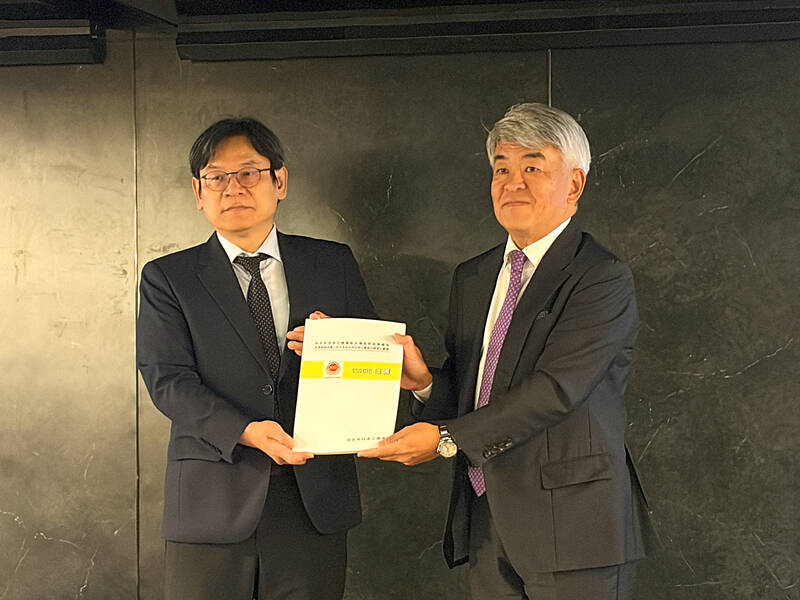
The Japanese Chamber of Commerce and Industry Taipei chairman Yuichi Masuda, right, presents the chamber’s annual white paper to National Development Council Minister Yeh Chun-hsien in Taipei yesterday.
Photo: CNA
Resolving them could encourage larger investments, bring in advanced technology and strengthen supply chains, he said, adding that the issues require coordination across government agencies.
On administrative procedures, the white paper called for a more transparent and efficient process for permit applications, approvals and consultations, as well as more flexibility in responding to businesses’ needs.
The recommendations drew on the chamber’s survey of all member companies, which received 368 responses, representing more than 70 percent of its corporate membership.
Respondents rated Taiwan’s living environment and business infrastructure highly, but identified difficulties with administrative practices and with recruiting and assigning staff.
While Taiwan-Japan trade continued to expand, individual Japanese investments in Taiwan remained relatively limited in size, the white paper said.
Responding at the event, Yeh described the annual document as an important channel for assessing Taiwan’s investment environment and the needs of multinational companies.
The government has introduced a preliminary review process for electricity license applications to simplify procedures and improve predictability, while also addressing changes to offshore wind projects and financing issues, Yeh said.
Taiwan is also developing renewable energy, promoting energy conservation and storage, and strengthening grid resilience to ensure a stable electricity supply, he said.
Turning to skilled workers, Yeh highlighted changes to improve working, residency and social security arrangements for foreign professionals.
He also asked the chamber to help promote a bilateral trade agreement.
“We hope to continue deepening our relationship and work toward signing a bilateral trade agreement,” Yeh said, asking the chamber to help convey its support for an agreement to Japan’s government.
Masuda thanked the NDC for helping secure some progress on 15 of the 41 requests in last year’s white paper.
Four have been implemented or are scheduled for implementation, while 11 have seen progress, but need further follow-up, the chamber’s assessment said.
This year’s document contains 51 requests, including 26 continuing items and 25 new ones.
The chamber also proposed a regular forum, coordinated by the NDC, to sustain policy dialogue and regularly review progress.
Yeh pledged continued coordination with government agencies to review regulations and administrative procedures and help businesses grow in Taiwan.
The chamber began submitting policy recommendations to Taiwan’s government in 2008 and issued its first formal white paper in 2009. This year’s white paper is its 18th.
KioskNews shows a cleaned-up reading view extracted from the publisher’s page — the original always lives on their site, not ours.