Beyond the cultural handshake
Taiwan’s cultural diplomacy in Britain shows that international visibility matters most when conversations grow into lasting creative partnerships
By Ming-yeh T. Rawnsley / Contributing reporter in London


Serving as interpreter during Culture Minister Li Yuan’s (李遠) visit to Britain offered an unusual view of cultural diplomacy — not as ceremony, but as a series of conversations capable of becoming lasting relationships.
During four intensive days, from Sept. 6 to Sept. 9, the delegation moved between museums, arts centers, universities and literary organizations. The program ranged from urban planning and museum access to translation, illustration and contemporary dance. Yet one question connected these encounters: How can an initial meeting become a relationship that lasts?
Li described himself as “greedy” about the possibilities. The word was characteristically humorous, but the ambition was serious. Taiwan does not simply need more one-off appearances abroad. It needs relationships through which artists, writers, translators and institutions can continue working together.
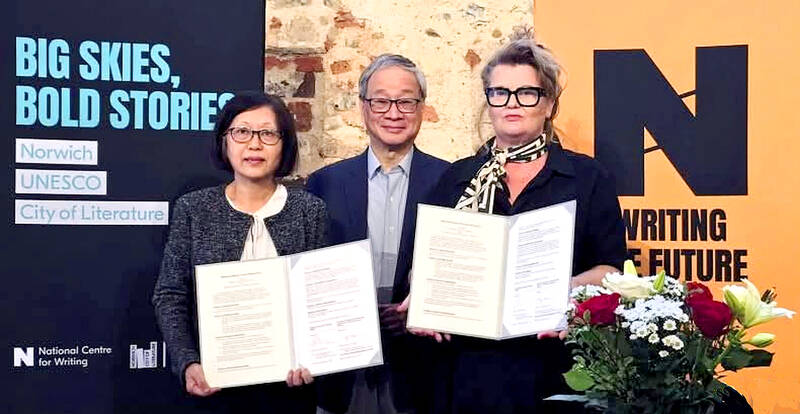
Minister of Culture Li Yuan, center, witnesses the signing of an agreement between Taiwan and the UK’s National Center for Writing to establish a “Literature from Taiwan” strand within its Emerging Translator Mentorships Program in Norwich on 8 September 2026.
Photo: Ling Mei-Hsueh, Taipei Times
CULTURE IN EVERYDAY LIFE
The first stop, London’s Barbican Centre, illustrated how culture can be woven into everyday life. Its concert halls, theaters, cinemas and galleries belong to a larger urban environment of housing, walkways, gardens and water. After touring the complex and visiting the immersive exhibition In Other Worlds, Li reflected on the relationship among cultural facilities, greenery and residential life. In Taiwan, debates about cultural equality often concern the uneven distribution of resources between regions. The Barbican raised a more spatial question: What might cities look like if access to art and nature were treated as part of ordinary life rather than occasional amenities?
At Young V&A, attention shifted from cities to children. Taiwan is preparing to build its National Children’s Future Museum, and the London museum offered more than a model of interactive design. Its deeper lesson was that children should be cultural participants, not simply recipients of instruction. Li was interested in their involvement in the museum’s redevelopment and in encouraging discovery without prescribing a single outcome.
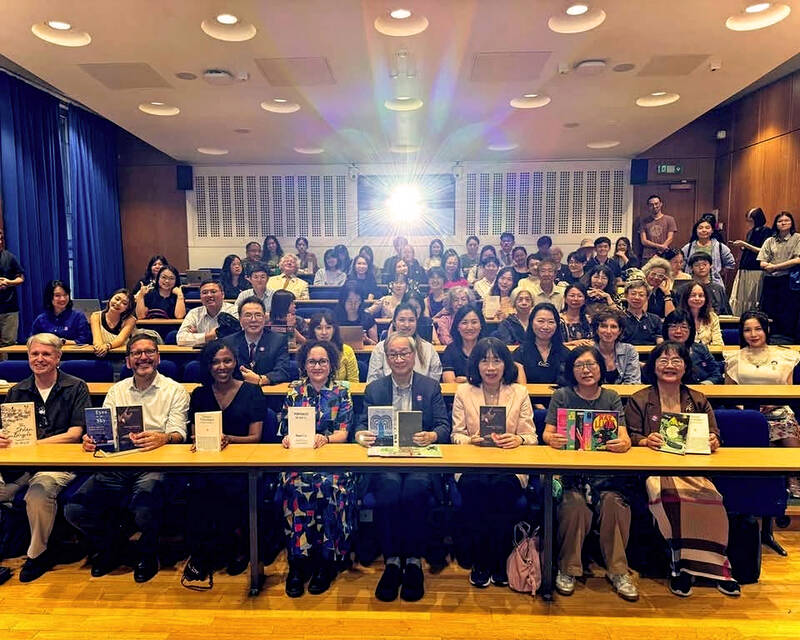
Minister of Culture Li Yuan, front fourth right, on Sept. 7 joins speakers and audience members for a group photograph at King’s College London.
Photo courtesy of the Ministry of Culture
His own vision is similarly concerned with process. A child who participates while a museum is being imagined may be a teenager when it opens. That passage of time can itself become an education: the child sees how an idea develops into a public institution and forms memories of the place before its doors formally open.
OPENING COLLECTIONS TO THE PUBLIC
Trust appeared again the following morning at V&A East Storehouse, opened last year in the former London Olympics media and broadcast center. Rather than replace its old storage facility with another closed warehouse, the V&A spent more than a decade developing an accessible working store. Visitors explore among objects from across the collections, watch conservation and research in progress, and can request particular items through the “Order an Object” service.
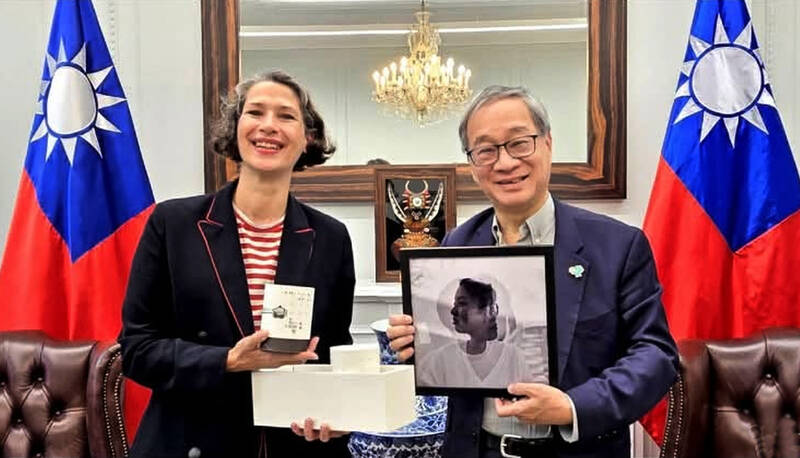
Minister of Culture Li Yuan, right, on Sept. 9 exchanges gifts with Gaby Wood, Chief Executive of the Booker Prize Foundation.
Photo: Ling Mei-Hsueh, Taipei Times
Li called it a “museum revolution.” The phrase captured more than the building’s impressive design. Traditional museums display a limited selection of objects within narratives created by curators. V&A East Storehouse retains expertise and conservation, but challenges the assumption that institutions must always decide what the public may see. Its experiment begins with trust: that people have a right to approach cultural heritage and will value what is opened to them.
The Ministry of Culture is considering converting a former university campus in Tainan into a joint storage center for collections that existing museums cannot accommodate. The British model cannot simply be transplanted, but it shows how practical constraints can generate cultural innovation. As Li observed, it is often through encountering limitations that we discover freedom.
PATHWAYS TO TAIWANESE LITERATURE
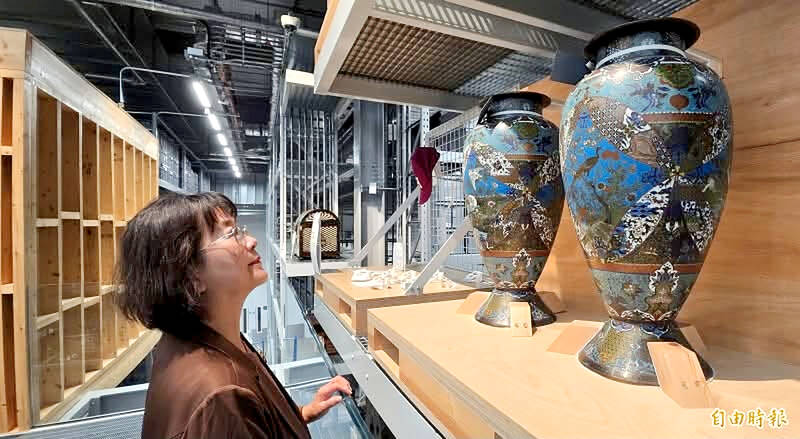
A visitor on Sept. 7 explores objects displayed in open storage at V&A East Storehouse in London.
Photo: Ling Mei-Hsueh, Taipei Times
That evening, a well-attended event at King’s College London considered how Taiwanese literature is seen internationally, taking the success of Yang Shuang-zi’s (楊?子) Taiwan Travelogue (臺灣漫遊錄), translated by Lin King (金翎), as its starting point. The novel shows what becomes possible when a work rooted in Taiwan’s particular history speaks to wider questions of colonialism, identity, desire, memory and power. It also demonstrates the essential role of translators, editors, publishers and cultural organizations. Literary quality alone does not carry a book across borders; it needs an infrastructure of selection, translation, advocacy and trust.
This became tangible the next day in Norwich, England’s first UNESCO City of Literature. Acting on behalf of the National Museum of Taiwan Literature, the Cultural Division of the Taipei Representative Office in the UK signed an agreement with the National Centre for Writing. Its Emerging Translator Mentorships Program will now include a “Literature from Taiwan” strand for people translating Taiwanese writing into English.
The program has already attracted 16 applicants, a notable response for a specialized mentorship. Further residencies and Taiwanese literary events are anticipated next year. Such initiatives may sound modest beside a prize-winning novel, but this is how the next success becomes possible. Translation requires years of language learning, cultural immersion and professional development. If Taiwan wants more of its literature to reach English-language readers, it must cultivate translators before their names are known.
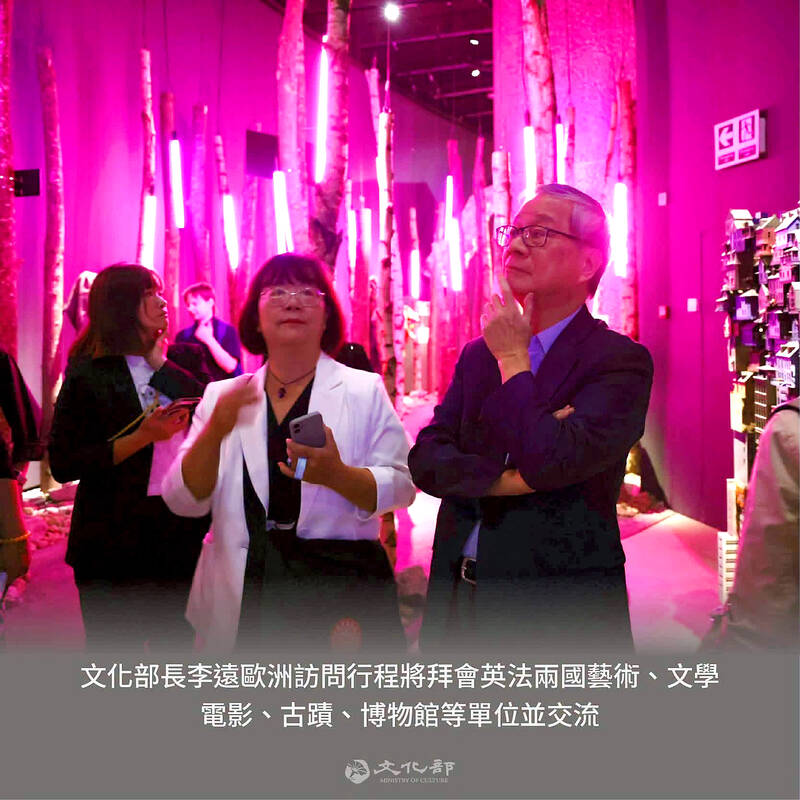
Minister of Culture Li Yuan, right, on Sept. 6 visits the Barbican Centre in London.
Photo courtesy of the Ministry of Culture
CONTEMPORARY CREATIVITY
Norwich offered a related lesson about heritage. Its medieval churches and historic buildings have not all been frozen as monuments. Some now serve as theaters, galleries and community spaces. The Norwich Puppet Theater, housed in a medieval church, combines performance, production, touring, education and community engagement. Preservation here is an active relationship between past and present: heritage survives not only because a building is protected, but because people still have reasons to enter and use it.
Back in London, the final day turned to dance, comics and illustration. At The Place, discussions explored sustained relationships between Taiwanese dance artists and British venues. Its Festival of Korean Dance demonstrates what can happen when cooperation grows from individual appearances into a recognizable platform encompassing residencies, performances, touring and audience development.
At the newly opened Quentin Blake Center for Illustration, Li announced plans for Taiwan’s first international comics festival next year, with British comics specialist Paul Gravett as curator. Gravett’s proposition — that Taiwanese comics belong within world comics — is simple but important. Internationalization should neither strip Taiwanese work of its distinctiveness nor confine it to a cultural niche.
FROM WORDS TO LASTING RELATIONSHIPS
The visit ended with Booker Prize Foundation chief executive Gaby Wood at the Taipei Representative Office. She brought an unexpected gift: a double-exposure photograph of Yang Shuang-zi and Lin King, taken with a vintage camera when they appeared together at the Hay Festival. Their profiles overlap while remaining distinct. “Two heads, two minds,” Wood said.
The photograph offered a fitting image of translation. A text does not simply cross intact from one language into another. Two creative minds retain their identities while producing a third form through their encounter. The same is true of worthwhile cultural exchange. It is neither imitation nor one-way promotion. British institutions offered ideas that Taiwan might adapt, while Taiwan arrived with artists, literature, experience and institutional ambitions of its own. The most promising conversations were those in which both sides began to imagine something neither could create separately.
What stays with me most is not the exhaustion or even the remarkable places we entered, but watching strangers discover shared interests across a table. High-level visits are necessarily filled with schedules, introductions and photographs. Their value emerges later, if those who met continue writing to one another, train translators, invite artists, share expertise and build programs together.
Cultural diplomacy begins with visibility, but matures through continuity. For four days, my task was to help words move between two languages. The more important work — turning those words into lasting relationships — has only just begun.
Ming-yeh T. Rawnsley is a research associate at SOAS University of London’s Centre for Taiwan Studies.
KioskNews shows a cleaned-up reading view extracted from the publisher’s page — the original always lives on their site, not ours.