Seven Canadian provinces trail behind most U.S. states on economic performance: study

A new study comparing economic performance in all of the Canadian provinces and U.S. states has found that, of the 60 jurisdictions, seven of the 10 lowest-ranking are in Canada.
Sign In or Create an Account
The research by the Fraser Institute looked at living standards, incomes, private sector employment and labour productivity to compare the economic growth of the two countries. It found that, in every category, Canadians have fallen further behind Americans.
In 2024 (the most recent year of comparable data), seven of the 10 lowest rates of gross domestic product (GDP) per person were Canadian provinces. New Brunswick ranked lowest, followed by Prince Edward Island (at number 59), Nova Scotia (58), Manitoba (56), Quebec (55), Newfoundland and Labrador (52) and Ontario (51).

Get a dash of perspective along with the trending news of the day in a very readable format.
By signing up you consent to receive the above newsletter from Postmedia Network Inc.
A welcome email is on its way. If you don't see it, please check your junk folder.
The next issue of NP Posted will soon be in your inbox.
We encountered an issue signing you up. Please try again
B.C. ranked 49th, while Saskatchewan ranked 35th, and Alberta — the only province in the top half — ranked 25th.
For comparison, in 1999 six Canadian provinces ranked among the bottom 10 in terms of GDP per person, while Alberta, which has remained Canada’s top-ranked province, was 7th-highest.
In the U.S., Mississippi ranked the lowest, at number 57, between Nova Scotia and Manitoba, followed by West Virginia (54) and Arkansas (53), both of which were sandwiched between Quebec and Newfoundland and Labrador.
At the top of the table for GDP per person is New York, followed by Washington, Massachusetts and California.
Jake Fuss, director of fiscal studies at the Fraser Institute and co-author of the new research study, said in a news release: “By comparing important economic outcomes in Canadian provinces and American states, it’s easy to see how Canadians stack up to their counterparts south of the border, and in recent years, Canadians have been falling further behind.”

Meanwhile, the study also found that most U.S. states out-earned most Canadian provinces. Inflation-adjusted median employment income — wages and salaries — increased faster in most states than in Canadian provinces in recent years and, in 2024, median employment incomes in all 50 states were higher than in all ten Canadian provinces.
In 2010, meanwhile, only eight Canadian provinces ranked among the bottom 10 in terms of median employment income, while Canada’s top province (Alberta again) ranked 12th-highest. By 2024, Alberta was the only jurisdiction in both countries where median income had declined and now ranks 51st.
Prince Edward Island was the jurisdiction with the lowest median employment income in 2024, followed by Manitoba and then Newfoundland and Labrador.
Maryland, Massachusetts and North Dakota are at the top of the table.
Elsewhere, the research found that from 1999 to 2024 every Canadian province experienced a decline in private-sector employment as a share of total employment, meaning the government sector outgrew the private sector in every province. This was not the case for most U.S. states, where 31 out of 50 saw an increase in private-sector employment between 1999 and 2024.
And from 2007 to 2024, all but five U.S. states experienced stronger labour productivity growth than every Canadian province. Meanwhile, Prince Edward Island was the only jurisdiction in both countries where labour productivity declined.
“The evidence is clear,” Fuss said. “The 21st century has, so far, not belonged to Canadians, who have seen their living standards and incomes fall further behind those of Americans.”
The latest Fraser Institute study is the second in a two-part series looking at whether Canada’s economic growth will outpace that of the U.S. in the 21st century.
The first part of the research compared Canada and the U.S. nationally, and similarly found that Canada’s economic performance has fallen further behind that of the U.S. over the past quarter century.
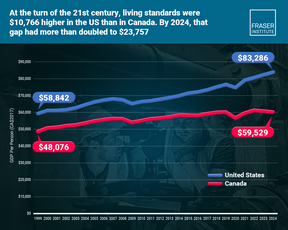
In 1999, inflation-adjusted GDP per person in Canada was $48,076, while in the U.S. it was $58,842. By 2024, GDP per person had grown to $83,286 in the U.S. compared to just $59,529 in Canada — meaning the gap had widened from $10,766 to $23,757 over 25 years.
And in 2010 (the earliest year of comparable data), inflation-adjusted median employment income was $6,126 higher in the U.S. than in Canada. But by 2024, that gap had increased to $8,663.
The Fraser Institute outlined three factors that explain the widening gap in economic performance between the two countries: a decline in private sector employment as a share of total employment in Canada, slower growth in labour productivity (a key driver of income growth, according to the think tank), and changes in business investment in Canada.
The research found that business investment in Canada — which equips workers with the tools and technology they need to produce goods and services — dropped from nearly 90 cents per worker for every dollar invested in the U.S. to 54 cents between 2007 and 2024.
The Fraser Institute suggests in its research that “serious and fundamental fiscal and economic reforms need to occur” for there to be any hope of Canada’s economic growth outpacing the U.S.
Our website is the place for the latest breaking news, exclusive scoops, longreads and provocative commentary. Please bookmark nationalpost.com and sign up for our daily newsletter, Posted, here.
Join the Conversation
This website uses cookies to personalize your content (including ads), and allows us to analyze our traffic. Read more about cookies here. By continuing to use our site, you agree to our Terms of Use and Privacy Policy.
KioskNews shows a cleaned-up reading view extracted from the publisher’s page — the original always lives on their site, not ours.