MAC details stark Taiwan-China divide
SHARED COMMITMENT: Taiwan’s lively debates would not be possible in China, a MAC official said, urging Taiwanese to unite to protect the nation’s sovereignty
By Fang Wei-li and Fion Khan / Staff reporter, with staff writer


The fifth plenum of the Chinese Communist Party’s (CCP) 20th Central Committee and Taiwan’s election debates highlighted a stark contrast between China’s centralization of power and Taiwan’s democracy, Mainland Affairs Council (MAC) Deputy Minister Shen Yu-chung (沈有忠) said yesterday.
Differences in political systems are the most fundamental issue in cross-strait relations, which have nothing to do with similarities in culture, language or ethnicity, he said.
Shen made the remarks at a forum held by the Secure Taiwan Associate Corporation to discuss possible developments in China’s domestic political situation following the fifth plenum, and their implications for Taiwan.
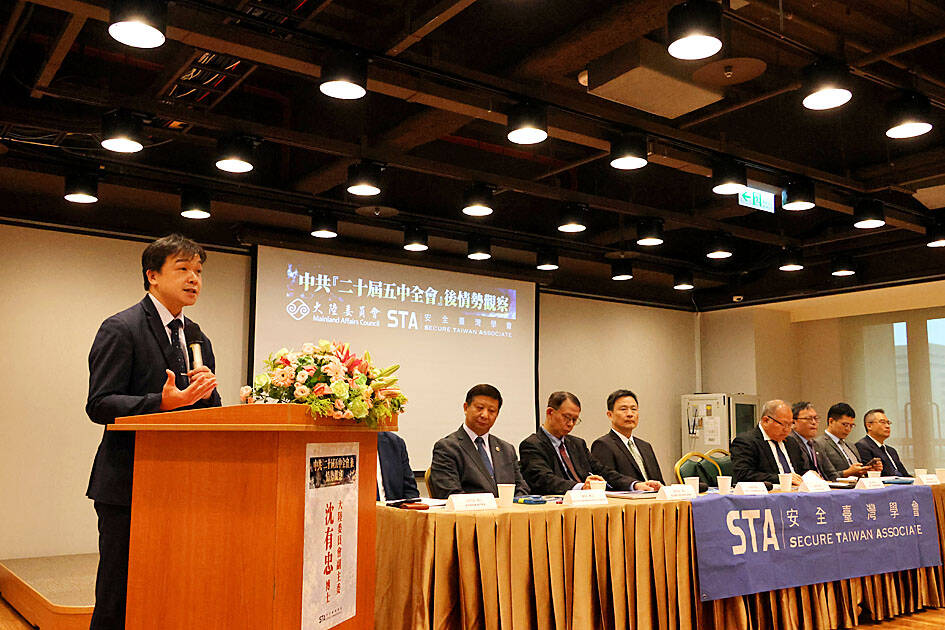
Mainland Affairs Council Deputy Minister Shen Yu-chung, left, speaks at a forum hosted by the Secure Taiwan Associate Corporation in Taipei yesterday.
Photo: Fang Wei-li, Taipei Times
The theme of the plenum, which concluded on Thursday last week, was “unswerving promotion of the full and rigorous party self-governance,” a move by Chinese President Xi Jinping (習近平) to further bolster the CCP’s leadership and consolidate his authority ahead of next year’s 21st CCP National Congress, Shen said.
The MAC’s analysis of the plenum can be summarized into four points, he said.
First, the “Xi Jinping thought on party building” was established as a political guiding principle, further consolidating Xi’s unchallengeable position as the party’s leader, Shen said.
The plenum confirmed earlier decisions to expel 33 officials from the party, including former senior military leaders Zhang Youxia (張又俠) and Liu Zhenli (劉振立), he said, adding that accusations against them, including failing to implement central policies and engaging in duplicity and disloyalty, demonstrated that anyone who is insufficiently loyal to Xi or deviates from his ideology and directives would be purged.
Second, the MAC believes that “strict party governance” aims to ensure the CCP’s long-term rule and preserve its one-party dictatorship, Shen said.
Whether it is political, organizational, integrity or work discipline, all rules must be based on monitoring and ensuring that party members and officials obey the CCP, he said, adding that the development of China’s constitutional system, and the protection of people’s rights and interests take a back seat to the goal of consolidating the CCP’s one-party rule.
Third, the promotion of “the party’s self-revolution” represents a rejection of external oversight by the public, media and civil society, Shen said.
Although the authenticity of posts that students from more than 10 Chinese universities had allegedly signed a petition calling for the abolition of the indefinite term for the president remains unverified, they signaled that the party’s leadership is not subject to any external oversight, he said.
Xi might respond to academic activities or social movements with further legal measures or intensified surveillance, he added.
The CCP has fully internalized its oversight mechanisms within the party’s disciplinary and supervisory systems, rejecting democratic checks and balances in the name of “self-correction within the party,” he said.
Fourth, moves to eliminate dissenting voices have paved the way for Xi to secure a fourth term at next year’s 21st National Congress, Shen said.
The number of Central Committee members and alternate members absent from the plenum reached a new high since the era of Mao Zedong (毛澤東), he said.
Large-scale purges of senior party, government and military officials over the past few years have removed potential political obstacles to Xi’s ambitions, ensuring he can continue on to a fourth term with the party’s full endorsement, he added.
While the plenum unfolded in Beijing, many in Taiwan were focused on the mayoral debates in Taipei and Kaohsiung, highlighting the fundamental differences between the political systems on the two sides of the Strait, Shen said.
The CCP’s fifth plenum demonstrated the consolidation of power and the growing dominance of Xi’s leadership, he said, adding that Taiwan’s lively mayoral debates would be impossible in China.
Shen urged Taiwanese to recognize these institutional differences and unite against authoritarian aggression, build a shared commitment to protecting freedom, democracy and national sovereignty to ensure that Taiwan can continue to deepen its democracy, prosperity and development amid the CCP’s multifaceted pressure campaign.
With local elections entering their final campaign phase, the government would continue to closely monitor developments within the CCP and shifts in its power structure, while preventing and exposing various forms of Chinese election interference, he said.
It will also continue to counter China’s cognitive warfare, transnational repression and attempts to infiltrate and divide Taiwanese society, while defending national sovereignty, freedom, security and the democratic way of life, he added.
KioskNews shows a cleaned-up reading view extracted from the publisher’s page — the original always lives on their site, not ours.