Toronto gained nearly 200,000 mayoral voters since 2023. Here’s where they are
A report is mapping out the nearly 200,000 new voters that Toronto has gained since 2023, when Mayor Olivia Chow was elected.
Sign In or Create an Account
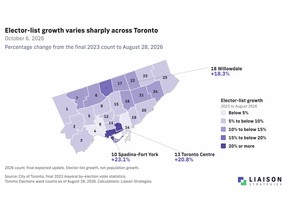
It found that Spadina-Fort York had the largest increase out of the 25 wards.
As Toronto’s mayoral race nears its end — with Chow and Councillor Brad Bradford as the top candidates battling it out in the polls — there have been 194,442 electors added to the voters’ list since the previous election, according to Liaison Strategies, a national public opinion research firm.
“I was definitely surprised by how concentrated voter growth is, and just how concentrated it is in three wards,” said David Valentin, who authored the report. “This creates new challenges for candidates because they have little to no data on these voters.”

Get a dash of perspective along with the trending news of the day in a very readable format.
By signing up you consent to receive the above newsletter from Postmedia Network Inc.
A welcome email is on its way. If you don't see it, please check your junk folder.
The next issue of NP Posted will soon be in your inbox.
We encountered an issue signing you up. Please try again
The wards that saw the most amount of growth from 2023 until August 2026 were Spadina-Fort York, with an increase of 23 per cent, Toronto Centre (20 per cent) and Willowdale (18 per cent).
“If these voters are from new developments particularly, there is no previous voting history so you wouldn’t know what to expect regarding support or turnout,” said Valentin. “For Council incumbents, their power comes from name recognition. If they have been targeting new developments as they came online they might still have an advantage with these voters, but if they haven’t been doing the work, these new electors are wildcards and up for grabs.”
Meanwhile, North York (comprised of York Centre, Eglinton—Lawrence, Don Valley West, Don Valley East, Don Valley North and Willowdale) had grown the fastest, adding 64,564 electors — an increase of just over 11 per cent.
The downtown area also added slightly more people to the list, at 67,509 electors — an increase of nearly 10 per cent. Scarborough added 39,817 electors, up 9.6 per cent, and Etobicoke added 22,552, up 8.4 per cent, according to the report.
The report also says that an increase in voters means a spending increase for campaign finances.
“The calculation uses electors, not the city’s total population,” it says. Using the general spending-limit formula for mayor ($7,500 plus 85 cents per eligible elector), it calculated $1,662,655.70 for the 2023 list and $1,827,931.40 for the August 2026 list. It found a difference of $165,275.70.
“For a campaign able to raise the money, that could mean more advertising, more literature or more paid organizing. But a higher limit does nothing for a candidate who was already struggling to fund the campaign. They still have to raise it,” says the report.
The report clarifies that the numbers refer to voters’ list figures, not to be confused with population growth.
“People move, become eligible and get added to the list; records also get corrected. We cannot identify how much of the increase comes from each of those things. What we can see is where the list has changed most,” it says.
The report uses data from 2023 provided by the City of Toronto’s final eligible-elector counts for the mayoral by-election. Toronto Elections provided the 2026 ward counts.
Join the Conversation
This website uses cookies to personalize your content (including ads), and allows us to analyze our traffic. Read more about cookies here. By continuing to use our site, you agree to our Terms of Use and Privacy Policy.
KioskNews shows a cleaned-up reading view extracted from the publisher’s page — the original always lives on their site, not ours.