Mohamed Fahmy: Qatar’s fatal deceit
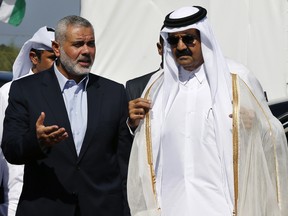
Qatar’s support for Islamist terror groups gives the small nation significant geopolitical leverage in its role as a mediator in Middle East conflicts. Its strategy of attempting to position itself as a global mediator goes beyond neutral diplomacy, as it maintains relationships with actors that fuel conflicts while presenting itself to the world as a broker capable of solving those very conflicts.
Sign In or Create an Account
To understand the wealthy Gulf state of roughly three-million people — foreign workers constitute up to 94 per cent of its workforce — it is useful to examine how the Al Thani ruling family welcomed prominent Muslim Brotherhood figures fleeing Egypt’s crackdown.

Columnist Jesse Kline keeps you up to date with what’s happening in Israel and the effects of antisemitism on life here in Canada. Friday mornings.
By signing up you consent to receive the above newsletter from Postmedia Network Inc.
A welcome email is on its way. If you don't see it, please check your junk folder.
The next issue of Channel Israel will soon be in your inbox.
We encountered an issue signing you up. Please try again
Among them was Yusuf al-Qaradawi, a student of Hassan al-Banna, who founded the Muslim Brotherhood — a transnational Sunni Islamist organization — in 1928. In 1962, al-Qaradawi was appointed head of the Qatari Secondary Institute of Religious Studies, and went on to lead the department of Islamic studies at Qatar University.
Al-Qaradawi was granted Qatari citizenship in 1968 and became one of the Brotherhood’s most influential voices. His Al-Jazeera program, “Sharia and Life,” reached an estimated 40- to 60-million viewers worldwide. Al-Qaradawi drew international controversy for issuing several fatwas — legal rulings on matters of Islamic law — permitting and encouraging suicide bombings.
In 1999, al-Qaradawi was barred from the United States. In 2008, he was barred from Britain. And in 2012, he was prohibited from entering France by then-president Nicolas Sarkozy following the al-Qaida-inspired Toulouse attacks. When he died in 2022, his funeral in Doha was attended by a senior member of the Al Thani family, Qatari ministers, as well as two senior Hamas figures.
But Qatar’s relationship with the Brotherhood did not end with providing refuge to its exiled leaders. Doha continues to support, harbour and fund the group’s regional branches, including its offshoot Hamas, which has been designated a terrorist organization by the United States, Canada, Israel, Australia, Japan, the European Union and others.
Then came Al-Jazeera, the cable news network established in Doha in 1996. It quickly became one of the Arab world’s most-watched networks and Qatar’s most powerful soft-power tool, amplifying Islamist voices while extending Doha’s regional influence.
In 2020, the U.S. Department of Justice determined that AJ+, a subsidiary of the Al-Jazeera Media Network, should register under the Foreign Agents Registration Act, concluding that it engages in “political activities” on behalf of the Qatari government and is designed, among other things, to “influence American perceptions” of domestic and foreign policy.
How deep-rooted is this problem? The Muslim Brotherhood was designated a terrorist organization more than a decade ago by Egypt, Saudi Arabia, Bahrain, Syria and the United Arab Emirates. More recently, the United States designated its Lebanese, Jordanian and Egyptian chapters as terror groups.
Qatar’s regional tensions came to a head in 2017, when Saudi Arabia, the U.A.E., Bahrain and Egypt severed ties with Doha and imposed a de facto blockade, citing its support for terrorism, ties to Islamist groups, relationship with Iran and the role of Al-Jazeera.
Iran helped Qatar weather the crisis by providing food supplies, airspace and trade routes after Saudi Arabia closed its land border and the other states barred Qatar Airways from their airspace. Iranian exports to Qatar subsequently surged from roughly $60 million in 2016 to $250 million the following year.
In 2021, a reconciliation agreement signed in Saudi Arabia restored relations with the Arab quartet, but Qatar maintained its ties with Tehran and continues to reject the designation of the Muslim Brotherhood and Hamas as terrorist organizations.
What does Qatar think of al-Qaida? Syria offers perhaps the clearest answer. Between 2012 and 2015, multiple reports documented Qatari support for the Al-Nusra Front, Al-Qaida’s Syrian affiliate, which the U.S. designated a foreign terrorist organization in 2012.
The Wall Street Journal reported that Al-Nusra commanders met with senior Qatari officials and financiers, while the New York Times noted that then-U.S. president Barack Obama privately warned Qatar about arming Islamist radicals, a request that was ultimately ignored.
In 2015, the U.S. State Department also warned about continued financial support from individuals and entities in Qatar to terrorist groups, particularly Al-Qaida affiliates such as the Al-Nusra Front.
Qatar has continued to use Islamist movements as a soft-power instrument, leveraging relationships with terrorist actors to expand its regional influence well beyond its size. I saw this firsthand while covering the Libyan civil war for CNN in 2011, where I met and interviewed Muslim Brotherhood-aligned leaders and fighters who were receiving millions in Qatari support, including Abdelhakim Belhaj and Ali al-Sallabi.
Doha also funded Libya TV, a satellite channel operating from Qatar that amplified the opposition while giving prominent space to Islamist voices. The strategy was to cultivate Islamist networks, amplify their narratives and convert that influence into regional power.
For more than a decade, Qatar has effectively played both arsonist and firefighter — maintaining relationships with, and at times supporting, the very militant groups whose actions help create the crises it later offers to mediate.
One year ago, senior Hamas leaders based in Qatar narrowly escaped an Israeli airstrike on a meeting in Doha. The strike marked the first-ever direct Israeli military attack on Qatar and on any member state of the Gulf Cooperation Council. The failed strike exposed the contradiction at the heart of Qatar’s regional role: presenting itself as a neutral mediator while simultaneously hosting Hamas’s political leadership and maintaining close ties with the group.
The Qataris will be watching Israel’s Oct. 27 election closely, particularly former prime minister Naftali Bennett, who has vowed to designate Qatar an enemy state if elected. Bennett said Qatar “works against us and poisons us from within.” Prime Minister Benjamin Netanyahu recently echoed his criticism, calling Qatar a “hostile state.”
A Qatari government spokesman responded to Netanyahu’s remarks at a press conference, calling them a smear campaign and adding that Israeli officials “know Qatar has thick skin and that it will not be deterred by such rhetoric, which is used for internal consumption.”
To gauge where relations between Qatar and Israel may be heading, I recently spoke with Tal Heinrich, an Israeli journalist and former Netanyahu spokesperson. I also asked her about Qatar’s funding of U.S. higher education, which, according to the Institute for the Study of Global Antisemitism and Policy, amounts to billions of dollars over the years.
“People in Israel don’t need any campaign to see Qatar in its true colours. If anything, the more significant campaign has been Qatar’s own effort to whitewash its image in the West, while providing a platform and support for actors that spread antisemitism and hostility toward the Jewish state. Qatar has been among the largest foreign sources of funding for U.S. higher education. It’s not out of generosity, obviously. This doesn’t fool anyone in Israel, though.
“In Israel, there is broad awareness across the political spectrum that Qatar has for years maintained close ties with, and provided support to, Hamas and other Islamist movements. They also stand financially behind some of the greatest sources of antisemitic hatred and anti-Israel propaganda in the world. This includes Al-Jazeera and some of the most hateful and dangerous antisemitic influencers out there,” she said.
“In that context, Qatar’s claim to be a neutral mediator is naturally met with deep skepticism in Israel at best, while many Israelis would reject the notion of Qatari neutrality outright. It is true that Qatar’s shady relationships give it some leverage, but the question is how Qatar chooses to use that leverage. Broadly, I would say that if you were to survey Israelis on the street and ask them, ‘Qatar: good or bad?’ most would answer the latter.”
At the moment, Doha appears to be playing both sides, leveraging its relationships with Islamist groups, mainstream Arab states and the West to project itself as a neutral arbiter. But the facade is becoming harder to sustain. How long will it take the rest of the world to see through it?
National Post
Mohamed Fahmy is an award-winning journalist who has covered the Middle East for numerous outlets, including CNN, Al-Jazeera, the Los Angeles Times and Foreign Policy.
Join the Conversation
This website uses cookies to personalize your content (including ads), and allows us to analyze our traffic. Read more about cookies here. By continuing to use our site, you agree to our Terms of Use and Privacy Policy.
KioskNews shows a cleaned-up reading view extracted from the publisher’s page — the original always lives on their site, not ours.