Blunder in, abandon allies and court a dictator: it’s the Trump doctrine, now playing out in Myanmar | Steve Bloomfield
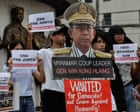
Marco Rubio was once adamant that the US had to do everything in its power to end what he described as the “ethnic cleansing” of the Rohingya in Myanmar. In a 2017 letter he signed along with 20 other US senators, Rubio called for “strong multilateral sanctions against specific senior Burmese military officials associated with the gross human rights abuses”. Those responsible for the atrocities should be prosecuted, he argued.
In the years since, the Myanmar military’s crimes have only increased. What was then deemed ethnic cleansing of the Rohingya is now widely viewed, including by the US, as genocide. What little democracy existed in Myanmar was eradicated in 2021 when Aung San Suu Kyi was arrested and imprisoned and her party’s election victory overturned, and the military took full control.
This sparked a civil war that has now turned into a brutal series of overlapping conflicts between the military, resistance forces and a medley of ethnic militias. Around 100,000 people have been killed in the conflict, which has forced 5 million people to flee their homes. The UN estimates that 16 million are now in need of urgent assistance. It is one of the world’s biggest humanitarian disasters – and entirely human-made.
Earlier this year, Myanmar held sham elections, and Min Aung Hlaing – the general most responsible for Myanmar’s genocide and one of the targets of Rubio’s letter – became president.
But Rubio, now the US secretary of state, no longer believes that Min Aung Hlaing should be prosecuted. Instead he’d rather like him to become an ally. This month the Trump administration decided to upend nearly a decade of united western policy and open direct talks with the Myanmar regime. The possibility of lifting sanctions is now being discussed. The move has shocked other western nations – none of which, it appears, was warned.
Inevitably, a Maga figure lingers in the background. This time it’s Roger Stone, the Donald Trump ally who was found guilty in 2019 of lying to Congress, witness tampering and obstructing the investigation into whether the Trump campaign conspired with Russia in the 2016 presidential election.
Stone, who was spared jail after Trump commuted his sentence, recently started working as a lobbyist for the Myanmar regime, helping to “rebuild relations between the Republic of the Union of Myanmar and the United States”.
It seems to be working. Earlier this month Michael Vance, the assistant secretary of state for intelligence and research, travelled to Myanmar’s capital Naypyidaw. The trip was supposedly to secure the release of a US citizen, but Vance also held talks with the generals. The purpose of the talks was not to persuade the military regime to reintroduce democracy or stop its brutal war. Instead it appeared to be about securing American access to Myanmar’s rare earth minerals.
In recent years, the race to control a steady supply of rare-earth minerals – elements used in a host of military technology and hi-tech manufacturing applications – has become increasingly fraught. China controls most of the world’s rare-earth mines and almost all of the processing capacity. The Trump administration’s desire to turn the tables has led it to strike one-sided deals with Ukraine and the Democratic Republic of Congo that have placed US business interests over practically everything else.
There are more than 600 rare earth mines in Myanmar, most of which currently supply China. Since the 2021 coup, rare-earth shipments from Myanmar to China have totalled $3.6bn, making up the majority of China’s rare-earth imports. This is the prize the US appears to have its eyes on.
Vance’s trip has handed Myanmar’s generals a propaganda victory at a moment when they are doing everything they can to legitimise the regime. The US, unfortunately, is not the only country welcoming Myanmar’s generals back into the fold. Min Aung Hlaing this month flew to Malaysia, once a strong opponent of the junta, where the prime minister Anwar Imbrahim floated the idea of Myanmar being welcomed back into the Association of Southeast Asian Nations (Asean). Trips to Indonesia and Brunei are also on the cards, while the Philippines has indicated that it too would like to see relations normalised.
The junta’s diplomatic victories follow growing military success. Over the last two and a half years, with the help of more sophisticated drones supplied by Russia and China, and the conscription of another 100,000 young men, the junta has regained control over several towns and pushed the resistance back into the countryside.
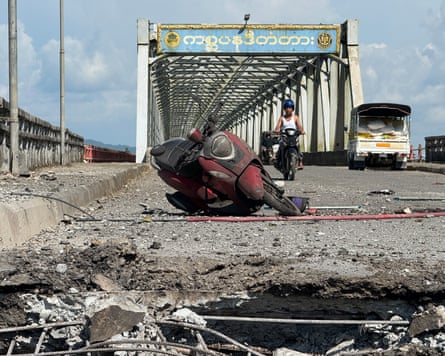
For Myanmar’s civilians, the long nightmare continues. Last month more than 50 people were killed when the military bombed a busy market in a rebel-held area. Every week brings fresh atrocities, while the hope of a peaceful, democratic Myanmar slips further into the distance.
The one silver lining that those fighting for Myanmar’s freedom can cling to is that the rest of the west hasn’t given up on it yet. British diplomats are adamant that there will be no change in the UK’s position, while Canada, Australia and the EU are all likely to hold the line too. But even here there are concerns.
after newsletter promotion
Campaigners point to the UK’s recent reduction in aid to Myanmar from £66m a year to £55m. Just half of the $889.6m the UN has requested for Myanmar this year has been provided by international donors. They would also like to see Britain and others engage more directly with Myanmar’s pro-democracy camp, including the resistance.
Trump is not the first president to prioritise resources over democracy, as a cursory glance at US relations with Saudi Arabia since it discovered oil in 1938 shows. But Trump’s rapacious attitude to oil and minerals, his willingness to enrich his friends and family, and his brazen support for dictators makes this a very different America. Myanmar is simply another example of the corrosive nature that Trump’s foreign policy is having in every corner of the globe.
The question is whether Trump will get what he wants. US policy on Myanmar has been driven by Congress, and there remains bipartisan support for keeping it in place. The House of Representatives recently passed a bill that would extend the sanctions regime for another six years. Particularly at a time when his support is waning, Trump is unlikely to have much joy in persuading senators and members of Congress who have long supported Myanmar’s pro-democracy movement to turn a blind eye to genocide and war crimes.
Even if he did, the bigger question is whether Myanmar’s generals can give Trump what he wants. The vast majority of Myanmar’s rare earth mines are near the border with China and many are controlled by militia groups, not the junta. “There is no way China is going to let the US get anywhere near the rare earths,” Joshua Kurlantzick at the Council on Foreign Relations told me.
And yet even if none of this leads to any real change, the Trump administration’s decision to open talks with a genocidal regime responsible for one of the world’s worst humanitarian crises is a disaster for those in Myanmar fighting for their freedom. Many Myanmar resistance figures, including Aung San Suu Kyi, have placed their hope in US help. Like other democrats fighting demagogues, such as Volodymyr Zelenskyy, they have been deserted.
Here is yet another example of the Trump administration blundering into a part of the world where it knows little, offering a prize to an authoritarian and leaving with not much to show for it.
-
Steve Bloomfield is the former international editor of the Observer
KioskNews shows a cleaned-up reading view extracted from the publisher’s page — the original always lives on their site, not ours.