Fish, with a side of moral ambiguity: The toughest questions in the HSC English exam
The final question on Wednesday’s Higher School Certificate English Advanced exam might have seemed oddly specific or even divorced from the poetry and novels students studied in class.
It posed a premise to students: while “busyness and distraction” preoccupied most people, it was wonder, absorption and play that are essential for flourishing. “The point isn’t to catch a fish – it’s how you feel while you’re trying to catch a fish,” it said.
Clued-up students knew to look deeper beneath the surface.
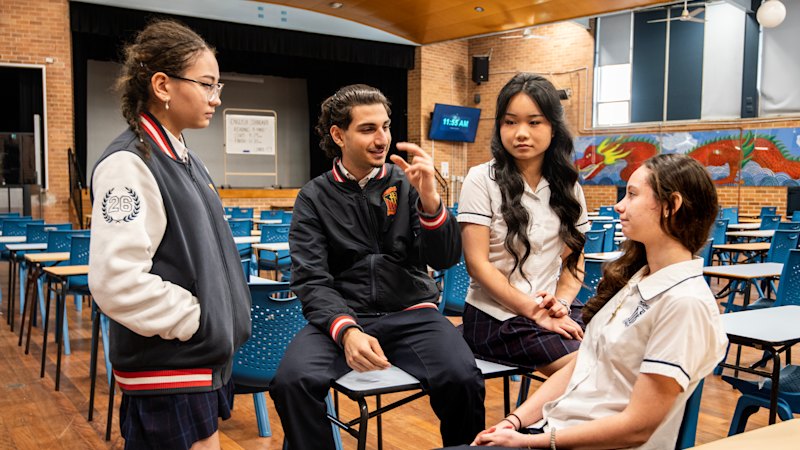
“The question didn’t specifically ask us to talk about fishing,” Bonnyrigg High student Tijana Kovacevic.
Students were given a choice between writing creatively, persuasively or discursively in response; Tijana opted for the third.
“I saw that the question was trying to tell us that it’s about the journey, not the end result.”
She wrote about how awards and recognition were signs of success but the lessons and experiences a person had along the way could be the most rewarding.
Bonnyrigg High English teacher Emmanuel Vazenios said he was confident most students at his school would have clocked it. “I think the majority of them would have figured out the metaphor,” he said.
Year 12 Julie Le also went for the discursive option.
“I wrote about like the erosion of intimate relationships in modern society as a result of digital communication,” she said.
The second HSC English exam runs for two hours, during which students must write two essays as well as the creative or discursive piece.
For Julie, the trickiest part of the exam was a question in the first section on “moral ambiguity” and how it pertained to the texts she had studied: Shakespeare’s The Tempest and Margaret Atwood’s Hag-Seed.
“I didn’t really know how to adapt that question,” she said.
But she found a way, discussing the moral ambiguities associated with gender identities in Shakespeare.
When English standard student Katherine Kurtz opened her paper, a question about how the relationship between “observations and feelings” was explored in the novel she’d studied – Feed by MT Anderson – did not have an immediately obvious answer.
“I was freaking out because I spent the entire time thinking about how I should make it relate,” she said.
The novel is set in a world where technology has just run rampant. “It’s taking over human lives,” she said, “and it’s about this character who’s really absorbed in it, and he meets this girl who’s quite against it.”
She got there in the end. “But it was a lot of trying to make sense of things that just didn’t make sense.”
For Christo Fathel, English was his hardest subject to study for, but he’s glad he did it.
“HSC English is really important for going into the real world and communicating, giving ideas, sharing ideas,” he said.
“It just taught me a bunch of things, including memorisation, critical thinking, analysis, all this stuff that is applicable to a future career.”
KioskNews shows a cleaned-up reading view extracted from the publisher’s page — the original always lives on their site, not ours.