Make the most out of the last spoonful
It has been almost three months now, and we still haven’t replaced the cupboards that fell off the kitchen wall. It is also disturbing how well we have adapted to the chaos and having half the room covered with plastic crates that once contained vegetables and that now contain the hundreds of items that used to fit in the three cupboards, the collective weight of said items explaining the incident. The lack of cupboards has put pressure on the fridge, too, which has become a depository. That’s why, when I finally looked inside it properly, I found three jars of honey, each with between 2mm and 2cm at the bottom, as well as two jars of peanut butter, and a pretty much scraped-out jar of chocolate spread. At least all of those jars provided inspiration for today’s newsletter.
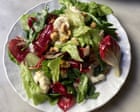
Making a dressing with the last inch of honey is perhaps the most efficient and satisfying way to deal with a near-empty jar. Pour in a bit of boiling water and some lemon juice, orange juice or red-wine vinegar, screw on the lid, then shake aggressively so the honey dislodges and dissolves into a syrup. Now add everything else – olive oil, a bit of mustard and whatever else you fancy – and shake again to emulsify. This dressing is great with one of the most useful, speedy and cheap salads in existence, namely shredded red and white cabbage, grated carrot, possibly with grated apple. Alternatively, use the same dressing on a seasonal salad of radicchio, hazelnuts and gorgonzola. And if the remnants in a jar happen to be mustard, do exactly the same as above, just inverting the order and adding honey later.
Felicity Cloake also suggests a dressing in her four healing honey recipes, which also function as suggestions for using the stuff up. Her suggestion of a hot toddy is great – add hot water into a jar with a centimetre of honey left, shake, then pour the now syrupy liquid into a glass or mug and add a curl of lemon peel, a knob of ginger, a cinnamon stick, a few cloves and a large dose of whisky, too, for a really effective cure. Her honey peanut butter is another way: put two tablespoons of hot water in the peanut butter jar, shake, then add honey to make a dip for celery and carrot, or add the mixture to cake batter.

It isn’t just honey, either. The most efficient way to use up the end of any jar, and especially peanut or any other nut butter, is to add a little hot water, then shake the jar violently to turn its contents into a paste. And a good way to use peanut paste is in the base of a soup (especially one with pumpkin and white beans) or with pasta or noodles.
I used to think I was controversial (and therefore interesting), until an Italian friend rolled her eyes and said that she also often makes pesto with peanut butter – pesto being a generic word for “a pounded paste”. Let me explain. In a food processor, blend a large handful of herbs (basil or parsley are ideal), a clove of garlic, salt and enough olive oil to make a paste. Then, while the pasta boils in well-salted water, add a little of the cloudy pasta water to the end of a peanut butter jar and shake to make a thick paste. Add this paste to the herb paste, stir in some grated cheese (grana padano or parmesan), and mix the lot with the cooked, drained pasta, maybe including a handful of baby spinach, which will wilt in the heat.
Fuchsia Dunlop does more or less the same thing for her spicy peanut butter noodles. While dried udon cook in water, she lifts a little of the hot water into the jar, shakes to make a thick paste, then adds two to six tablespoons of chilli oil, two teaspoons of sesame oil and a minced clove of garlic, and shakes again for a sauce the consistency of single cream (if necessary, add more water). Once the noodles are done, she lifts them into a bowl, pours on the dressing, tosses well, divides the now slippery noodles between plates and tops each serving with minced spring onion and toasted sesame seeds.
Next up, jars with an inch of jam in them, which can also be used in a dressing, or to thicken gravy or to add to stews. More fun and slightly more work is to make a jam tart. Dan Lepard has good advice and an excellent shortcrust pastry recipe, which he suggests turning into individual jam tarts. I have also used his pastry to make a large tart filled with a mixture of leftover jams and marmalades, which I tried to keep in sections, but was not very worried when they blurred into a multicoloured mess. The last bit of jam can also be loosened with a little water and used as a glaze for roast vegetables or pork chops. It is also a reason to make semolina pudding.
The jar of chocolate spread that looks empty, meanwhile, should be turned into a drink: add hot milk to the jar, shake, then pour into a mug, add a bit of sugar, if required, and a generous pour of rum. Now, does anyone have the number of a good handyperson in Rome?
after newsletter promotion
My week in food
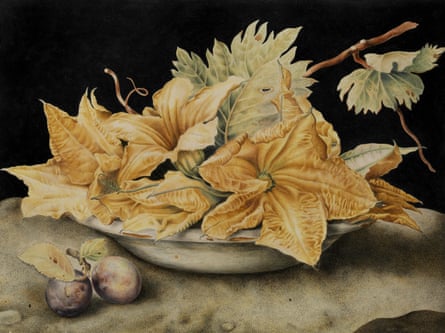
Where the art is | The most exquisite cookbook of the year is Paola Gavin’s Still Life Cookbook, a collection of vegetarian recipes inspired by great paintings. An art expert and the editor-in-chief of Epoch Review, Gavin has written many cookbooks, including the excellent Italian Vegetarian Cooking. In this, her ninth book, her two worlds meet and still-life paintings from throughout the centuries are paired with recipes. So, Giovanna Garzoni’s 17th-century Still Life With Pumpkin Flowers and Vine Leaves sits next to a recipe for flowers stuffed with ricotta and spinach. The publisher must be praised for producing such a beautiful but practical edition: the images are breathtaking, the fonts fantastic and the recipes gorgeous.
The Kei to my heart | Running down Wardour Street in London’s Chinatown the other day, on our way to see My Neighbour Totoro, the musical (go before it finishes in January), and desperate for something good and quick to eat, I saw a “CASH ONLY” sign in the window of a restaurant. “That has to be Wong Kei,” I thought, remembering an article by Angela Hui. As promised, the setting is stark but comfortable, the service fast and functional, and the vegetarian mapo tofu with mushrooms and peas, in a soft gravy warmed with chilli on a mound of sticky rice, was exactly what we needed.
Go with the grain | Last week, I had the pleasure of cooking with chef Fatmata Binta at the Food and Agriculture Organization of the UN in Rome. Originally from Sierra Leone and now working in Ghana, Binta is an award-winning culinary innovator and advocate for African agri-food systems. A particular focus of her work and advocacy is a tiny, millet-like grain called fonio that is not only densely nutritious and gluten-free but also incredibly versatile: it can be used like couscous, rice or semolina, as well as in breads, cakes and biscuits. As part of the demonstration, she made a porridge from fonio, which was new as a taste while at the same time reminding me of creamy oat porridge and semolina – made even better with the last of the jam scraped from the jar.
KioskNews shows a cleaned-up reading view extracted from the publisher’s page — the original always lives on their site, not ours.