[Column] A Trump-Kim summit may happen. A deal is another matter
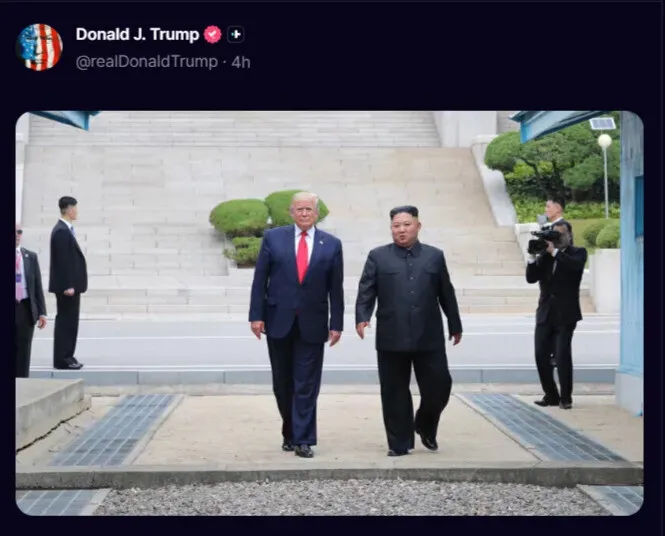
US President Donald Trump posted this photo of himself and North Korean leader Kim Jong-un on his Truth Social account on Aug. 24, 2026. (via Truth Social)
By Kim Yeon-chul, former minister of unification and current professor at Inje University
US President Donald Trump appears to be fondly recalling his past negotiations with North Korean leader Kim Jong-un. That’s welcome news.
It doesn’t really matter whether his aim is to create a distraction from the logjam in negotiations with Iran, to get a diplomatic win ahead of the midterm elections, or to create more leverage in trade talks with South Korea.
When a deadlock is devolving into a downward spiral, what’s needed now is a chance to change course.
Seven years have passed since dialogue broke down in Trump’s second summit with Kim in Hanoi in February 2019.
In the meantime, North Korea’s nuclear capabilities have grown enormously, the Pyongyang-Beijing-Moscow triad has become a central pillar in the Northeast Asian order, and Trump’s second term has made the world even less predictable.
Given the distrust that has built up over years of stalemate, it’s hard to know where to begin seeking an onramp to dialogue.
Little trust remains amid the protracted impasse, and the negotiating environment is unfavorable for various reasons, including Russia’s war with Ukraine. In short, rekindling the dying embers of dialogue won’t be easy.
Many are hopeful that North Korea will agree to dialogue with the US, but unfortunately, such negotiations will prove difficult — though not because Pyongyang refuses to denuclearize. Though time is needed, the goals and process of such talks could shift depending on how Pyongyang-Washington relations evolve.
Another non-factor is the challenge of getting the US and China to work together to create a favorable environment for negotiations. Despite major differences in Beijing and Washington's strategies for the regional order, the two countries share the common goal of stability, so this shouldn’t be seen as complicating Pyongyang-Washington dialogue.
The real obstacle is the Trump administration’s policymaking structure. Political will is crucial for resolving a long-standing intractable conflict characterized by deep distrust, but another precondition is a structured framework for coordinating, managing and maintaining long-term negotiations.
A negotiated statement can only happen after repeated rounds of political commitment at the leadership level and technical coordination at the working level. To overcome the limits of working-level negotiations stemming from the unique nature of the North's regime, the structure of the US negotiating apparatus is crucial.
Another question is whether the Trump administration can achieve the internal consensus necessary for negotiations. Looking at its approaches to dialogue with Iran or trade talks with Canada, Washington clearly lacks an internal system for coordinating dialogue. As shown by the sudden suspension of joint military exercises with South Korea, the only given is Trump’s impulsiveness, unilateral actions, changes by the day, frequent confrontations and unpredictable mood.
He lacks the patience required for drawn-out negotiations. American officials will act in response to his directive to prepare for bilateral talks with the North, but the administration's framework for communication will not change.
As for a meeting, difficulty in negotiations notwithstanding, could a tête-à-tête between the two leaders still be possible? Albeit briefly, the proposed talks could ease tension and pave the way for negotiations, but only if the interests of both sides align. Trump will weigh whether a meeting with Kim Jong-un will help the Republicans in the November midterm elections.
Unfortunately, it will not — a meetup alone is not expected to produce tangible results. The North is also not even an attractive diplomatic counterpart. Given the unpredictable landscape of American politics after the midterm elections, what political incentive is there to play the North Korea card?
And what about North Korea? It wants to be treated as a “normal” country rather than a divided one and considers its diplomatic standing higher due to developing relations with China and Russia, so Pyongyang has no reason to refuse a meeting with Trump.
Yet the North must consider a new emerging variable: Trump’s tendency to use brinkmanship, a tactic often wielded by weaker nations. In Washington’s negotiations with Tehran, Pyongyang saw how he is willing to take the exact opposite hard-line stance if his demands are not met. The North will likely weigh its options between the current situation of “stability amid instability” and “unpredictability” if a summit with the US happens.
Washington's negotiations with Pyongyang have grown increasingly difficult due to their prolonged stalemate, shifting dynamics and deeply rooted distrust. Overcoming this reality requires acknowledging it.
The North's nuclear threat is also gradually shifting from a variable to a constant in Northeast Asia. The second half of this year could offer the last chance to turn things around.
This is also no time to fall back on the old inertia of denuclearization. With the door to negotiations on this matter closed, the next step should be to open the door to talks on establishing a permanent peace regime on the Korean Peninsula. Seoul and Beijing must also revise their roles to complement unstable dialogue between Pyongyang and Washington.
Neither the independence movement during the Japanese colonial period nor the reunification movement after national division was undertaken simply because they were possible. These actions were necessary at the time, no matter how difficult.
Negotiations between the North and the US remain challenging, with even a meeting between Trump and Kim appearing far from easy. So South Korea must keep trying to create an environment conducive to dialogue, adjust its negotiation goals considering the changed circumstances, and set an efficient framework for talks.
Looking back at history, preserving peace on the Korean Peninsula requires continued efforts just to maintain the status quo. All diplomacy begins at home. To serve as an active participant in the matter rather than a mere spectator, Seoul must first resolve the confusion within its own ranks.
KioskNews shows a cleaned-up reading view extracted from the publisher’s page — the original always lives on their site, not ours.