Musk says US$40bn chips debt closed; talks continue
Elon Musk said SpaceX has closed a US$40 billion debt deal to pay for the chips needed to fuel its artificial intelligence (AI) ambitions. People familiar with the discussions, though, told Bloomberg News that talks over pricing were still ongoing.
“SpaceX closed US$40B of debt for GPUs,” Musk wrote in a post on X, referring to Nvidia Corp’s graphics processing units. He went on to suggest that debt markets had all but shut for neoclouds depending solely on revenue streams from AI data centers. “That means the 200+ neoclouds are going to see guppy-level death and consolidation,” Musk wrote. “Some will make it through, but not many.”
Musk’s comments came on the heels of a tumultuous week for AI companies in debt markets as concern mounted over the industry’s rapid spending, and limited profits so far to show for it. With investors demanding increasingly large premiums to finance the AI buildout, the volatility roiled pricing discussions over the SpaceX debt, which is being structured as private bonds to be issued by an off-balance sheet entity.
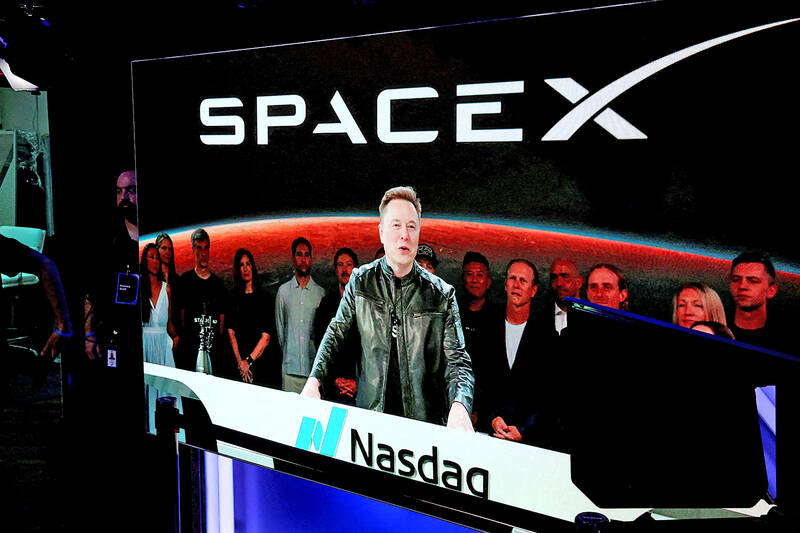
SpaceX founder, CEO, chairman and chief engineer Elon Musk speaks via videolink on the day of SpaceX’s initial public offering at the NASDAQ MarketSite in New York City on June 12.
Photo: Reuters
As of late Sunday in New York, those conversations remained ongoing and the deal had not priced, people with knowledge of the discussions said. The parties are still working on finalizing the debt package in the coming days, the people said.
More broadly in markets recently, much of the investor angst has been focused on the so-called neoclouds, which sell high-end computing power to technology companies. Noting SpaceX’s revenue from its Starlink business and rocket launches, Musk sought to differentiate his company from those businesses.
“As of the past few weeks, debt markets have almost entirely shut off access to money for any company that doesn’t have substantial revenue independent of AI data centers,” Musk said in his post. He later said that SpaceX would not buy any neoclouds, calling it “pointless.”
SpaceX, which is rated investment-grade by the three largest credit graders, has seen the price of its own debt tumble in recent weeks. Credit-default swaps tied to SpaceX, which are used to insure against losses on the company’s debt, surged last week to a record 266 basis points at the close of trading on Friday, a level more typical of a junk-rated borrower. The chip debt was expected to be issued in the form of private placements called 144a, the people said.
The debt raise comes after strong third quarter earnings, with SpaceX’s AI unit turning a profit for the first time. The enterprise is increasingly driving revenue by selling computing power from its Memphis data centers to external AI labs and hyperscalers.
KioskNews shows a cleaned-up reading view extracted from the publisher’s page — the original always lives on their site, not ours.