The Girl from Arles review – Bizet’s music for forgotten rustic tragedy has punch and poetry

‘The prettiest music in the world” was how the playwright Alphonse Daudet described the incidental music Bizet composed for his 1872 play The Girl from Arles – which is a bit like describing Carmen, the opera Bizet would compose less than three years later, as a charming little love story.
Daudet’s play initially flopped but was saved by the music Bizet wrote for it, which comprises 27 separate numbers ranging from string whispers a few bars long to full-blown orchestral entr’actes and celebratory choruses. Two orchestral Suites from L’Arlésienne have long been familiar in the concert hall. But, after more than 150 years, this was the first chance for UK audiences to hear the complete incidental music in its proper context. Presented by the Orchestra of the Age of Enlightenment and conducted by Mark Elder, there was a danger this play with music could turn into music with a play – but in fact the two elements complemented each other at equal strength.
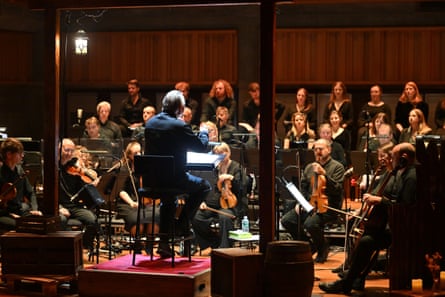
In this earthy, ultimately tragic story set in rural Provence, the girl of the title, like Godot, remains unseen – she’s over in town, where people are no better than they should be. But her betrayal of the farm boy Frédéri, played here with wide-eyed openness by Kerill Kelly, and his inability to give up his infatuation, wreaks havoc. There are few surprises – given that we are pointedly told in Act 1 how high the farm’s hayloft is, there can be only one ending for despairing Frédéri. Yet Daudet’s characters are not drawn from stock: in particular, Frédéri’s mother Rose is passionate but pragmatic in a way that came across here every moment Helena Lymbery was on stage. In Alex Doidge-Green’s designs, the playing area was flanked on either side by the shepherd’s grubby caravan and a neat laundry hanger, and by the orchestra and chorus at the back. Directing, Jeremy Sams set the action in the north of England not so long ago, with the text in his own pleasingly to-the-point translation.
As for the music, written for a small, cello-heavy orchestra coloured with saxophone and harmonium, pretty is only half of it. This is music that smells of lavender and pine trees, yes, but also of farm animals in the sun. With the chorus contributing snappily, the OAE and Elder brought out its rustic flavour punchily while never losing sight of its elegance.
KioskNews shows a cleaned-up reading view extracted from the publisher’s page — the original always lives on their site, not ours.