China leans in to hi-tech systems to counter emerging AI-fuelled terror threats
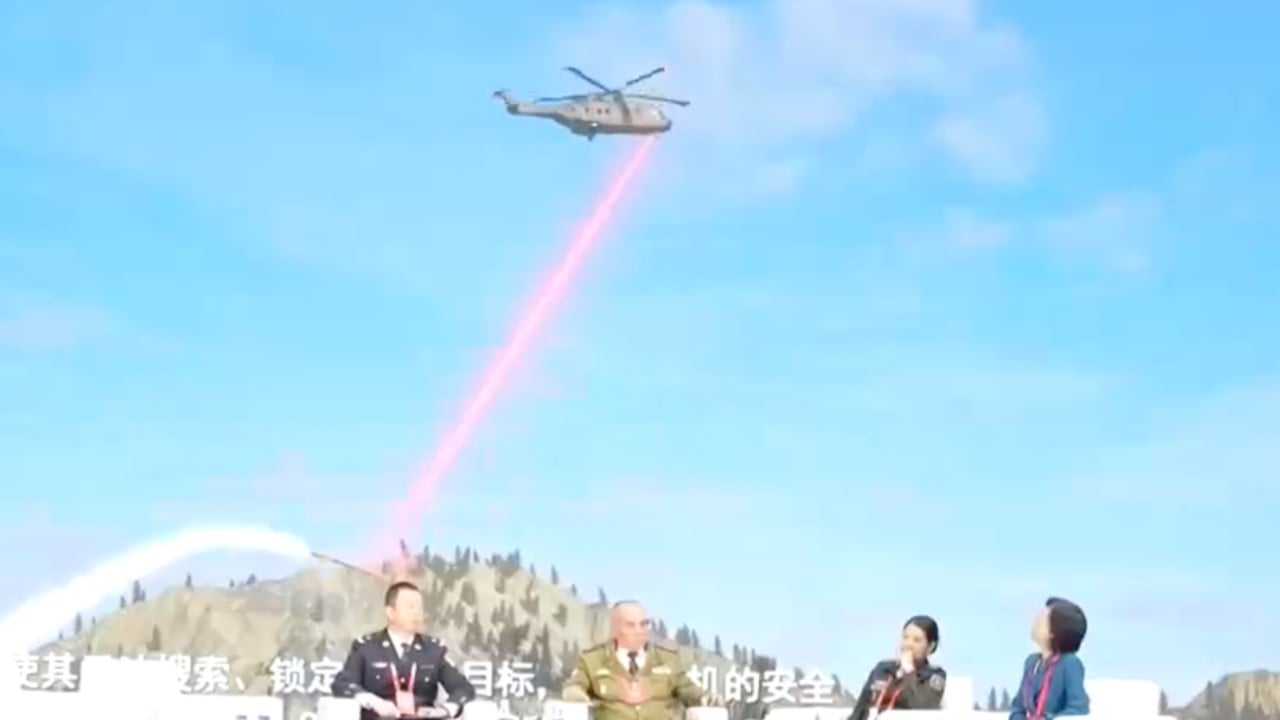
China revealed AI-powered drone interceptors and other uncrewed systems at an international counterterrorism forum in Beijing this week, as security experts warned that new technologies could enable new forms of terrorism.
The equipment was on display at the Great Wall-2026 International Forum on Counterterrorism, which ran from Tuesday to Thursday and was attended by more than 320 defence experts and military delegates from 62 countries.
Discussions focused on how advances in artificial intelligence and unmanned systems were enhancing counterterrorism capabilities while creating new and unconventional security risks.
The hardware showcased included low-cost, high-speed interception drones equipped with artificial intelligence guidance systems designed to neutralise “low, slow and small” unmanned aerial vehicles (UAVs) with high precision and rapid response times.
Humanoid robots, robotic dogs, unmanned ground vehicles, drone detection systems and laser-based defence systems were also featured in the exhibition, covering capabilities from reconnaissance to swarm defence and control, as well as precision response.
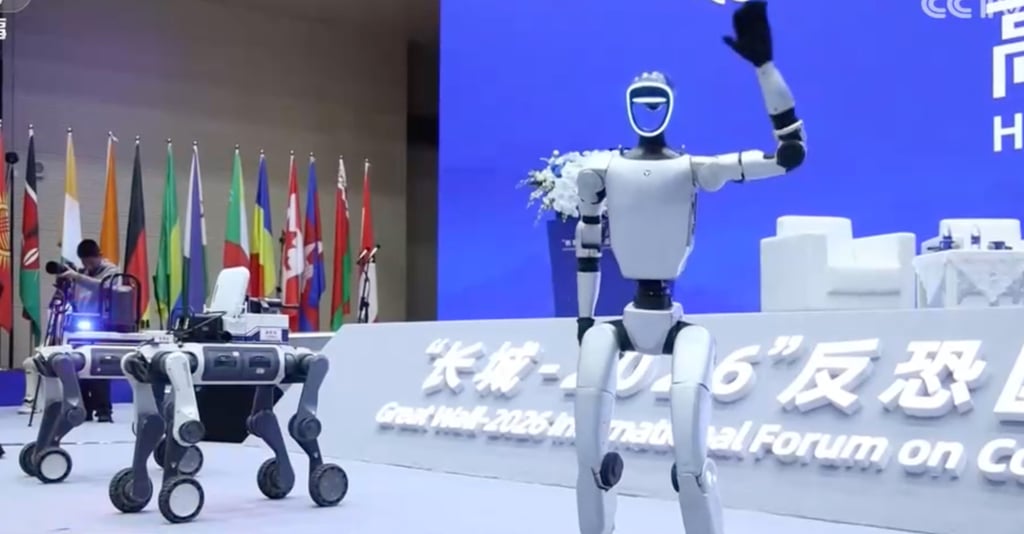
According to state broadcaster CCTV, the exhibition showed that AI technology now spans the entire chain of counterterrorism operations, from situational awareness and incident response to post-action assessment.
The event was organised by the People’s Armed Police, China’s paramilitary force responsible for internal security, riot control and counterterrorism, underscoring Beijing’s push to harness emerging technologies to address evolving security threats.
Experts at the forum cautioned that terrorist organisations were increasingly exploiting emerging technologies – including autonomous drones, drone swarms, encrypted communications and AI – for radicalisation, recruitment, funding and conducting complex multi-domain attacks.
Science and Technology Daily reported that the proliferation of AI and unmanned technologies was reshaping the threat landscape, with terrorist groups using them to expand strike ranges and methods, while continuously shifting the geographical focus of their attacks.
Terror groups were increasingly fielding UAVs with greater autonomy, as well as upgrading their cyberattack capabilities, increasing the use of drone swarms and improving their resilience to electronic warfare, it said.
The key challenge will be regulating autonomous intelligence systems – from who uses them and who sells them, to how they are bought, deployed and disposed of. Coordinated international regulation will be needed to prevent misuse and strengthen counterterrorism efforts.
“Terrorists might exploit AI models for learning and training, for which the developers must configure their large language models to prevent misuse,” Wu Mingxi, an expert in military intelligence and systems, told CCTV.
“Terrorists can also employ AI to research and engineer new attack equipment.”
Malicious actors might use generative AI to produce deepfake videos and misinformation, which presents more challenges, he added.
“If we do not pay attention to the application of AI technology and fail to prevent its misuse by terrorist organisations and violent extremists, the consequences will be disastrous,” said Peng Jijun, secretary general of the forum’s organising committee.
KioskNews shows a cleaned-up reading view extracted from the publisher’s page — the original always lives on their site, not ours.