Domestic workers helped raise our children. Who helps them care for our parents?
SINGAPORE – Leizle Menez woke up one morning in 2008 to discover that Lee Lai Ho, the 83-year-old woman she had cared for over the past three years, had died in her sleep.
Towards the end of the elderly woman’s life, the Filipino domestic worker had shared a bedroom with her. When Menez found her that morning, her body was still warm to the touch.
Her employers asked her to wash the body, dress the deceased in funeral robes and apply her make-up so that they could take a final photograph before the funeral home workers came to collect the body and seal the coffin.
“I put some lipstick and make-up on her, and I thought: ‘Can I really do this?’” She did it, crying. “It’s not like they were forcing me to do it, but I didn’t have a choice.”
The family did not realise how distressed she was until they heard her crying. They then comforted her.
Now 47, Menez has spent 24 years – more than half of her life – working as a domestic worker in Singapore. She still vividly recalls that morning nearly 20 years ago. For her, it shows how Singapore families sometimes overlook a domestic worker’s feelings, even when she has cared for a loved one in their final days.
She is one of five domestic workers interviewed by The Straits Times who were hired by Singapore families to care for elderly relatives who could no longer live independently because of dementia, cancer, stroke or other debilitating conditions.
Yet when these elderly charges die, the workers are often left to process their mourning in silence. The term “disenfranchised grief” is used by counsellors to refer to loss that goes unacknowledged because the person grieving is not considered family.
As Menez puts it: “(The children) are not sleeping with their mothers; domestic workers do that. They don’t shower their mothers; domestic workers do that.
“When that person passes away, it’s hard for us, the caregivers, even though they’re not our family.”
“Grandma” and “Grandpa”, as Menez calls them, were in their 80s when she started working for the family.
Grandma had dementia, diabetes and a hip problem that left her in a wheelchair and needing help with daily tasks. After her death, Grandpa's health took a turn for the worse, eventually requiring Menez to change his urinary catheter every six hours.
Menez had no healthcare experience and learnt on the job, often from physiotherapists and nurses.
She learnt to manage the mood swings and confusion of dementia, transfer and exercise someone in a wheelchair, dress wounds and change catheters.
Like other domestic workers who spoke to ST, Menez found that the elders preferred her to bathe and tend to them, even in hospital with nurses available. She believes they wanted to hold on to what independence they could and avoid troubling others.
The relationship was contractual, which set her apart from the family. Yet it was also deeply familial. She picked up some Cantonese and learnt to cook dishes the couple loved. She also learnt to play mahjong, which they played almost every day, even on family holidays to China.
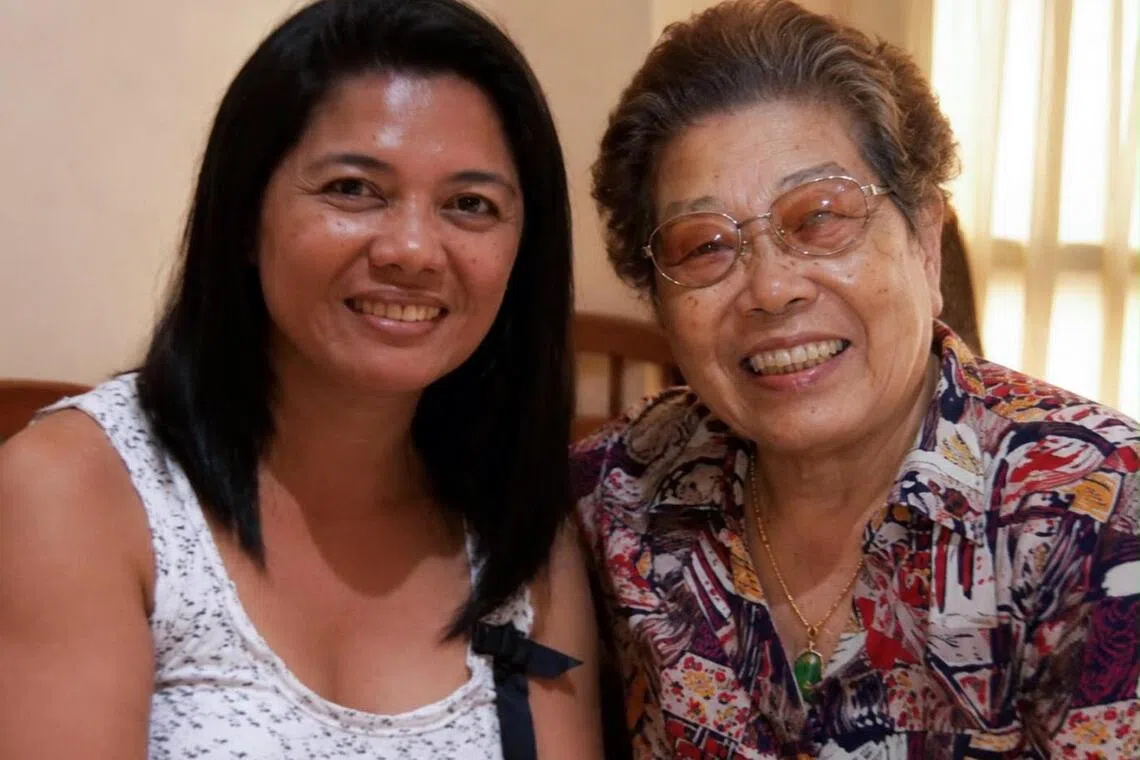
Leizle Menez (left) with Lee Lai Ho, whom she looked after for three years.
PHOTO: LEIZLE MENEZ
“It just made me feel that this was my father and this was my mother,” she says, tearing up as she recounts their time together. “I loved my job, even though there were challenges and stress.”
After the couple died, Menez worked for another family but stayed in touch with her former employers. They still meet occasionally for meals and to pay their respects to the late elderly couple. The family agreed to let ST use Grandma’s photograph for this story.
As Singapore relies more on domestic workers to care for its elderly, an uncomfortable reality is emerging. They provide care that many families cannot give, while leaving behind their own loved ones who may need the same.
“After Grandma passed away, I realised that I didn’t get to do for my own father what I did for her,” she says. “I bathed her, I put on her make-up, I was very involved during her funeral and everything, but I never did that for my father.”
Her father fell ill in the same year, 2008. She was given time off to return to the Philippines. But she arrived too late to be with him in his final moments.
A job deeply human
Jasmine Wong, 46, the late couple’s granddaughter, says Menez’s contributions “went far beyond the practical care she provided”. She became someone her grandparents trusted and felt safe with, particularly towards the end of their lives.
“Even after my grandparents passed away, the relationship we had built continued,” adds the social worker. Menez’s care, she adds, was more than just a transactional job. “It was deeply human,” she says.
Menez’s experience is increasingly common. In September 2026, Singapore officially became a super-aged society when more than one-fifth of its citizen population crossed the age of 65. The role of domestic workers in Singapore has shifted with it.
The decades since the 1970s have seen a drastic evolution in the role of foreign domestic workers in Singapore’s social fabric.
The foreign domestic servant scheme was introduced in 1978 to help more Singapore women join the workforce. In 1970, only one in seven married women was economically active.
As the Ministry of Labour wrote at the time: “There is a good number of women in Singapore with special skills or training but who are not in gainful employment as they are being burdened with household duties.”
The work was long associated with child-rearing. Today, helpers are increasingly hired for the oldest member of the family rather than the youngest.
Dr Chong Poh Heng, medical director at HCA Hospice, attributes this to the “sandwiched generation”: middle-aged adults stretched between ageing parents and children, often in dual-income households. It is now almost customary for families to hire a domestic worker after an elderly family member loses independence.
With foreign domestic labour not cost-prohibitive, “it is not uncommon for me to see average households with two helpers during my rounds in the community”, Dr Chong says.
The data bears this out. A 2011 survey for the Ministry of Community Development, Youth, and Sports – the last major one on informal caregiving – covered more than 1,000 primary caregivers of adults aged 75 or above. Two-thirds of these caregivers had secondary caregivers, 71% of whom were domestic workers.
A 2024 study by researchers from Duke-NUS Medical School estimates that migrant domestic workers provide 42 hours of caregiving a week, far more than other caregivers. These researchers valued informal caregiving time for Singaporeans aged 75 at about $1.28 billion, as of 2020.
Unlike family caregivers, however, these workers face a distinct set of often invisible challenges.
The emotional cost of caring
The strain is evident in the story of Fatmawati. The 43-year-old was hired in 2017, the family’s sixth domestic worker in a year.
The Ministry of Manpower required the household to attend a mandatory workshop before hiring again, a standard step for employers who change helpers more than three times in 12 months.
The problem for Fatmawati, from central Java, was clear. She could not care for a 90-year-old and run the household at the same time.
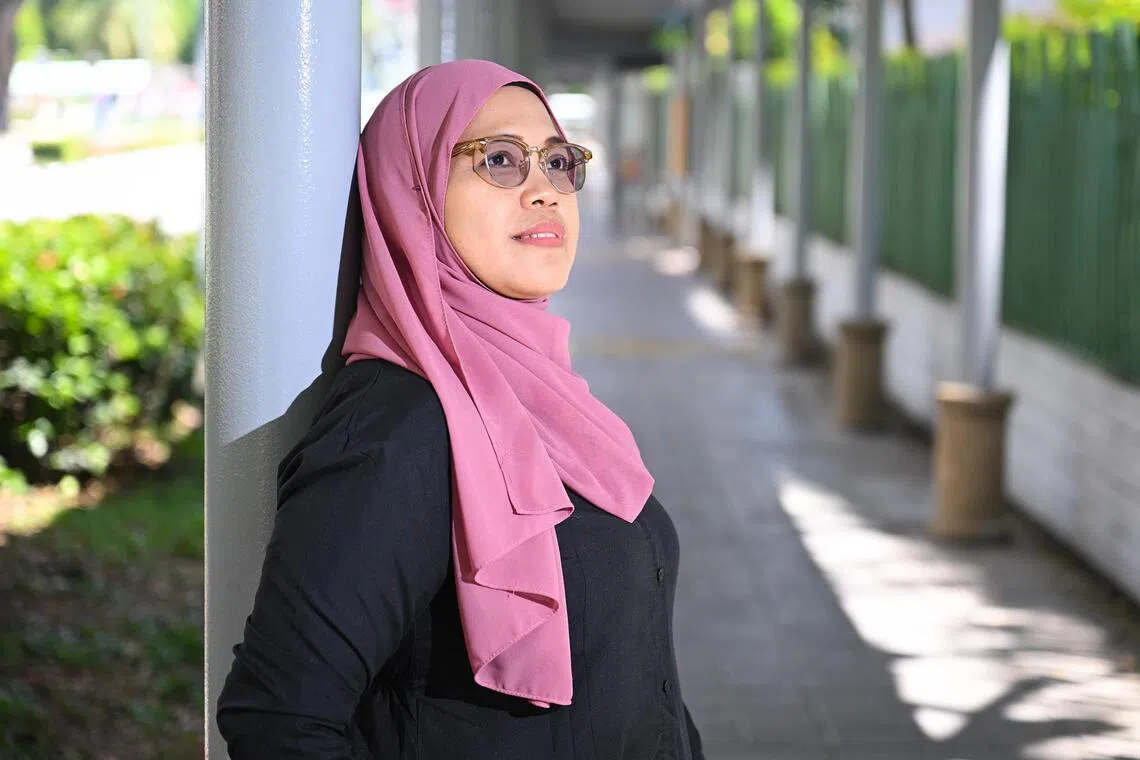
Each Mother's Day, Indonesian domestic worker Fatmawati would think of the elderly woman she took care of.
ST PHOTO: SHINTARO TAY
The senior had dementia and often woke up late at night demanding to be let out.
“We could not let her be alone; we were scared she’d fall down,” says Fatmawati. “If she couldn’t sleep, we also couldn’t sleep.”
Stroke, shingles and other health conditions meant that she could not be left alone for long.
When the senior was hospitalised at Tan Tock Seng Hospital, Fatmawati shuttled between her employer’s home and the hospital. Attached to her, her charge insisted the helper shower her instead of the nurses. Fatmawati arrived at the hospital by 8am, left in the afternoon to do chores and cook for her employer before returning to the hospital in the evening.
Her Sunday off was at most a half-day because of her employer’s rules about when she had to return.
She felt that her employer, grieving over her mother’s decline, did not understand the strain she was under. When Fatmawati broke down over her workload, a bitter blow-up followed. She was told she could easily be replaced by another helper who could cope.
Nearly a decade on, recounting the story to ST, Fatmawati has to stop to dry her eyes. She stayed out of obligation to the senior and fear of the stigma of changing employers too often.
“Every day, we were together. At night, when she couldn’t sleep, she always touched me like this,” she says, patting herself on the arm.
After the elderly woman fell one night, Fatmawati began sharing her room, a common arrangement for helpers caring for the elderly.
Her charge died in 2021, but every Mother’s Day, around the time of the elderly woman’s birthday, Fatmawati still thinks of her.
The elderly woman liked cute animal puzzles, she recalls.
“Sometimes, on my days off, I would buy puzzles for her. When we were at home, and I had finished my chores, we would do the puzzles together and I would turn on the music she liked,” she says.
“When she passed on, there were so many puzzles. We gave them away to the childcare centre downstairs.”
Fatmawati now works for a different household, mainly caring for children. She says: “Children are more cheerful. You never think that next time you go out, that they might leave us.”
Her experiences echo those of most of the workers interviewed – closeness from sharing a room, the number of days off that shrinks as the senior declines, and fear of how families will react if they admit being overlooked.
Dr Stephanie Chok, executive director of local nonprofit Humanitarian Organisation for Migration Economics (HOME), notes that helpers are sometimes expected to provide round-the-clock care while also managing cooking, cleaning and other household duties. This combination can result in long working hours, interrupted sleep and significant physical and emotional burnout.
A 2020 study by HOME and local women’s organisation Aware found that workers interviewed averaged 14.5-hour workdays, and most do not have weekly rest days.
Beyond tasks such as feeding and bathing, the work includes companionship and reassurance, and more time with the senior than any family member spends.
Dr Cheong says for these workers, “the emotional cost of caring may not be apparent and relevant grief support might not be forthcoming from the family or the system.”
He adds: “It is compounded when they are promptly sent back home or transferred to another family after the patient dies.”
Domestic workers caring for those with chronic illnesses can feel constantly on guard, afraid that they will be blamed if something goes wrong. They can also face distressing choices, such as refusing food to someone pleading for it because doctors have warned that they could choke.
Support, but for whom?
As Singapore’s population ages, it has expanded care services and made it easier for families to hire domestic workers as caregivers.
Figures from the Ministry of Health show that nursing home beds more than doubled from 9,551 in 2010 to 21,002 in 2025. Daycare places also rose, from 2,100 in 2011 to 9,400 in 2025, while home care places went up from 3,800 to 15,400 in that period.
The number of domestic workers also grew, from 201,000 at the end of 2010 to 316,900 at the end of 2025, partly driven by initiatives to make hiring them as caregivers more accessible.
Eligible households with an elderly person, a young child or a person with disabilities pay a reduced monthly domestic worker levy of $60, compared with the standard $300 for a first helper.
To help families manage these needs, the Government has rolled out several initiatives over the years.
In 2007, the Caregiving Training Grant was introduced to provide households with $400 to offset caregiver training costs for helpers, with a $200 top-up each year.
Nearly a decade later in 2016, the Advance Placement Scheme was rolled out. It allows selected employment agencies to bring in domestic workers without first securing employers to help families eligible for the levy concession find caregivers more quickly.
The following year, the Household Services Scheme allowed firms to hire more migrant workers to provide part-time domestic services, such as elder-minding.
Workers welcome these initiatives, and several have taken grant-subsidised caregiving courses. But these policies, they say, do not reach what matters most: the households they land in.
Mutiyah, from Indonesia, shows how much that matters. The 45-year-old cared for an elderly grandmother with stomach cancer. The job required round-the-clock monitoring, tube feeding and changing a stomach bag. Two to three helpers worked in shifts, living with the senior without other members of the family present.
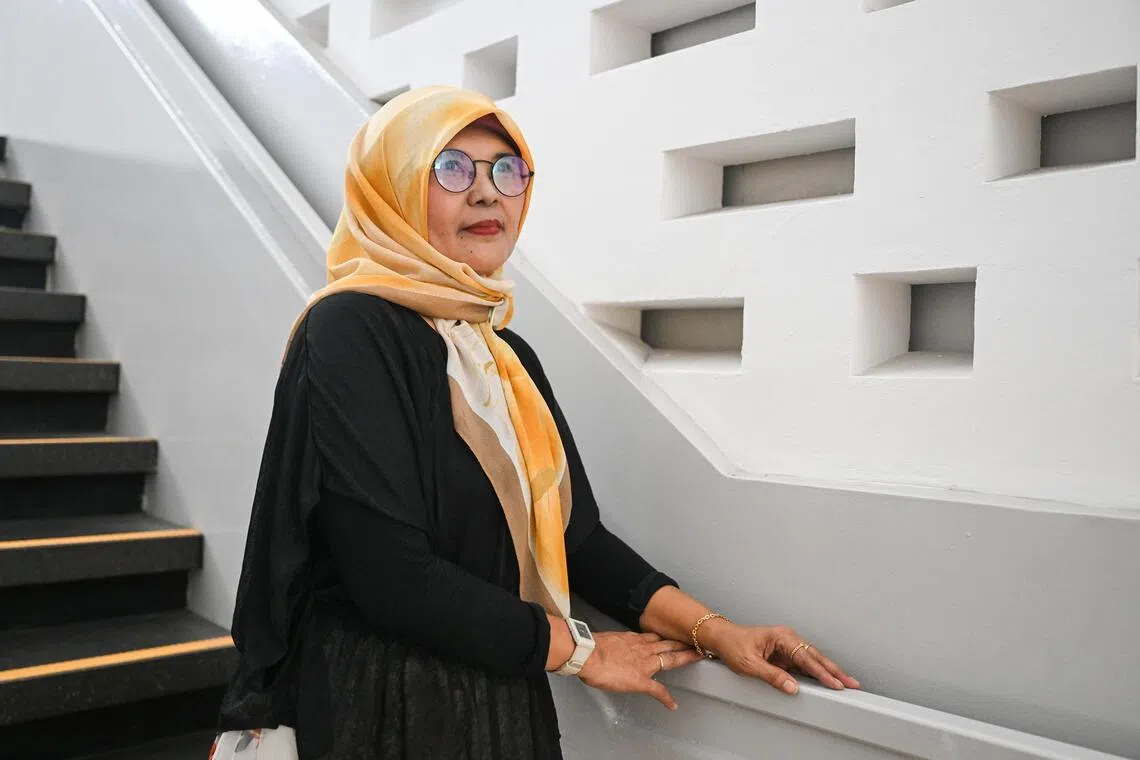
Domestic worker Mutiyah cared for an elderly grandmother with stomach cancer, a job which required round-the-clock monitoring, tube-feeding and changing a stomach bag.
ST PHOTO: SHINTARO TAY
One evening, her employer – the senior’s son – phoned to tell her to check the room because of something he saw on the CCTV. She found the senior in a precarious position on the bed while the helper on duty was distracted. That worker was fired the next morning and replaced.
For others, years away from their families take a toll. Ani Sumarni Rasman Ratam, 40, recalls six difficult years when Covid-19 restrictions and caregiving responsibilities kept her from returning home.
She was caring for a woman in her 80s who had dementia and had grown dependent on her. The woman often could not remember her own children, but recognised Ani, who spent nearly all of her waking hours by her side. Even when her children offered to feed her or keep her company, she insisted on Ani.
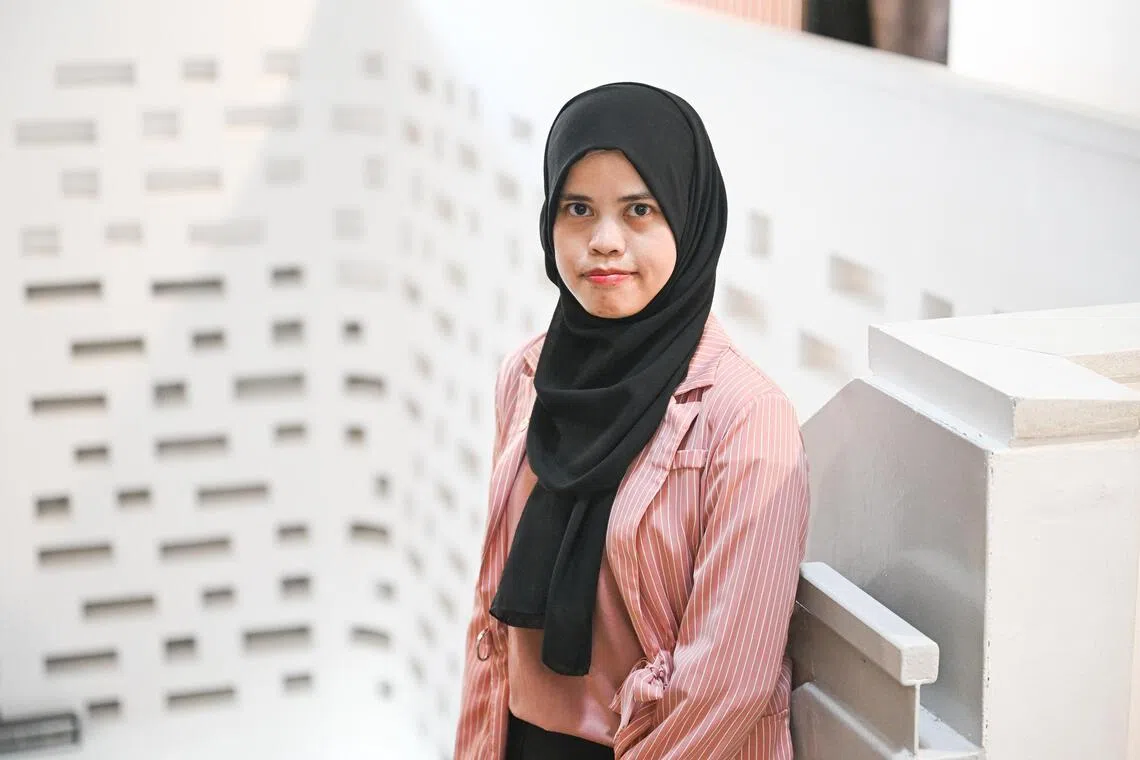
Domestic worker Ani Sumarni Rasman Ratam could not be with her maternal grandmother in Indonesia when she died because she was in Singapore caring for an elderly woman with dementia.
ST PHOTO: SHINTARO TAY
Their bond made leaving difficult. But staying meant being away from her own family without a clear end in sight.
Ani, who is supporting her ageing parents and paying for her younger sister’s university fees, recalls: “Sometimes, when I call my family, they say if you are really very tired and stressed, you can just resign and come home. But I said I cannot, because grandma is already...” Ani trails off. “I don’t know how long she will stay.”
The stress eased over time, but the woman’s eventual death brought fresh grief and memories of losses back home.
She explains: “When my grandparents died, I didn’t have the chance to stand beside them. My maternal grandma was very close to me. But at the time she died, I was already working overseas. I never had a chance to see her in her last days.”
Beyond advocating for migrant worker labour protections, such as measures which balance the power between employers and domestic workers, HOME also argues that there should be a policy framework separating work pass categories for domestic work and caregiving.
Advocates say structural change is needed. In addition to stronger labour protections that balance power between employers and workers, HOME wants separate work pass categories for domestic work and caregiving. Dr Chok believes this would allow clearer job scopes, proper training and stronger protections, rather than assuming that one worker can perform both full-time caregiving and household duties.
“Such recognition can also lead to better support for migrant domestic worker caregivers, for instance, in the form of specialised support networks for those grappling with the emotional weight of caregiving.”
Some employment agencies now offer contracts tailored to caregivers hired on domestic worker permits, says Dr Chok. These spell out caregiving duties and set clearer expectations between caregivers and employers.
Sharing the grief
One household shows what clearer expectations can do.
Indonesian Ismiyati, 50, was hired in 2006 to care for her employer’s ageing parent. The mother, then 68, had, among other illnesses, dementia, stroke, Parkinson’s disease and a heart condition requiring a pacemaker.
Ismiyati showered Tee Siam Kiaw, walked and exercised with her and took her to daycare. Because of her dementia, Tee also often woke up at night shouting, and was prone to unpredictable mood swings and bouts of confusion.
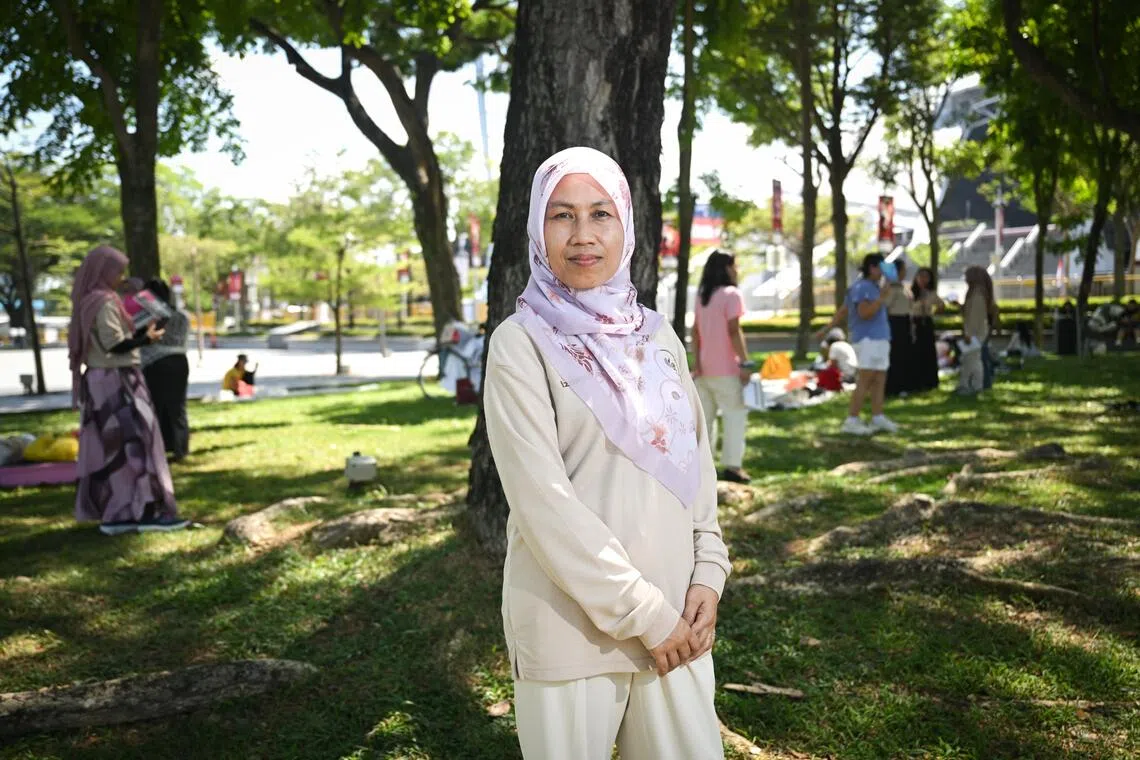
Indonesian domestic worker Ismiyati said what made the work manageable was her employer’s understanding that caring for the elderly woman came first.
ST PHOTO: SHINTARO TAY
The helper says: “I did everything for her. I had no time to clean the house.”
What made the work manageable was her employer’s understanding that caring for the elderly woman came first. The family hired a part-time cleaner weekly to do the household chores. Tee’s children also cooked the meals and took turns accompanying her to hospital appointments.
“They really treated me like their own family, like their own sister,” says Ismiyati. Tee often referred to her as her youngest daughter, while her employer called her a sister.
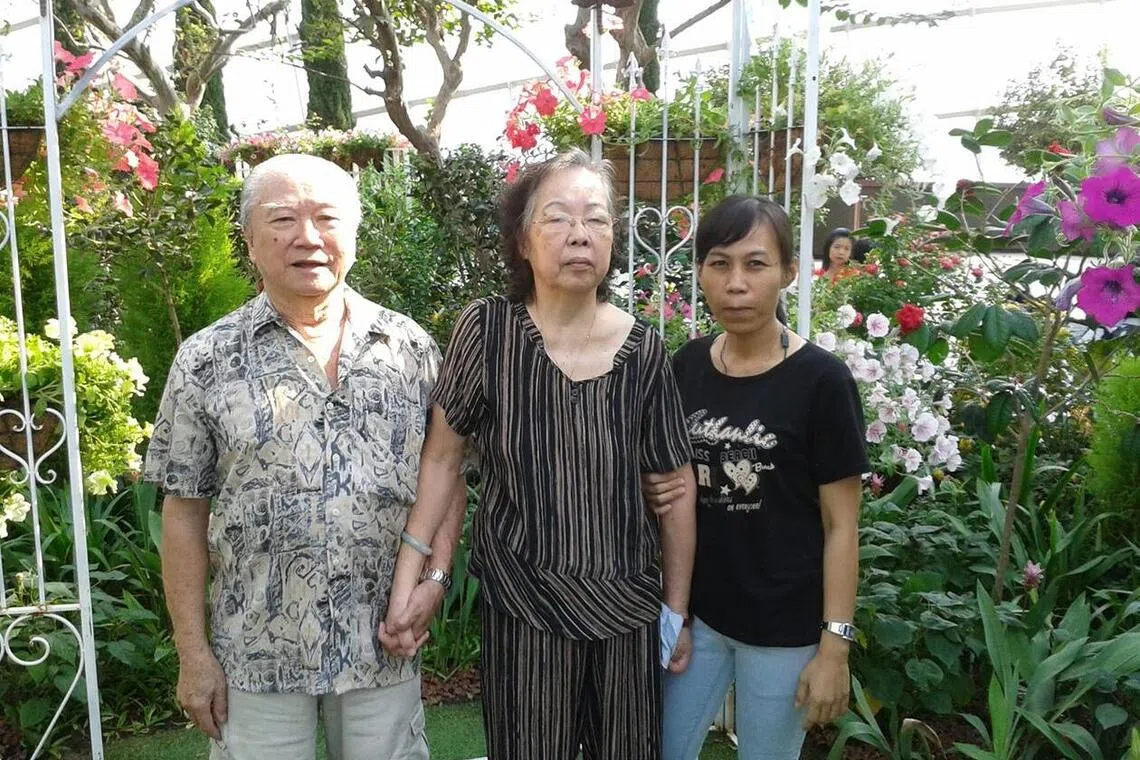
Ismiyati (extreme right) with her late charges, Ang Bo Ha and his wife, Tee Siam Kiaw, at Gardens By The Bay in 2011.
PHOTO: ISMIYATI
Together, the three spent many nights in the hospital ward on Tee’s last days. By then, her mind had drifted into the distant past. When she got agitated, Ismiyati and her employer pretended to be customers at a noodle shop, using toys as food. The elderly woman – a former noodle seller – played along gleefully. She died of pneumonia in 2022 at 80.
Ismiyati still works for the family.
She says: “A lot of times, I will dream of her. When my boss and I have dinner, we talk about her all the time and what she’d be doing now.”
KioskNews shows a cleaned-up reading view extracted from the publisher’s page — the original always lives on their site, not ours.