Personal, Home Or Education Loan Rejected? 7 Things To Do Before Reapplying

A loan rejection can be frustrating, especially when you have been counting on the money for a major expense. Whether it is a personal loan for an emergency, a home loan to buy your dream house or an education loan to fund higher studies, a rejection can leave borrowers wondering what went wrong.
But a rejected application does not necessarily mean you are financially unfit to borrow. Sometimes, it takes just one weak parameter, an error in your credit report or a lender's internal risk assessment to derail an application.
The important thing is not to rush to another lender with a fresh application. Multiple applications without fixing the underlying problem can make matters worse.
Also Read | Layoffs Are Rising In Tech, But These Skills Are Helping People Unlock Better Pay
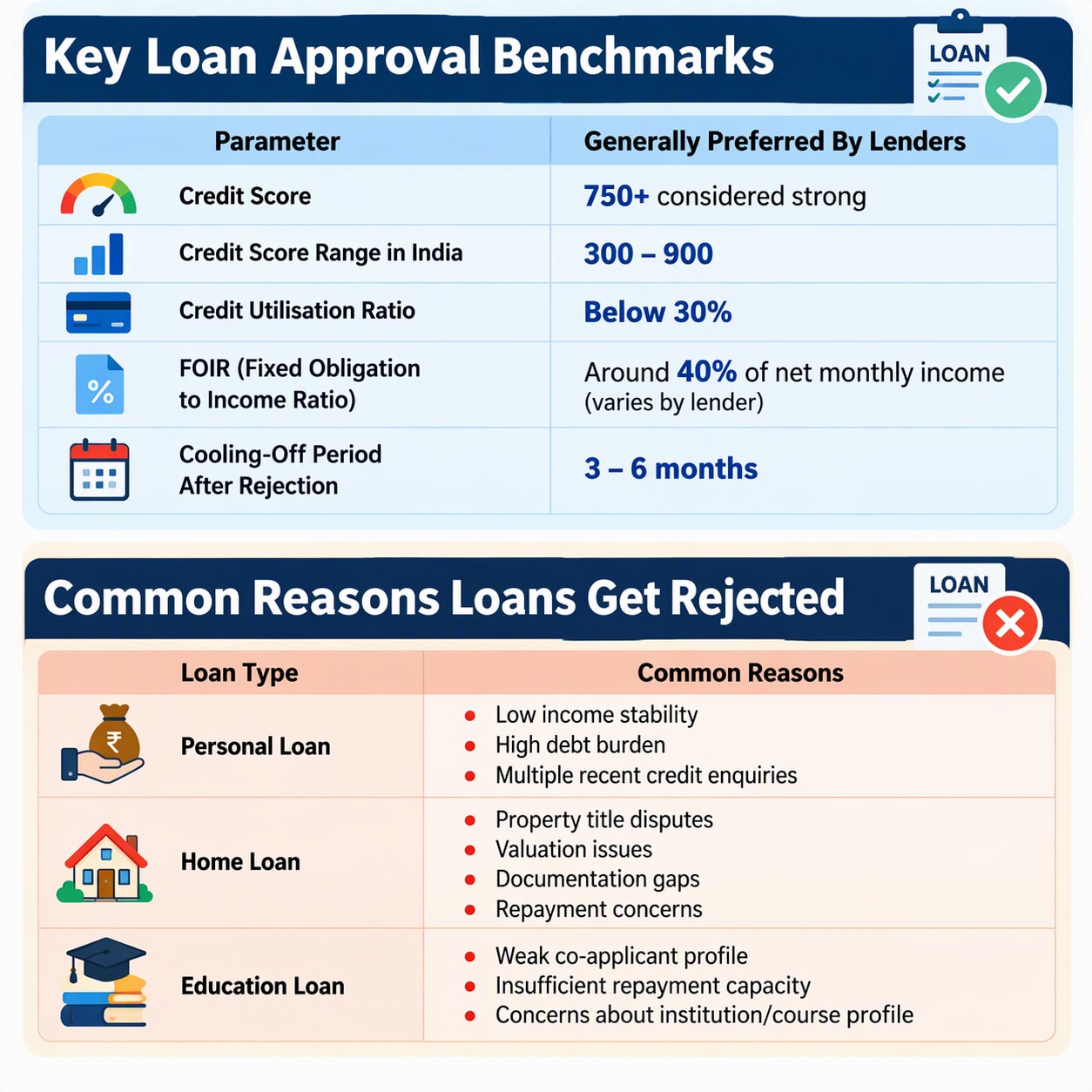
In India, credit scores generally range from 300 to 900. A score of 750 or above is considered strong by many lenders. However, a good credit score does not guarantee loan approval. Lenders also examine income stability, existing debt, repayment capacity and the purpose of borrowing.
The reasons for rejection can also differ depending on the loan. Personal loans are unsecured, making lenders particularly careful about income stability and recent credit enquiries. Home loan applications can get stuck because of property-related legal or valuation issues, even if the applicant has a healthy credit score. Education loans, meanwhile, may depend heavily on the co-applicant's repayment capacity and the institution's profile.
So, what should you do before applying again?
1. Find Out Why Your Loan Was Rejected
Start by understanding the reason behind the rejection. Do not assume that a low credit score is always responsible. Check whether the lender flagged your repayment history, income, existing EMIs, employment stability or documentation.
For a home loan, examine whether the property has any legal, title or valuation-related issues. For an education loan, review the co-applicant's income and financial obligations. You can also contact the lender and ask for the specific reason for rejecting your application. This will help you identify what needs to change before your next attempt.
2. Check Your Credit Report For Errors
An error in your credit report could affect your chances of getting a loan. Under RBI rules, individuals are entitled to one free full credit report every year from each of India's four credit information companies: CIBIL, Experian, Equifax and CRIF High Mark.
Go through the report carefully. Look for loans that have already been repaid but are still showing as active, incorrect overdue amounts, unfamiliar credit accounts or repayment entries that do not belong to you.
If you find an error, raise a dispute with the credit bureau as well as the concerned lender. Follow up until the information is corrected. Do not apply again until you have checked whether the error has been resolved.
3. Clear Outstanding Dues And Fix Your Credit History
Your repayment history matters. Even a relatively small unpaid amount can create problems if it is reported as an overdue payment. Check for missed EMIs, credit card dues and outstanding Buy Now, Pay Later (BNPL) obligations.
If you have an account marked as 'Settled', understand that it is different from one marked as 'Closed'. A settled account generally indicates that the lender accepted less than the full outstanding amount. This can affect your credit profile.
Where possible, clear the remaining dues and request the lender to update the account status accurately. Remember, paying off a loan does not automatically mean the credit bureau will immediately reflect the updated status. Check your report again after the lender has processed the update.
4. Reduce Credit Card Usage And Existing EMIs
Lenders do not just look at how much you earn. They also calculate how much of your income is already committed to debt repayment. Two important parameters are credit utilisation and Fixed Obligation to Income Ratio (FOIR).
Credit utilisation refers to the portion of your available credit card limit that you are using. Ideally, keep it below 30 per cent. For example, if your credit card limit is Rs 1 lakh, try to keep your outstanding balance below Rs 30,000.
FOIR measures how much of your monthly income goes towards existing financial obligations. Many lenders prefer total monthly EMI commitments, including the proposed loan, to remain around 40 per cent of net monthly income, although the actual threshold varies across lenders and loan products.
If your existing EMIs are too high, consider closing smaller loans, clearing BNPL dues or reducing the loan amount you plan to borrow. Adding an earning co-applicant, where permitted, may also improve repayment eligibility.
5. Avoid Applying To Multiple Lenders Immediately
A loan rejection can tempt borrowers to approach several banks and NBFCs in quick succession. This is not always a good idea. Every formal loan application generally triggers a hard enquiry on your credit report. Several enquiries within a short period can signal credit-hungry behaviour and may affect your credit score. Instead, take a break from fresh applications while you work on your financial profile.
A cooling-off period of three to six months can be useful, depending on the reason for rejection and the time needed to fix it. However, simply waiting will not solve an unresolved default, high debt burden or documentation issue. Use this time to address the actual problem.
6. First-Time Borrowers Should Build A Credit Record
What if your loan application was rejected despite having a steady income and no history of missed payments?
The problem could be that you have no credit history. For first-time borrowers, lenders may not have enough information to assess repayment behaviour. Having no credit score is not the same as having a poor credit score, but it can make underwriting more difficult.
Sharath Pareddy, Head of Credit and Analytics (India), Branch International, told NDTV that a rejection should be treated as feedback rather than a final assessment of a borrower's financial ability.
"A rejection is not always a reflection of someone's ability to repay. Often the lender simply does not have enough information. Treat it as feedback, understand what drove the decision, fix what you can, and reapply when your profile is stronger. For those new to credit, starting with a smaller loan and repaying it on time is one of the most effective ways to build a record lenders can trust. Increasingly, lenders also look beyond bureau scores like consented signals of financial behaviour, to assess people who are new to credit."
A small loan or credit product, used responsibly and repaid on time, can help establish a repayment record. However, do not borrow unnecessarily just to build a credit score.
7. Recheck Your Documents Before Applying Again
Sometimes, the problem is not your credit score but incomplete or inconsistent paperwork. This is particularly important for home loan applicants and self-employed borrowers.
Atul Monga, CEO and Co-founder of BASIC Home Loan, told NDTV that borrowers should understand the reason behind a rejection before approaching another lender. "Having a loan application rejected does not necessarily mean that a borrower is ineligible for credit. It is important to first understand the reason behind the rejection before applying again. Borrowers should start by reviewing their credit report for errors, checking their repayment history and assessing their existing financial obligations. A good credit score is important, but lenders also evaluate income stability, debt-to-income ratio and overall repayment capacity before making a decision."
For home loan applicants, this means checking salary slips, bank statements, income tax returns (ITRs) and other income-related documents. Self-employed individuals should maintain proper financial records to establish that their earnings are stable.
Education loan applicants should also ensure that admission documents, fee details and co-applicant income records are in order. Monga adds that applying to multiple lenders without addressing the underlying issue can lead to repeated rejections and additional credit enquiries. Borrowers should first fix documentation gaps, reassess the loan amount they can comfortably repay and approach a lender when their financial profile is better prepared.
KioskNews shows a cleaned-up reading view extracted from the publisher’s page — the original always lives on their site, not ours.