Knesset advances bill to repeal judicial selection committee overhaul in preliminary reading

The votes come as the bloc led by Yashar party leader Gadi Eisenkot holds a parliamentary majority - with the support of the Arab parties - over Netanyahu’s bloc.
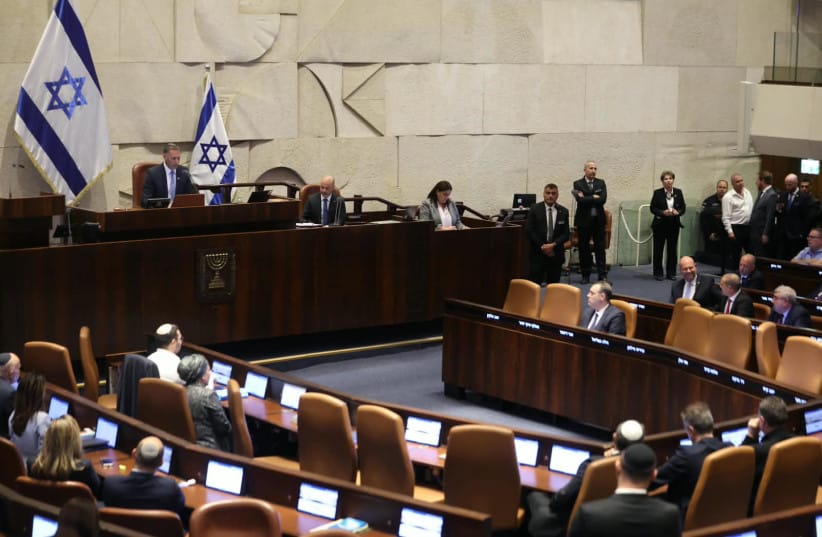
The Knesset plenum on Wednesday began voting on preliminary readings of a series of bills seeking to repeal key components of the judicial overhaul passed by Prime Minister Benjamin Netanyahu’s outgoing coalition.
The first bill to pass its preliminary reading seeks to repeal the bill that dramatically amended the Judicial Selection Committee responsible for electing Israel’s judges, by increasing political involvement in judicial appointments.
The bill passed its preliminary reading with 67 MKs voting in favor and 47 against. Justice Minister Yariv Levin, considered one of the architects of the judicial overhaul that sparked nationwide protests, sharply criticized the move ahead of the plenum vote, calling it corrupt.
"The repeal means returning representatives of the Israel Bar Association to the committee, with all the conflicts of interest involved, and that is corruption. The truth about the judicial system has been fully exposed," he said.
Meanwhile, Democrats MK Efrat Rayten, one of the bill's sponsors, told the plenum that bills to repeal are "not intended to destroy, but to repair. Today marks the beginning of healing.”
"They [the bills to repeal] are intended to erase four destructive and divisive years. We will once again present the beautiful face of the State of Israel to all its citizens," she said.
Eisenkot bloc holds parliamentary majority, with Arab support
The votes come as the bloc led by Yashar party leader Gadi Eisenkot holds a parliamentary majority - with the support of the Arab parties - over Netanyahu’s bloc.
It also comes as the Eisenkot-led bloc secured a majority on Tuesday to oust Knesset Speaker Amir Ohana (Likud) and appoint Yashar MK Matan Kahana as his replacement.
The move granted the Eisenkot-led bloc significantly greater control over the parliamentary agenda during the period before a new government is formed following the elections.
Among the other bills slated to be voted on for repeal in its preliminary reading on Wednesday is legislation that sought to significantly weaken the role of the attorney-general.
Another repeal bill up for a vote is the communications reform, advanced by Communications Minister Shlomo Karhi (Likud), which sought to enact sweeping reforms to the country's broadcasting sector. Critics argued that the legislation would grant the government substantial control over broadcasting outlets.
Bills passed during previous government
The bills were passed during the previous Knesset amid the government’s ongoing rift with the judiciary and Attorney-General Gali Baharav-Miara.
Once the bills seeking to repeal the laws pass their preliminary readings, they will return to the Knesset committees for further deliberations and will still require three additional readings to be enacted.
The Eisenkot-led bloc has been seeking to advance as much legislation as possible during the period before a new government is formed, while it holds the parliamentary majority that Netanyahu’s bloc lost following the October 27 elections.
The election results showed that the opposition bloc received 67 seats, including 19 held by the Arab parties, while Netanyahu’s bloc won 53.
However, no new government has been formed yet, as most party leaders have drawn a red line against partnering with the Arab parties.
Nevertheless, the Arab parties’ support still allows the bloc to pass key legislation even while Netanyahu heads a caretaker government.
KioskNews shows a cleaned-up reading view extracted from the publisher’s page — the original always lives on their site, not ours.