'Can't drive into future looking at rearview mirror': India calls for UNSC reforms
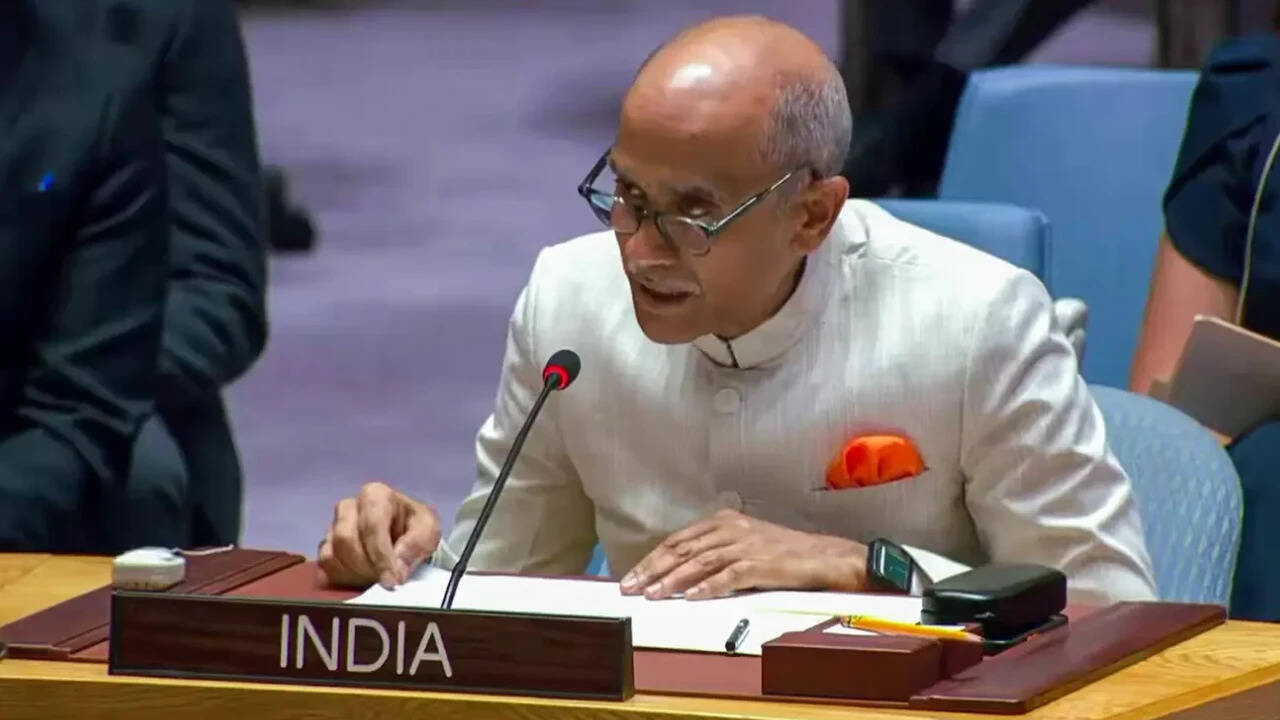
India's Permanent Representative to the UN, Ambassador Parvathaneni Harish
India has called for urgent reforms to the United Nations Security Council (UNSC), warning that its 80-year-old structure is struggling to address some of the world’s gravest conflicts.
New Delhi said the Council’s composition must reflect present-day global realities, arguing that its post-Second World War framework no longer adequately represents the international community.According to news agency PTI, India’s Permanent Representative to the UN, Ambassador Harish Parvathaneni, said on Thursday that the authority inherited from the Second World War could no longer compensate for the Council’s lack of representative membership.“The cost is already visible. Eighty years on, the Organisation is struggling to deliver peace and reconciliation in some of the gravest conflicts before the Council,” Parvathaneni said while addressing the UN General Assembly on equitable representation and an expansion of the Security Council.He added that “the authority derived from a victory eight decades ago cannot compensate for the deficit in legitimacy of an unrepresentative Security Council today.”
The Indian envoy argued that 1945, when the UN was established after the Second World War, could not remain the sole reference point for global governance.“No war, especially one that took place over 80 years ago, should determine today’s state of the world,” he said.“History can be a guide for what not to do. It cannot determine today’s choices for what needs to be done to face contemporary challenges. We cannot reasonably drive into the future by constantly looking at the rearview mirror,” he added.Parvathaneni also highlighted India’s contribution to the World Wars, arguing that the sacrifices of several nations had not received adequate recognition in the post-war international order.“An organisation crafted of the victors, for the victors and by the victors did not, obviously, care to include the concerns of the victims,” he said, calling for the Security Council to evolve “for the sake of its own relevance”.According to PTI, he noted that around 2.5 million Indians participated in the Second World War, with approximately 90,000 dying in military service. He also referred to the Bengal famine, which he attributed to colonial wartime policies.India further pointed to the under-representation of Asia-Pacific, Africa and Latin America. The Asia-Pacific region accounts for more than 60 per cent of the world’s population but has only one permanent seat on the Council, alongside a fluctuating elected representation.“Reform is not the settlement of old scores. It is an investment in a Council that all Member States can trust, and which would be stronger as a result,” Parvathaneni said.The 15-member UNSC comprises five permanent members — China, France, Russia, the United Kingdom and the United States — with veto powers, alongside 10 elected members serving two-year terms.
India supports expanding both permanent and non-permanent membership, arguing that changes limited to elected seats would leave the central imbalance intact.Criticising the pace of negotiations, Parvathaneni said, “That is not negotiation; it is merely perpetuation of status quo.”He added, “Convergences are not consensus, and the search for a lowest common denominator must not become an excuse for cosmetically tinkering with the existing structure while calling it reform.”India also maintained that any permanent membership expansion must address the veto question fairly. “A two-tier permanent membership would only institutionalise inequality,” he said.
KioskNews shows a cleaned-up reading view extracted from the publisher’s page — the original always lives on their site, not ours.