US deploys weapons in space: What international law says on militarisation
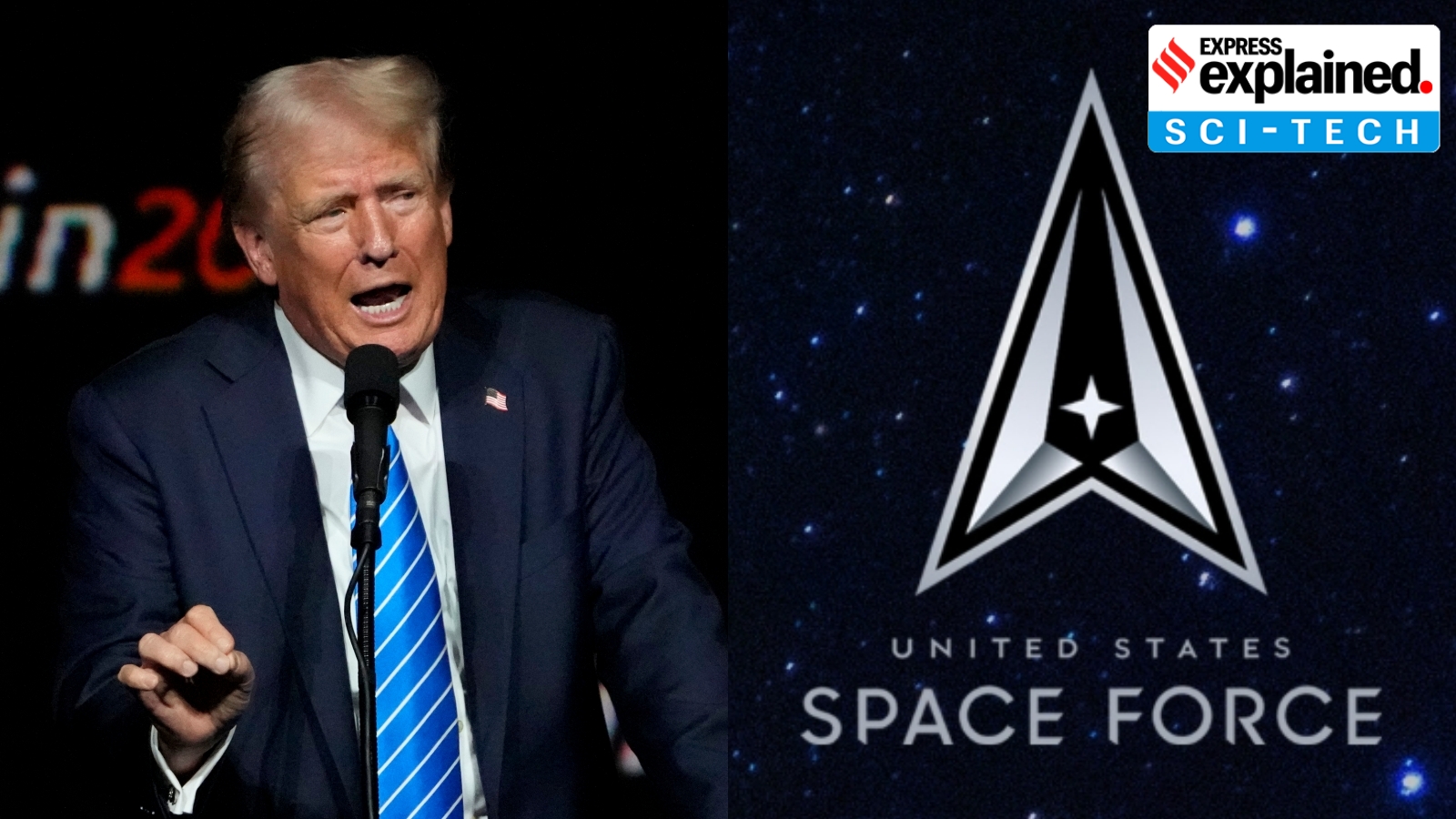
The US Space Force was set up in 2019 during the first presidential term of US President Donald Trump (2017-21). Photo: AP/US Space Force
The United States on Tuesday (September 15) said it had active weapons deployed in space, the first such public admission by any country, sparking a fresh debate. The US did not reveal the nature of weapons deployed, or when they were deployed.
“Today we continue to ensure we remain ready to meet the challenges of evolving threats wherever they exist. This is why the US now has on-orbit space control weapons capable of defending the joint force against hostile adversary action,” US Air Force Secretary Troy Meink said at a conference in Maryland, according to a CNN report.
There was immediate reaction from China and Russia, two countries that the US considers its space adversaries. “We urge the US side to stop expanding its military capabilities and preparing for war in outer space,” Chinese foreign ministry spokesman Guo Jiakun told reporters, according to an AFP report.
That same report also quoted Kremlin spokesman Dmitry Peskov calling for keeping space free of any weapons. “We are counting on broad international consolidation to continue working toward the complete demilitarisation of space,” he said.
Interestingly, the US accuses China and Russia of improving their space capabilities with the objective of tracking and targeting US forces. “China and Russia are also testing and fielding sophisticated counterspace capabilities with the intent to disrupt and degrade US space-enabled capabilities,” reads a factsheet on space threats, published on the website of the US Space Force, set up in 2019.
Weaponisation of space
Although this is the first time a country has publicly admitted to deploying weapons in space, the capabilities to do so are neither new nor a revelation. The military use of outer space covers a wide variety of capabilities: the ability to launch a missile from Earth to destroy enemy satellites or other space-based assets, the ability to send weapons from space to destroy ground-based targets, or the use of space-based weapons to target space-based assets. It is not clear which of these categories the US’s newly-acknowledged weapons fall into.
But the weapons need not be “kinetic” — they need not necessarily be able to cause physical destruction of enemy targets. The ability to disrupt or jam the enemy’s communications between its space and Earth-based systems, or attack their cyber-networks, can also be extremely effective in a conflict situation.
Story continues below this ad
Several countries have developed some, or all, of these capabilities, though not every such capability has been tested and demonstrated.
The most open demonstrations of such capabilities have been the anti-satellite tests, in which countries send a missile to destroy a satellite in space. Four countries — the US, Russia, China and India — have demonstrated this. Although the countries targeted their own non-functional satellites during the tests, this ability to completely destroy any space-based asset happens to be the most dramatic use of weapons in space to date.
There have been examples of non-kinetic methods as well. Just before the Russian attack on Ukraine in February 2022, Russian hackers gained control over ground stations of the Viasat satellite that was being used to provide internet services to Ukrainian subscribers, including their military agencies. There are also reports of attempts by Russia to block GPS signals in Ukraine.
Legal ambiguity
All countries emphasise on peaceful uses of space and call upon each other not to militarise space. But there is no international law that explicitly prohibits the deployment or use of such weapons or tactics in space. The Outer Space Treaty of 1967, an old but still the most relevant international law on this subject, bars countries from carrying or placing nuclear weapons or “other kinds of weapons of mass destruction” in space, but it is silent on conventional weapons, or those that target physical infrastructure in space. It does not say anything about earth-to-space weapons, the development of which was still some distance away in the 1960s.
Story continues below this ad
Attempts to create an international legal framework to regulate the deployment and use of weapons in space were made, but support from all the major space powers was lacking. Around 2008, China and Russia had together proposed the idea of a “Prevention of the Placement of Weapons in Outer Space” treaty banning the deployment of all weapons — not just nuclear and other weapons of mass destruction — in space, but this too left out earth-to-space weapons. This idea never came to fruition.
An ongoing discussion on “Prevention of an Arms Race in Outer Space” at the UN Conference on Disarmament has also not led to any international law or treaty.
Meanwhile, the Artemis Accords, an initiative of NASA and the US State Department, is a voluntary code of conduct on exploration of space. It has over 70 signatory countries, including India. All cooperative activities are meant to be for peaceful purposes, but there is nothing that prevents signatories from deploying or using weapons in space.
KioskNews shows a cleaned-up reading view extracted from the publisher’s page — the original always lives on their site, not ours.