From bling and birds to ‘really fancy armour’ – the best dressed characters of the Bayeux tapestry

Blood, booze, arrows and boats; these are what you might typically imagine when you think of the Bayeux tapestry, which has become one of the hottest historical tickets since it went on display at the British Museum in London this month. But what about the hair?
“The Anglo-Saxons all have these little moustaches, which are brilliant. And then the Normans have these funny haircuts with the back of their heads shaved,” says Prof Laura Cleaver, an expert in medieval manuscripts at the Institute of English Studies.
And the clothes? There are crowns and tights, and brooches that wouldn’t look out of place anchoring one of Colman Domingo’s lapels at the Oscars.
The 70-metre-long embroidery – it’s famously not, in fact, a tapestry – was stitched almost 1,000 years ago and tells the story of the Norman conquest.
But its clothes, while not always an accurate reflection of what people actually wore, give us codified hints about status, power and who was wealthy enough to own – and flaunt – the medieval equivalent of designer pieces. So, with the help of a clutch of medieval experts, here are the tapestry’s most stylishly, interestingly, or illuminatingly dressed characters.
King Edward (the Confessor)
Depicted in the first scene, Edward the Confessor (pictured top), who is king when our story begins, looks smart. Wearing a crown, holding a sceptre and with nifty stitching on his shins, he presides grandly over the opening of the tapestry.
According to Gale Owen-Crocker, professor emerita of Anglo-Saxon Culture at the University of Manchester, he’s wearing “the most elaborate dress in the whole tapestry”. Plus “he’s seated on an elaborate lion-headed and footed bench in a magnificent building”. All in all, some serious optics.
The get-up and the furniture befit the story: “That’s the opening scene,” says Owen-Crocker, “and that is the prosperity of England. That’s what the two contenders [Harold and William] are going to be fighting for, a magnificent kingdom like this. So Edward’s dress and his whole setting is a preliminary for what it’s all about.”
Harold Godwinson
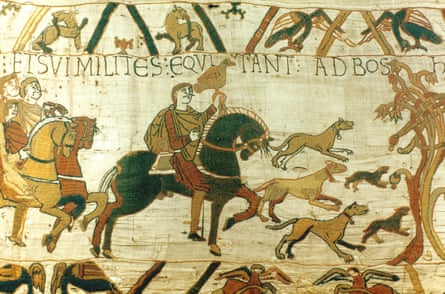
Harold Godwinson, a powerful earl, brother-in-law to Edward, and rival to William the Conqueror, appears frequently throughout the tapestry. But it’s this scene, where he’s on his way to the south coast with his followers, to which Prof Leonie Hicks, a medievalist at the University of Canterbury, is drawn.
The outfit isn’t the most interesting thing here, though; the accessory is. Hawks were a status symbol – the medieval equivalent of a Birkin or a Rolex – because “hunting with hawks was an aristocratic pursuit”. Not only that, but Harold’s also on a stallion – a Tesla or a Range Rover today, perhaps – and the stallion has a swanky saddle (not to labour the point, but think leather, heated seats).
All of this adds up to say “this is absolutely somebody who’s going to play an important part in the story,” says Hicks. He goes on, of course, to become the last crowned Anglo-Saxon king of England, until his death at the Battle of Hastings.
Count Guy of Ponthieu
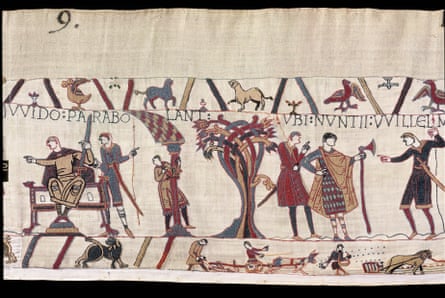
French nobleman, Count Guy of Ponthieu, is the figure in this scene with the axe, pretty tunic-style garment and stripy tights that give Main Character Energy. He is not, explains Cleaver, “somebody that we think of now as being a big part of this. But when Harold, at the start of the story, goes over into Normandy, he gets captured by Guy, who then takes him to Duke William’s.”
“He’s wearing something absolutely unique,” says Owen-Crocker: “some kind of a patterned or scaled garment” and “differently coloured, two-tone garters”. What it represents, she says, “is an attempt to make him look really fancy” but in a way that, in modern parlance, takes the mickey out of him. He was, she says, “considered to be effeminate or generally lacking in manliness”, which at the time was a reason for ridicule in ways similar to today’s manosphere.
To a modern audience he might just look like he’s mastered the art of pattern clashing. But according to Owen-Crocker, “he is a character that the designer seems to want to satirise, to make him look a fool”, and that would have been legible to a medieval audience through his outfit.
Duke William of Normandy
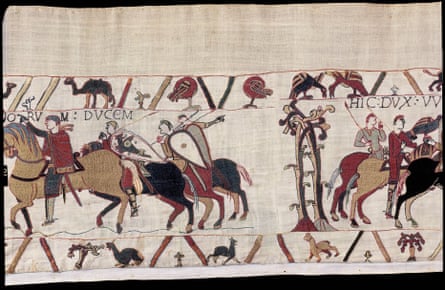
Duke William of Normandy, who goes on to become William the Conqueror, is on the far left on a great big stallion. Which tells us instantly that he means business in this tale of shifting power. (Guido, by contrast, is depicted elsewhere in the tapestry “on a mare with a donkey’s ears”, according to Owen-Crocker; the final jab “in a series of put-downs”.)
William has “got ribbons attached to his cloak … those are pretty unusual”, she continues. Apparently a Roman imperial style, this denotes power. If the ribbons weren’t enough, William’s also wearing a cloak with a gold border, a double gold belt, and spurs. “They’re all subtle indicators of relative status,” says Owen-Crocker. Even if you don’t remember your year 7 history, you might pick up that this French nobleman is going places.
after newsletter promotion
Bishop Odo of Bayeux
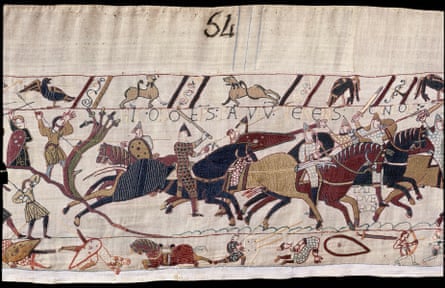
According to Owen-Crocker, Bishop Odo of Bayeux (in the centre on a black horse) is “galloping on to the battlefield to rally the troops in a heroic sort of way”. He’s wearing what Hicks describes as “really fancy armour”. There’s a good reason that might be: it’s believed the tapestry was commissioned by Odo, William the Conqueror’s half-brother, or, says Hicks, “someone close to Odo, so he wanted to be depicted in a flattering light”.
As a person, she thinks “he was quite flamboyant”, and his armour here is certainly that. While most of the other men on the tapestry wear fairly identikit chainmail, Odo looks strikingly different.
Plus, Owen-Crocker says: “His horse, in this sort of flying gallop, is one of the longest images in the tapestry. And it’s a really virile stallion, if you look closely at that part of it.” Manspreading, the medieval way; he, and his horse, are quite literally taking up space.
Archbishop Stigand
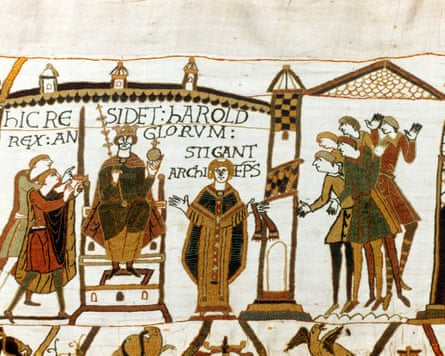
UNSPECIFIED - CIRCA 1754: Bayeux Tapestry 1067. Harold II crowned King of England, 6 January 1066. Harold enthroned holding orb and sceptre, Archbishop Stigand on his right. Anglo-Saxon Coronation Ceremony Christian Textile Embroidery Linen (Photo by Universal History Archive/Getty Images) Photograph: UniversalImagesGroup/Getty Images
“Stigand is the archbishop,” says Hicks. “On the tapestry, he’s the one who crowns Harold after Edward the Confessor dies and Harold assumes the throne.” Given that Stigand (pictured on the far right) is “in some of the sources, a very problematic character … having Harold crowned by him is a way of maybe ‘casting shade’, as the young people say.”
Nevertheless, he looks legit. He is, she says, wearing his “liturgical garments … a manacle over his left arm [a little short scarf] … his chasuble and his alb and his stole and his special pallium, which is a marker of him being archbishop”. According to Martin Bostal, director of the museum of Bayeux and expert in medieval archeology, [could you pop in a full name and a descriptor? We haven’t encountered Bostal before], “the depiction of the clergy is, in fact, quite close to what is described in texts from the period”.
Arguably most striking to a modern audience, though, isn’t Stigand’s millefeuille of liturgical layers, but his tonsured hair. It’s an unfortunate style but apparently again something that would mark him out as a member of the clergy.
Aelfgyfa
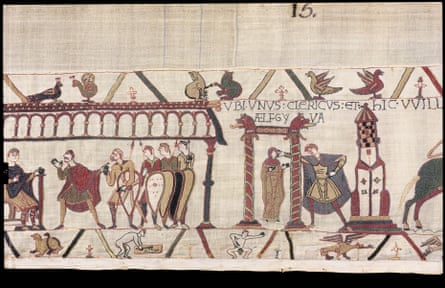
The tapestry has slim pickings when it comes to women – there are just three on the central frieze. One is fleeing a burning building with her child, another, according to Hicks, is thought to be Queen Edith, “who’s sitting at the front of Edward the Confessor’s bed as he lies dying, warming his feet in her lap”.
But Aelfgyva, who is standing under the arch here, is worthy of some attention. As Hicks puts it: “We’ve got this really weird scene with a heavily veiled woman, wearing the sort of flowy garments that women are depicted wearing in the pre-conquest artistic style.”
Frustratingly, the men around her steal a lot of thunder. “There’s a priest in secular clothing who’s touching the side of her face, and then in the bottom margin – this is the very famous bit – there’s a very prominently naked bloke mirroring the posture of the priest.” It might, says Hicks, “be a reference to some kind of sex scandal”.
But Aelfgyfa’s statement sleeves are making their own bid for attention. For Martin Bostal, director of the museum of Bayeux and expert in medieval archaeology, it seems plausible “that the tapestry is depicting the attire of the wealthy class, as such loose sleeves would be unsuitable for manual labour”.
Their material extravagance, Owen-Crocker adds, is “what you call conspicuous consumption of cloth” – using lots of not-strictly-necessary (and expensive) fabric to show off your wealth. The medieval precursor, perhaps, to today’s logo-drenched designer wear.
To read the complete version of this newsletter – complete with this week’s trending topics in The Measure and your wardrobe dilemmas solved – subscribe to receive Fashion Statement in your inbox every Thursday.
KioskNews shows a cleaned-up reading view extracted from the publisher’s page — the original always lives on their site, not ours.