Is China’s H-6K strategic bomber getting powerful jamming capabilities?
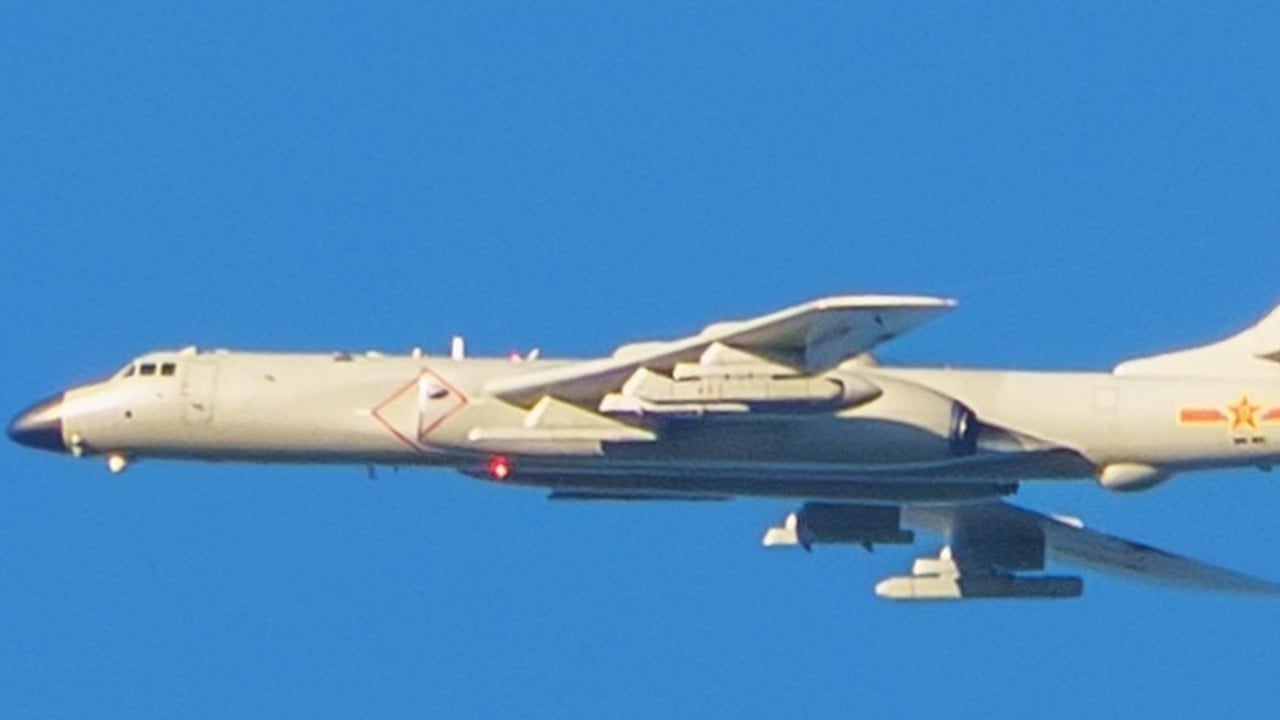
A Chinese H-6K strategic bomber has been sighted with two new electronic warfare pods used for jamming, according to images circulating on social media, potentially indicating an expansion of the aircraft’s capabilities.
The photos – which have not been independently verified – emerged on Saturday and show an H6-K in flight with the pods on two of its six pylons. They appear to be similar to the RKZ930 pods carried by China’s J-16D electronic warfare aircraft.
The location and date of the photos were not disclosed in the social media post, and it was not clear if the pods were operational or undergoing testing.
The H-6 series is the People’s Liberation Army’s only strategic bomber in service. The bombers can carry a range of stand-off cruise and ballistic missiles, including those with nuclear warheads.
Equipping the bomber with a powerful jamming pod could enable it to disrupt or confuse enemy radar during long-range bombing or patrol missions. That could potentially reduce its reliance on escort electronic warfare aircraft, according to military analysts, though they noted that the pod’s capabilities and operational status had not been verified.
Earlier variants of the H-6 series – China’s modified derivative of the Soviet Tu-16 bombers – have previously been fitted with electronic warfare pods. They include the H-6C, China’s first specialised electronic countermeasure aircraft that was active in the 1980s, and the H-6G from the 1990s.
The PLA’s legacy JH-7 fighter-bomber – production of which ended in the 2010s – has also been observed carrying electronic warfare pods during operations.
The H-6K variant, which first flew in 2007, is among the newest in the series and is a mainstay of the PLA Air Force’s long-range strike fleet. It has a maximum range of some 8,000km (4,970 miles) and a payload capacity of 12 to 15 tonnes.
Earlier this month, Chinese state media released footage of an H-6K launching a YJ-21 hypersonic anti-ship missile with an estimated range of about 2,000km and Mach 8-10 speed.
The PLA’s RKZ930 pods were developed for the J-16D, the air force’s most advanced electronic warfare aircraft that was unveiled in 2021. The J-16D is a dedicated electronic attack variant of the J-16 fighter jet and is often compared with America’s EA-18G Growler.
The RKZ930 series includes several variants with different shapes that are designed to be fitted on wingtips, under the wings or beneath the fuselage. They are believed to cover different radar frequency bands. Some variants may also be used on the J-15D, the PLA Navy’s carrier-based electronic warfare aircraft.
KioskNews shows a cleaned-up reading view extracted from the publisher’s page — the original always lives on their site, not ours.