2026 Elections: China trying to isolate Puma Shen: source
By Liu Yung-yun and William Hetherington / Staff reporter, with staff writer


China is attempting to isolate Democratic Progressive Party Legislator and Taipei mayoral candidate Puma Shen (沈伯洋) by pressuring people and businesses associated with him, a source familiar with national security cases said after a celebrity’s statement denying support for Taiwanese independence.
Television host Kevin Tsai (蔡康永) faced a backlash from Chinese authorities and Internet users after on Oct. 4 attending an event marking the opening of Shen’s campaign headquarters. Tsai on Sunday night in a post on Chinese social media apologized, saying that he had never supported Taiwanese independence.
Beijing cannot easily use the Chinese market to pressure Shen directly, so it is targeting Taiwanese entertainers and companies that attend his events or appear alongside him, the source said yesterday.
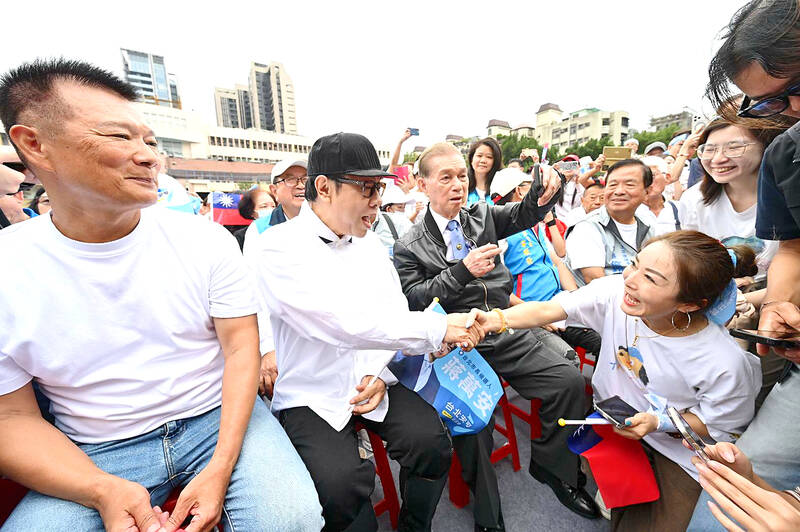
Television host Kevin Tsai, front, second left, shakes hands with a supporter of Taipei Mayor Chiang Wan-an at Chiang’s campaign headquarters opening in Taipei yesterday.
Photo: Tien Yu-hua, Taipei Times
By threatening their commercial interests, Beijing hopes to deter others from participating in Shen’s campaign and limit his ability to secure resources and support, they said.
Tsai had attended Shen’s event to familiarize himself with Shen ahead of a potential interview with the candidate, Tsai’s manager said.
However, business partners in China continued to distance themselves from Tsai.
The pressure could lead businesses and people to avoid even routine professional interactions with political figures, as the risk lies not only in what a person says but also in which events they attend and who they appear alongside, the source said.
If potential supporters become reluctant to meet a candidate, accept invitations or publicly collaborate with them because of their business interests in China, the candidate loses not only potential campaign surrogates, but also opportunities to explain their positions and attract new supporters, they said.
Beijing has said that it would target people and businesses associated with political figures, they said, citing the Chinese government’s investigation and penalties against Taiwan’s Far Eastern Group in 2021.
At the time, China’s Taiwan Affairs Office said businesses would not be allowed to make money in China while funding people it described as advocates of Taiwanese independence. It also identified affiliated companies and financial backers as targets for punishment.
Shen yesterday said the timing of Tsai’s post denying support for Taiwanese independence appeared to have been determined by outside forces, adding that it showed signs of Chinese interference in Taiwanese people’s ability to make their own decisions.
He was referring to the statement issued a day before his opponent — Taipei Mayor Chiang Wan-an (蔣萬安) of the Chinese Nationalist Party (KMT), who is seeking re-election — was slated to launch his campaign headquarters.
Tsai, who previously said he would attend the event, showed up yesterday.
Shen said that Tsai was the top trending topic on Chinese social media yesterday, adding that topics in the top three positions on the platform’s trending list were generally determined by Chinese authorities.
Regardless of whether Tsai had been directed to issue the statement, the incident showed signs of Chinese intervention, Shen said.
The interference was not necessarily in the election itself, but in Taiwanese people’s ability to make their own decisions, he added.
Chiang yesterday said he respected Tsai’s post and political position, adding that he would not accept threats against people because of their political views.
In local media, Tsai’s post was widely compared to a 2016 incident in which Taiwanese K-pop star Chou Tzu-yu (周子瑜), more commonly known as Tzuyu, issued a video apologizing for holding a Republic of China (Taiwan) flag on television.
Chiang was asked about the comparison and whether the controversy could affect his election campaign.
Chiang said he welcomed Tsai’s attendance at the opening of his campaign headquarters, adding that regardless of whether Tsai or any other citizen supports him, he respects their opinions and is committed to serving them as mayor.
Chiang also criticized the tendency to attack, boycott or ostracize people because of their differing political views.
“I absolutely will not permit or accept such anti-democratic intimidation,” he said.
Additional reporting by Tung Kuan-yi, Chang Tsai-chien and CNA
KioskNews shows a cleaned-up reading view extracted from the publisher’s page — the original always lives on their site, not ours.