Vietnam, Japan issue joint vision statement
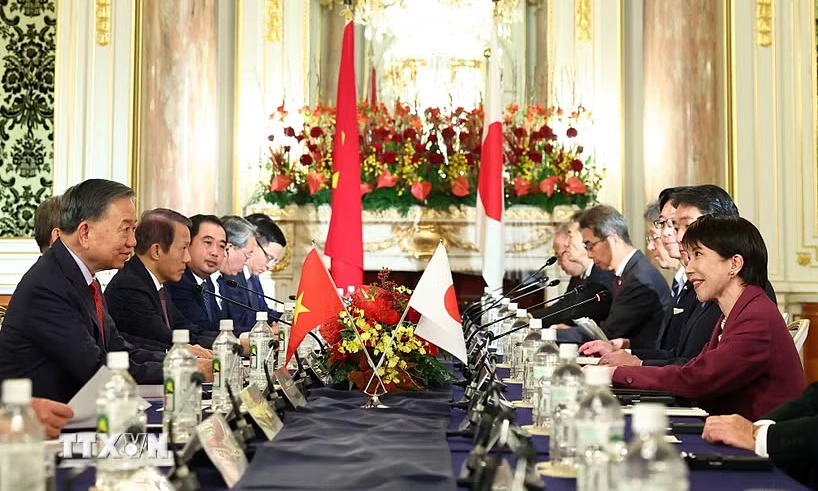
Vietnam and Japan have agreed to strengthen political trust, deepen economic connectivity, expand cooperation in science and technology, and promote people-to-people exchanges, according to a joint statement issued on Monday during Party General Secretary and President To Lam's official visit to Japan.
Against the backdrop of the increasingly complex international environment, on the basis of the new strategic vision for Vietnam-Japan relations, General Secretary and President To Lam and Prime Minister Takaichi agreed to adopt the Vietnam-Japan Joint Vision Statement to elevate the "Comprehensive Strategic Partnership for Peace and Prosperity in Asia and the World" to new heights, guided by the spirit of "Partners Advancing Together and Co-creating for Mutual Benefit, High-quality Growth, Strategic Autonomy and Resilience".
The two sides reaffirmed their commitment to maintaining high-level exchanges and contacts through channels involving their political parties, governments and parliaments, as well as local authorities and people-to-people organizations.
They also agreed to strengthen cooperation in defense, security and law enforcement, including maritime security, intelligence sharing and efforts to combat transnational organized crime. The second Vietnam-Japan Foreign and Defense Vice-Ministerial Consultation, known as the "2+2" dialogue, will take place in Vietnam in December 2026.
 |
|
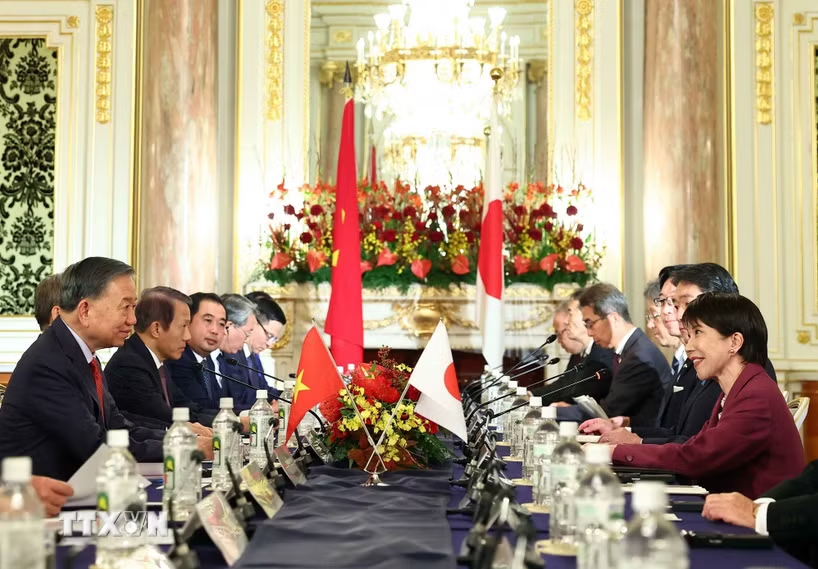
Vietnam's Party General Secretary and President To Lam (L) holds talks with Japanese Prime Minister Takaichi Sanae in Tokyo on Nov. 9, 2026. Photo by VNA |
Economic connectivity and investment
The two countries committed to strengthening economic ties based on equality, mutual benefit and closer collaboration, with a focus on four areas: science and technology and innovation; education and human resource development; production and supply chain connectivity; and finance, investment and development assistance.
Japan reaffirmed its support for Vietnam's economic development through a new generation of official development assistance (ODA), including projects in artificial intelligence (AI), semiconductors, energy security and large-scale infrastructure.
Both sides also pledged to improve conditions for businesses. Japan welcomed Vietnam's efforts to make its investment environment more transparent and predictable, while Vietnam reaffirmed its commitment to facilitating high-quality Japanese investment and enabling companies to operate and expand in the country.
The two leaders also agreed to advance cooperation in agriculture, environmental protection and energy. They called for early implementation of 15 energy projects under the Asia Zero Emission Community (AZEC), alongside Japanese-invested liquefied natural gas and gas-fired power projects.
Japan will also provide technical assistance, training and financial support for Vietnam's national energy reserves. The two countries agreed to continue cooperation in nuclear power development and explore joint projects involving critical minerals to strengthen supply chains.
In agriculture, they will continue implementing their medium- and long-term cooperation plan for 2025-2030, focusing on technology transfer, investment, food security and workforce development. Technical consultations on market access for Vietnamese pomelos and Japanese grapes are nearing completion, with exports potentially starting next year.
Science, technology and human resource development
Science, technology, innovation and workforce training were identified as key areas for deeper cooperation.
The two countries agreed to expand joint research and training in advanced fields, particularly AI and semiconductors, while strengthening cooperation between universities, research institutions and businesses.
They welcomed six joint research projects under the Japan-ASEAN NEXUS program and plans to train around 250 Vietnamese doctoral-level specialists in semiconductors. The cooperation will also support Vietnam's goal of training approximately 100 doctoral-level AI specialists by 2030.
The Vietnam-Japan University will remain a flagship education cooperation project. Both sides agreed to develop it into a regional training hub for specialized talent in advanced science and innovation, including semiconductors.
Other areas of cooperation include digital infrastructure such as submarine cables, 5G and 6G networks, satellite communications and AI-based networks. The two countries will also work together on Earth-observation satellites, data sharing and space-related workforce development.
People-to-people exchanges and cultural ties
The two leaders recognized the contributions of Vietnamese communities in Japan and Japanese communities in Vietnam to the development of both countries and their bilateral relationship.
They agreed to strengthen cooperation on labor issues and promote negotiations for an early signing of a bilateral social security agreement.
Both sides also pledged to expand cultural, educational and local exchanges through tourism, festivals, culinary events and language education. They will continue implementing the "Partnership to Co-create a Future with the Next Generation: WA Project 2.0."
The third Vietnam-Japan Local Cooperation Forum is scheduled for 2027. The two countries also agreed to designate 2027-2028 as the Japan-Vietnam Tourism Year, ahead of the 55th anniversary of diplomatic relations in 2028.
Regional and international cooperation
Vietnam and Japan reaffirmed their commitment to ASEAN's unity and centrality and agreed to strengthen the ASEAN-Japan Comprehensive Strategic Partnership.
They will also advance cooperation in the Mekong subregion, particularly in infrastructure connectivity, digital transformation, energy, human resource development and sustainable water management.
The two sides pledged to coordinate at regional and international forums, support reform of the United Nations, including expansion of both permanent and non-permanent seats on the Security Council, and promote free trade through agreements such as the Comprehensive and Progressive Agreement for Trans-Pacific Partnership (CPTPP) and the Regional Comprehensive Economic Partnership (RCEP).
Japan expressed support for Vietnam's preparations to host APEC 2027.
On the East Sea, known internationally as the South China Sea, the two countries stressed the importance of maintaining peace, stability, security and freedom of navigation and overflight. They called for disputes to be resolved peacefully and in accordance with international law, particularly the 1982 United Nations Convention on the Law of the Sea (UNCLOS).
They also called for the full implementation of the Declaration on the Conduct of Parties in the East Sea and an effective Code of Conduct consistent with international law.
Following the talks, General Secretary and President To Lam and PM Takaichi witnessed the exchange of nine cooperation documents between the two countries' ministries and agencies, covering maritime policy, the environment, energy, education, grant aid and judicial affairs.
The Vietnamese leader and his spouse are paying an official visit to Japan from Nov. 8 to 11.
Vietnam and Japan established diplomatic relations in 1973 and upgraded their ties to a Comprehensive Strategic Partnership in 2023.
Japan is Vietnam's largest provider of official development assistance (ODA) and its biggest labor cooperation partner. It is also the country's third-largest investor and fourth-largest partner in tourism and trade. Bilateral trade exceeded US$51 billion in 2025.
KioskNews shows a cleaned-up reading view extracted from the publisher’s page — the original always lives on their site, not ours.