Adam Zivo: It is in Canada’s interest to forge deeper ties with Ukraine
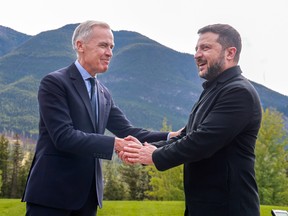
Some critics have argued that Prime Minister Mark Carney’s pursuit of an enhanced alliance with Ukraine undermines Canadian interests. In truth, investing in Kyiv’s defence puts Canada first by cost-effectively safeguarding our country in an increasingly perilous world.
Sign In or Create an Account
Consider our fragile Arctic sovereignty, for example. Both Russia and China have made clear that they want to dominate the Far North. Their ambitions are neither hypothetical nor abstract: Moscow has been rapidly expanding its Arctic military footprint, eliciting intense concern among Canadian security experts who worry about control over the Northwest Passage and natural resources.
This is why Canada has been expanding its own Arctic capabilities — including a recently announced $40-billion investment in northern military and civilian infrastructure, and another $11.3 billion to build six new icebreakers for the Coast Guard. But it will take years, if not decades, to secure our North.

Columnist Jesse Kline keeps you up to date with what’s happening in Israel and the effects of antisemitism on life here in Canada. Friday mornings.
By signing up you consent to receive the above newsletter from Postmedia Network Inc.
A welcome email is on its way. If you don't see it, please check your junk folder.
The next issue of Channel Israel will soon be in your inbox.
We encountered an issue signing you up. Please try again
Canada obviously benefits if Russia, our main Arctic rival, is militarily degraded by the Ukrainians. At the very least, it buys us precious time to fortify our territory. Alternatively, if we allow Kyiv to fall, we will have to contend with an emboldened Moscow that will have absorbed Ukraine’s now-formidable defence industry.
Canada also urgently needs access to Ukraine’s world-leading expertise on wartime drone technology and robotics. The Ukrainians are so prodigious in this realm that they dominated their NATO peers in a recent war exercise. Our military, meanwhile, lacks practical experience in deploying these assets and relies on equipment that is often obsolete and in disrepair.
Ukraine’s cost-efficient, battle-tested innovations will be indispensable for preparing Canadians for a new generation of warfare, especially because drones can be effectively deployed over vast, underpopulated territories (one need only look to Ukraine’s deep strikes inside Russia to understand their efficacy).
But western access to this knowledge will be stymied if Ukraine collapses, leaving Russia and its authoritarian allies with an enduring advantage.
The third and perhaps most underappreciated danger of Ukraine’s defeat is nuclear proliferation. For decades, western-aligned middle powers have refrained from developing their own nukes thanks to the protection of the American nuclear umbrella. Now that Washington is perceived as an unreliable ally, some may seek alternate arrangements.
Ukraine’s defeat could spur countries like Germany and Poland to develop their own nuclear weapons, and then, indirectly, South Korea and Japan. This is not empty speculation: these countries have already been debating going nuclear.
Defending our North, modernizing our military and slowing down nuclear proliferation are all worthy objectives. Supporting Ukraine cannot by itself solve these issues, but it constitutes an essential part of our security toolkit.
Canada has spent, on average, around $6 billion per year on Ukraine since 2022. That isn’t a negligible sum, but it represents only around 0.25 per cent of our gross domestic product, or about 10 per cent of the 2025-26 defence budget. This is ultimately a modest price to pay to help keep Canadians safe. National security isn’t free, after all.
Regrettably, some commentators have misrepresented these figures and, exaggerating the scale of Ukrainian aid, claimed that helping Kyiv is bankrupting Canada and that the money would be better spent on things such as homelessness, veterans and forest fire management.
They suggest that there is a strong causal link between these spending commitments, when actually they are largely parallel. Yes, Canada should spend more on its veterans and homeless, but it makes no sense to claim that Ukrainian aid — an unrelated sliver of the budget — is an obstacle to those goals.
While Canada should tackle the national deficit and debt, cutting strategic defence investments in the current global security environment would be self-sabotage. It would be better to focus on actual budgetary fat, like Canada’s extravagant and ineffective corporate welfare system, which ballooned during the Trudeau era and cost $87.7 billion in 2024.
Some critics worry that Canadian tax dollars are being stolen or squandered in Ukraine, leading to no real payoff. No one can deny that corruption is a problem, but it is less severe than often assumed.
Confidential Ukrainian state audits, which were recently publicized by the New York Times, estimated that US$1.2 billion (C$1.7 billion) was lost to fraud and waste in 2024. This sum is substantial, but represents only three per cent of Ukraine’s total military budget that year (US$40 billion). The vast majority of aid evidently ends up in the right place.
Furthermore, the harsh reality is that large government spending programs, including wars, will always breed some corruption. Profiteering and waste were endemic even during the Second World War, yet no one would argue that Washington should have abandoned Europe to the Nazis.
What matters is overall return-on-investment. Canada is made safer by sending a fraction of a percent of its GDP to Ukraine, a strategic ally. Corruption adds to the cost of business, but not nearly enough to negate the benefits of containing Moscow.
That may change should the graft worsen, but Ukraine’s anti-corruption institutions are demonstrably making gradual progress towards reform, as illustrated by consistent investigations and arrests targeting top government officials.
If we treat national security with the seriousness and cold calculation it deserves, helping Ukraine clearly puts Canada first.
National Post
Join the Conversation
This website uses cookies to personalize your content (including ads), and allows us to analyze our traffic. Read more about cookies here. By continuing to use our site, you agree to our Terms of Use and Privacy Policy.
KioskNews shows a cleaned-up reading view extracted from the publisher’s page — the original always lives on their site, not ours.