Netanyahu is guilty: His Palestinian strategy was a failure, and October 7 was the price - opinion

The approaching election should not be reduced to Prime Minister Benjamin Netanyahu’s criminal trial, judicial reform, or a coalition partner. It is about October 7, what led us there, what happened on that day, and what has happened every day since.
When we go to vote, the question we must focus on is what has happened to Israel during the years (since 2009) in which Netanyahu has dominated its politics.
And yes, October 7 stands above everything else.
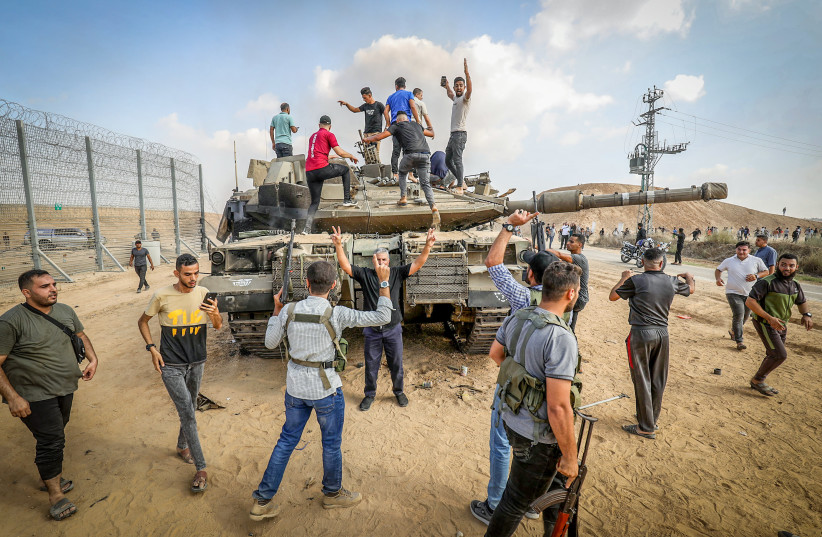
It was the greatest security catastrophe in Israel’s history. Hamas overran Israeli communities and military positions, murdered about 1,200 people, and abducted 251 into Gaza. The IDF and intelligence services made catastrophic mistakes and must be held accountable. But ultimate responsibility cannot be outsourced to generals.
October 7 was not only an intelligence failure. It was the catastrophic culmination of a political strategy. Since returning to power in 2009, Netanyahu has been determined to prevent the emergence of a Palestinian state alongside Israel. In my view, almost everything else followed from that strategic choice.
A Palestinian state meant dealing with the Palestinian Authority and confronting the issues of borders, settlements, Jerusalem, and occupation. Netanyahu wanted none of that. Instead, Palestinian division served Israeli policy.
In 2019, Netanyahu worked to bring Qatari money into Hamas-controlled Gaza as part of a strategy of maintaining the separation between Hamas in Gaza and the Palestinian Authority in the West Bank. The logic was clear: A divided Palestinian polity made a negotiated Palestinian state far less attainable. Israel could then continue saying there was no Palestinian partner.
But strategies have consequences.
The consequences of Netanyahu's Palestinian strategy
GAZA REMAINED isolated and heavily restricted for years. More than two million people lived in an enclave with extraordinarily limited movement and economic opportunity.
Long before October 7, youth unemployment in Gaza had exceeded 60%. Universities and colleges continued producing educated young people for an economy incapable of absorbing them. A generation grew up with few prospects and little exposure to the world beyond Gaza.
None of that excuses Hamas. Poverty, occupation, and hopelessness do not justify murdering civilians or taking hostages. Hamas made its own decisions and bears responsibility for its crimes.
But responsible Israeli strategy should have asked a different question: What kind of Gaza were we creating on the other side of the fence?
Instead, Israel convinced itself that Hamas could be deterred, contained, and periodically weakened while the Palestinian political question was indefinitely postponed.
That conception exploded on October 7. The tragedy is that even now the larger lesson has not been absorbed.
The Israel-Hamas War formally ended with the October 2025 ceasefire. The American-led Board of Peace subsequently developed a framework intended to remove Hamas from governing Gaza, introduce a Palestinian technocratic administration, deploy new Palestinian police and an international stabilization force, begin reconstruction, and accompany Hamas’s disarmament with phased Israeli withdrawal.
A year later, implementation remains stalled because of Netanyahu. He has rejected important elements of the American plan and insisted that Israel will not withdraw until Hamas is fully disarmed, while the Board of Peace framework envisages phased, reciprocal implementation.
The result is precisely the vacuum Israel should fear: Hamas remains in control of much of the Palestinian population while the legitimate Palestinian alternative remains largely unable to take over.
We are again preserving the conditions we claim to oppose.
AND NOW look at the West Bank.
OCHA (United Nations Office for the Coordination of Humanitarian Affairs) documented 925 checkpoints, road gates, and other movement obstacles by the end of 2025 – the highest number in 20 years – restricting the movement of 3.4 million Palestinians.
Settlement expansion has accelerated dramatically. In July, the government approved funding for 34 additional settlements, bringing the number established during Finance Minister Bezalel Smotrich’s tenure to more than 100.
Settler violence has also intensified. There have been more than 1,380 settler-related incidents of settler terrorism in the first seven months of 2026 alone. Just this week, more than 100 settler terrorists attacked the Palestinian village of Jalud, burned homes, and even injured Israeli soldiers who had arrived to facilitate a Palestinian family’s return.
Are we reproducing in the West Bank the same strategic failure that preceded October 7?
Millions of Palestinians living without a political horizon. Expanding settlements. Land increasingly inaccessible to Palestinians. Movement increasingly restricted. A weakened Palestinian Authority. Growing violence and despair. And Israeli ministers openly declaring that a Palestinian state will never exist.
You cannot permanently deny millions of people any prospect of freedom and then assume that military superiority alone will keep Israel safe.
October 7 should have taught us that.
Instead, Netanyahu’s political survival has increasingly depended on empowering precisely those forces that want to make Palestinian statehood impossible.
Itamar Ben-Gvir moved from the extreme margins of Israeli politics to become national security minister. Smotrich became finance minister and minister in charge of life in the occupied West Bank. Netanyahu did not create Israel’s far Right, but he legitimized it and placed it at the center of government because he needed its votes.
The consequences reach far beyond the Palestinian issue.
Reservists and their families have carried an extraordinary burden through years of war, while the government has continued trying to preserve broad military exemptions for haredi (ultra-Orthodox) men.
The economy has shown impressive resilience, but Israel has accumulated enormous war costs, greater debt, and reduced fiscal room for education, welfare, health, and infrastructure.
Public education is overcrowded and unequal. Welfare services are crashing. The health system is suffering from highly qualified medical personnel deciding to build their lives elsewhere.
And Israel’s international standing has collapsed to levels that should alarm anyone who cares about this country’s future. Some international criticism is unfair and hypocritical. Some ignores Hamas and the threats Israel faces. But Israel is a small country dependent on alliances, trade, technology, investment, and American support. International legitimacy is not a public-relations luxury. It is a strategic asset.
Netanyahu is unquestionably one of the most skillful political survivors in Israel’s history. But political survival is not national strategy. His great strategic failure was the belief that preventing Palestinian statehood would protect Israel from the risks of peace.
Instead, it helped preserve the conflict itself. And unresolved conflicts eventually send us their bill. October 7 was the most terrible payment.
The question now is whether we are preparing the next one in the West Bank.
ISRAEL NEEDS a completely different vision – one based not on permanently controlling Palestinians but on reaching a political settlement that enables Israel eventually to live in peace with all of its neighbors. That is not naive idealism. It is a strategic opportunity.
Across the Middle East, hundreds of billions of dollars in infrastructure, energy, transportation, technology, and trade are being planned. IMEC – the India-Middle East-Europe Economic Corridor – could eventually connect India through the Gulf and the Middle East to Europe.
Israel sits geographically at the heart of that possibility. Imagine Israel connected by rail, energy, technology, and commerce to Saudi Arabia, the Gulf, Jordan, Egypt, Europe, and India. Imagine Israeli young people growing up seeing the Middle East not only as a source of threats but as a region of opportunity.
That future will remain incomplete as long as the Israeli-Palestinian conflict remains unresolved.
The choice ahead is therefore much larger than Netanyahu. It is between continuing to manage an increasingly unmanageable conflict and finally deciding where Israel wants to go.
A secure Israel. A democratic Israel. An Israel in which citizens share responsibility. An Israel with functioning schools and public institutions. An Israel integrated economically and diplomatically into its region. And an Israel that has ended its conflict with the Palestinian people and can finally live in peace with all of its neighbors.
That is the strategic vision Israel has lacked for far too long. On October 27, we must decide that Netanyahu has to pay the bill for his failures. On October 27, we are sending Netanyahu home – out of control over our future!
The writer is the Middle East director of the International Communities Organization and the co-head of the Alliance for Two States.
KioskNews shows a cleaned-up reading view extracted from the publisher’s page — the original always lives on their site, not ours.