This is what it takes to be a judge for Guinness World Records
We independently select everything we recommend. Buying through us may earn us a commission, which supports our work.
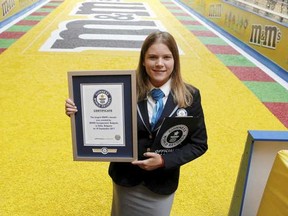
Paulina Sapinska lives in superlatives. The biggest and the smallest, the shortest and the tallest. The most, least, quickest, longest.
Sign In or Create an Account
She’s a Guinness World Records adjudicator — one of 78 people who verify records for the brand. In her 10 years of carrying that distinction, Sapinska has adjudicated hundreds of record attempts. And in doing so, she’s gained insights into the human spirit that go beyond any concrete measurement.
“I’ve learned that people are capable of achieving extraordinary things when they have the right mindset and truly believe they can do it,” she says. “While some people have incredible natural talent and skill, I’ve also seen ordinary people push themselves far beyond what they thought were their limits.”
Sapinska, who born in Toronto and lived in Canada for over two decades, recalls her experience overseeing the “farthest distance crawling under barbed wire in 12 hours” record. Eric Hutterer, at the time a 25-year-old power line worker from Alliston, Ont., set the record by crawling 12.13 kilometres (7.54 miles) on July 13, 2018.
Sapinska has also verified the “largest chain of people underwater” record, set by 182 divers in Koh Tao, Thailand, on Dec. 27, 2016. Another highlight was adjudicating the “largest Poco-poco dance” in Jakarta, Indonesia, which involved 52,121 participants on Aug. 5, 2018.
Sapinska joined Guinness World Records in 2014 as an events and project manager, organizing large-scale record attempts, live events, and public relations launches. Then in 2016, she trained to become an adjudicator.
Before she oversees an event, Sapinska meets with the organizer or would-be record breaker to review guidelines. Then, on the day of the attempt, she observes, counts, times, or measures as the record dictates. If needed, specialists help confirm the result.
“There is often a lot of pressure to deliver the result quickly, as everyone involved is eager to find out whether the record has been broken. My priority is always to ensure the result is 100 per cent accurate while delivering the result as quickly as possible,” she says.
“Once I am confident in the outcome, I prepare for the official announcement, which often involves presenting the result on stage or on video … I also have to be prepared to deliver the disappointing news that an attempt has failed.”
Ah, failure. Always a possibility but never hoped for.
Imagine crawling under barbed wire for 12 hours, maybe covered in mud like Hutterer was, and, as he told the Alliston Herald, “basically suffering from heat exhaustion.” Or Poco-poco-ing under the Jakartan sun with 52,120 other people, perhaps sweaty and cramping and miffed that someone keeps stepping on your foot.
Then, an official says the effort won’t be enshrined in the annals of Guinness for lack of a metre or a single dancer. Brutal.
But, says Sapinska, defeat today can beget victory tomorrow.
“Breaking a world record is not easy, but what I often see in people who don’t succeed on their first attempt is incredible perseverance,” she says.
“Rather than giving up, they recognize that breaking a world record is supposed to be difficult and come back to try again. In many cases, that determination eventually leads to success, and when they finally achieve the record, the sense of accomplishment is incredible.”
Guinness World Records currently oversees 71,571 active record titles. The brand originated in the U.K. after Hugh Beaver, managing director of the Guinness Brewery, got into a pub argument about what the fastest game bird in Europe was.
Unable to find an answer, he created a Guinness promotion based on settling pub arguments with a fact book. Researchers Norris and Ross McWhirter helped execute his vision, and the first book was published in 1955. Since then, more than 157 million have been sold worldwide. The 2027 edition was released on Sept. 8.
With the global reach of the Guinness brand, and travel a job requirement, Sapinska is proud to bring a Canadian sensibility to her role.
“I think Canadians are often seen as friendly, compassionate, and approachable, and those are qualities that have shaped how I approach my role as a Guinness World Records adjudicator,” she says.
“My job requires me to be extremely strict and impartial, ensuring that every official record attempt follows the guidelines. At the same time, I’ve learned how to balance those responsibilities with making people feel comfortable, supported, and respected throughout what can be a very stressful experience.”
And although she can’t attempt to break any records herself, Sapinska has one on her wish list: “If I ever had the opportunity, I’d love to attempt the ‘largest human mattress dominoes’ record,” she says.
That title is held by a mattress and furniture company called Multiflex RNC Philippines, Inc — Uratex. Its leaders invited 2,355 people to line up, each holding a mattress behind them, and domino their way into history on Oct. 22, 2023. Afterwards, and for the record, the mattresses were donated to charities.
Join the Conversation
This website uses cookies to personalize your content (including ads), and allows us to analyze our traffic. Read more about cookies here. By continuing to use our site, you agree to our Terms of Use and Privacy Policy.
KioskNews shows a cleaned-up reading view extracted from the publisher’s page — the original always lives on their site, not ours.