Lee’s approach runs risk of normalizing North Korea as a nuclear power
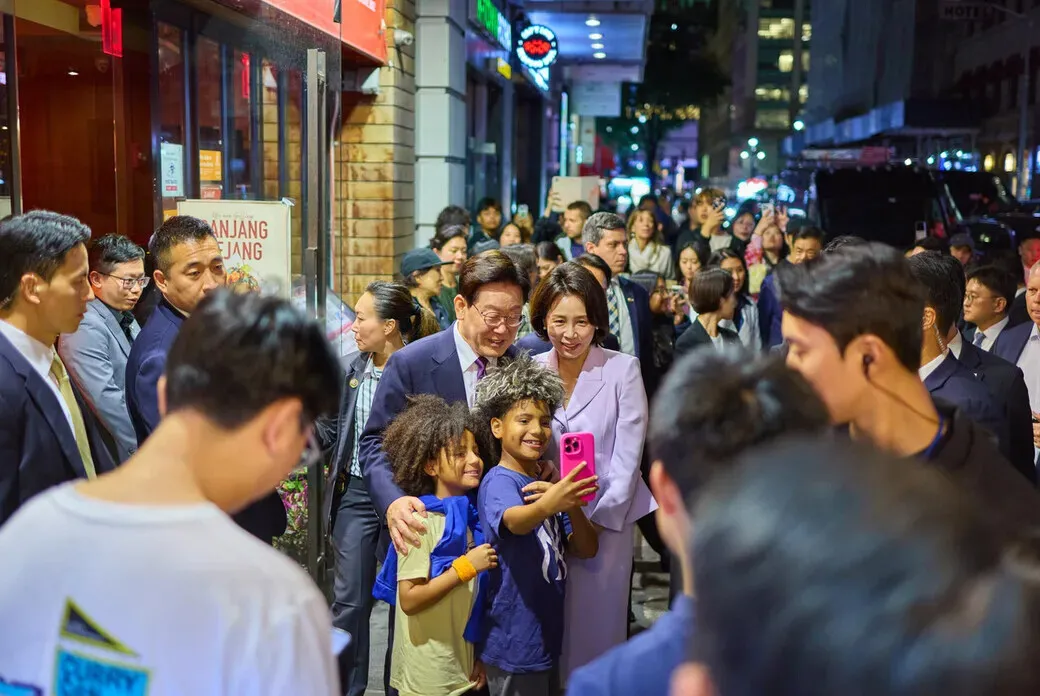
President Lee Jae Myung and first lady Kim Hae-kyung take a photo with two kids while visiting New York’s Koreatown on Sept. 21, 2026. (pool photo)
In an interview published Monday, South Korean President Lee Jae Myung stressed the need to encourage North Korea to freeze its nuclear program before attempting denuclearization.
“Aiming for denuclearization under the current circumstances guarantees that nothing will be accomplished,” he cautioned.
His remarks were interpreted as emphasizing the importance of a realistic approach amid speculation that a North Korea-US summit could happen in November. But experts also warned against allowing the pursuit of a freeze to turn into acknowledgment of North Korea’s nuclear capabilities.
Lee, who was visiting the US to attend a meeting of the UN General Assembly, spoke on the matter in an interview published in The New York Times on Monday.
“I believe there is significant value in a trade-off between sanctions — which are not particularly effective anyway — and a stop to the development of additional nuclear weapons and intercontinental ballistic missile technology,” he was quoted as saying.
He proposed an approach where the US lifts or loosens its sanctions on the North on the condition that Pyongyang agree to suspend additional production of nuclear weapons and ICBM development.
Lee stressed that North Korea must not be left to continue bolstering its nuclear capabilities.
“Our estimates suggest that North Korea is now capable of producing, or may already be producing, an additional 10 to 20 nuclear weapons each year,” he noted.
“Once it believes it has accumulated enough nuclear weapons and missiles to guarantee its survival, it will be tempted to export them to make money,” he warned.
“That will be a truly dangerous moment,” he added.
In another written interview with the Associated Press published on the same day, Lee similarly emphasized the importance of a suspension and freeze of North Korea’s nuclear program as a pathway toward denuclearization.
“To change the direction of a moving vehicle, it must be brought to a halt first,” he said.
“A phased approach of stopping, reduction and dismantlement is a practical way of effectively resolving the North Korean nuclear issue,” he continued.
He went on to say, “Given the extent to which North Korea’s nuclear and missile capabilities have advanced, it is not a realistic solution to wait until complete denuclearization can be achieved all at once.”
“This is because, in the interim, North Korea’s nuclear capabilities will continue to advance, escalating the threat,” he explained.
Lee had previously shared a three-stage roadmap of a nuclear freeze followed by reductions and eventual denuclearization in an August 2025 interview published in Japan’s Yomiuri Shimbun. His argument was that an emphasis on denuclearization should not be allowed to lead to an outcome where North Korea is effectively left to bolster its nuclear capabilities.
Lee’s interviews appeared at a time when a US-China summit was scheduled to take place this Thursday, with speculation on the possibility of a North Korea-US summit in November.
Speaking to The New York Times, he questioned what options remained besides diplomacy, stressing that Seoul and Washington were both willing to pursue dialogue with Pyongyang without conditions. He also indicated his intention to play a peacemaker role in the rumored North Korea-US summit in November.
Experts praised the pragmatism of Lee’s approach to the North Korean nuclear issue but stressed the need for caution.
Should Washington offer sanctions easing and relief in exchange for Pyongyang freezing the development of its ICBMs, it could lead to a situation in which North Korea is effectively recognized as a de facto nuclear-weapon state, while South Korea continues to face the threat posed by its short- and medium-range missiles.
“The president’s remarks appear to me as priming the pump for US-North Korea talks by bringing North Korea into the conversation ahead of the US-China summit,” Cho Seong-ryoul, a visiting professor of military studies at Kyungnam University.
“In actual negotiations, North Korea should not be allowed to trade a halt to ICBM development for sanctions [relief]; there needs to be a broader plan to reduce the overall nuclear threat,” he suggested.
Lee Byong-chul, a professor at the Institute for Far Eastern Studies at Kyungnam University, stressed the need to “definitively remove” the threat posed to South Korea by North Korea’s tactical nukes and hypersonic missiles, alongside the halt in ICBM development sought by the US.
Some observers suggest that sanctions against North Korea should not be taken lightly, considering that China continues to uphold the sanctions regime and North Korea itself is seeking the removal of sanctions for the sake of its own economic development.
“Sanctions remain an important tool for easing the security threat posed to South Korea by North Korea’s nukes and conventional weapons,” one former senior foreign affairs and security official told the Hankyoreh.
As for the issue of a potential deployment to the Strait of Hormuz, Lee told The New York Times that South Korea’s Constitution prevented him from sending troops to a war already underway between foreign countries.
During a press conference on Friday, Lee told reporters that there “will be no deployment to a war.”
Lee had further expressed that US President Donald Trump’s abrupt decision to unilaterally reduce the joint Ulchi Freedom Shield drills last month came “somewhat unexpectedly.” At the same time, he said, it was an intentional measure meant to send a clear message to Pyongyang that the US has no ill will toward North Korea.
By Seo Young-ji, staff reporter; Park Min-hee, senior staff writer
KioskNews shows a cleaned-up reading view extracted from the publisher’s page — the original always lives on their site, not ours.