Lost, Looted, Crumbling: The Vanishing Temple Murals of Yu County
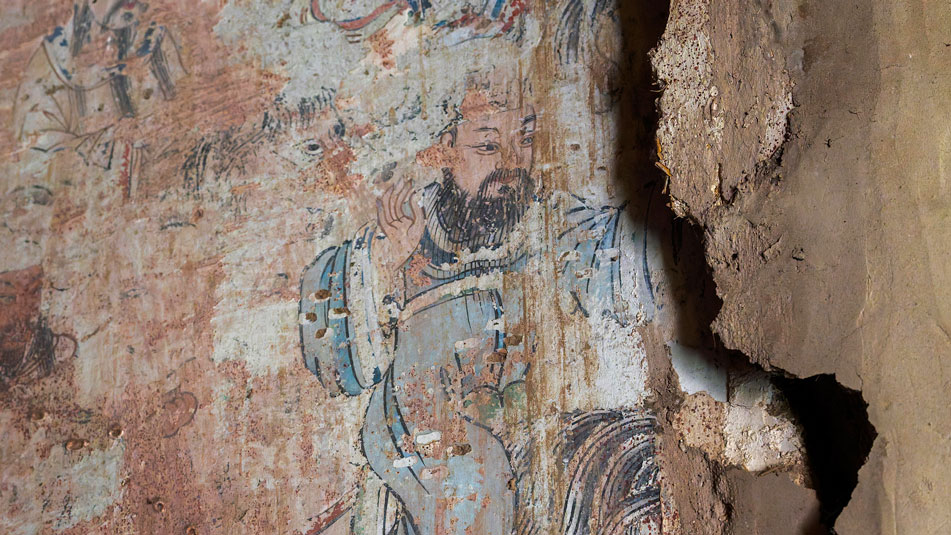
A Chinese county known as the home of over 400 temple murals dating back to the Ming dynasty (1368–1644) is facing a heritage restoration crisis, with many of its murals stolen, destroyed, or marred by thieves.
In an investigation published Wednesday, Shanghai-based news outlet The Paper visited 16 fortified villages in Yu County in the northern Hebei province and found that many of the area’s temple murals had been stolen, destroyed during temple collapse, or weathered beyond recognition. Remaining fragments often bore looters’ cut marks.
A major cultural relic hub, the county served as a military and commercial crossroads during the Ming and Qing dynasties (1644–1911) and is home to more than 1,600 registered cultural heritage locations, including numerous fortified villages. The accompanying temples feature murals depicting Taoist, Buddhist, and folk religious elements.
Danhou Village — inscribed on China’s official list of traditional villages in 2016 — is one of the county’s most popular tourist destinations. The village’s Guandi Temple was once home to extensive murals, but only fragments remain today.
When The Paper visited, the temple was under renovation for leaking roofs, missing wooden components, and cracked walls after years of neglect. Work began in April and is projected to be completed by the end of the year.
Of the 16 villages The Paper visited, only those officially considered “traditional villages” or protected sites received restoration and care. The report noted that overall neglect of the fortified villages stems from their abandonment, as villagers have mostly lived outside the sites since the 1980s, leaving the buildings to decay.
A member of the county’s cultural relics management office told The Paper that he recently inspected a temple on a visit to his hometown.
“I went there around noon, and the wall was still standing,” he said. “But at around 2 p.m., I got a call saying the western wall of that temple had collapsed. If I had gone any later, I might have been buried under it.”
Another obstacle to upkeep is funding. Under China’s cultural relics law, their owners or users must preserve them, with government subsidies provided where possible. But in Yu County, most low-level relics are owned by villages that can’t afford maintenance, placing the burden on the county.
The cultural relics worker described how every village has an appointed relic steward, but with no subsidy budget, the role falls to village cadres as an additional duty. With heavy workloads and no stipends, protection relies on individual goodwill.
Yet government investment has been considerable. Over a decade ago, Yu County built a 12,000-square-meter museum for 10,000-plus movable relics, free to the public, costing the county nearly 4 million yuan ($600,000) annually. In 2023, state and provincial funds for restoration projects totaled 14.6 million yuan.
Despite the investment, Yu County’s neglected relics expose gaps in China’s heritage architecture protection, a problem that it has been working to solve in recent years.
In July 2024, the Finance Ministry created a lottery-funded program for unlisted ancient buildings. Upon submitting a proposal, local authorities whose heritage architecture and restoration projects are deemed to serve the public good are given priority. The program will run through 2027.
Editor: Marianne Gunnarsson.
(Header image: Murals at an ancient temple in Yu County, Hebei province, June 20, 2026. VCG)
KioskNews shows a cleaned-up reading view extracted from the publisher’s page — the original always lives on their site, not ours.