2026 Elections: KMT supporters mobilizing quietly, lawmaker says
By Lin Hsin-han and William Hetherington / Staff reporter, with staff writer


Democratic Progressive Party (DPP) Legislator and Taipei mayoral candidate Puma Shen (沈伯洋) has dominated the campaign narrative over the past month, but has also galvanized opposition supporters to mobilize quietly, a Chinese Nationalist Party (KMT) lawmaker said.
“Ocean Wave (洋流)” — a play on the last character of Shen’s name, which means “ocean” (洋), emerged last month as Shen campaigned, quickly becoming a dominant theme, KMT Legislator Lee Yen-hsiu (李彥秀) said.
KMT and Taiwan People’s Party (TPP) supporters did not disappear, but went quiet and were working behind the scenes, Lee said.
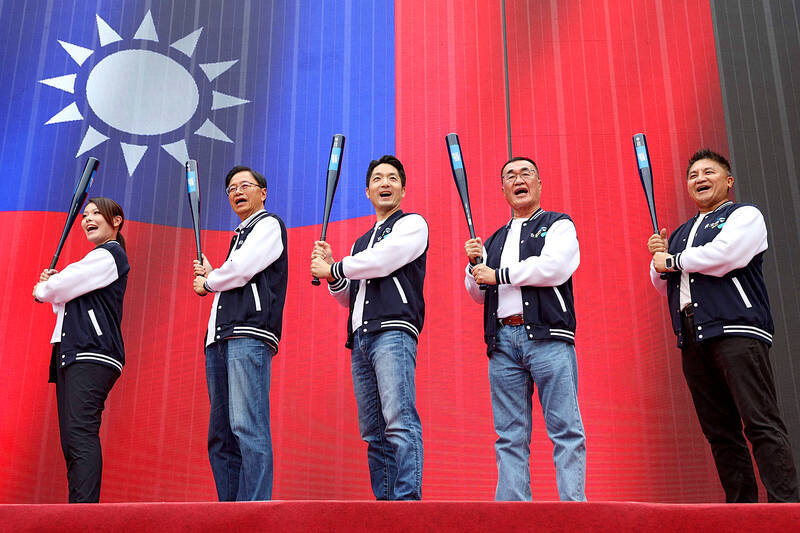
From left, independent Hsinchu Mayor Ann Kao, and Chinese Nationalist Party (KMT) Taoyuan Mayor Simon Chang, KMT Taipei Mayor Chiang Wan-an, KMT New Taipei City Mayor candidate Lee Shu-chuan and KMT Yilan County commissioner candidate Wu Tsung-hsien pose with baseball bats in front of a Republic of China flag during the opening ceremony of Chiang’s campaign headquarters in Taipei yesterday.
Photo: I-hwa Cheng, AFP
Shen’s Ocean Wave has heightened opposition supporters’ sense of urgency, she said, adding that the relative silence of KMT and TPP supporters was also reflected in Taipei mayoral election polls.
KMT Taipei Mayor Chiang Wan-an’s (蔣萬安) supporters are calling friends and relatives to solicit votes and sharing messages in online groups to urge people to vote, a marked departure from their previously more passive attitude, she said.
The greatest impact of the Ocean Wave was in Taipei, with its influence diminishing as it spread to other administrative regions, she said.
DPP candidates in other administrative regions naturally wanted to capitalize on its popularity, but were also concerned about a possible backlash, she said.
Elections are similar to marathons, with the first candidate to cross the finish line on Nov. 28 emerging as the winner, Lee said.
With a month remaining before voting day, the greatest advantages of Chiang were his personal qualities, charisma and record in office, she said, adding that she believed Taipei voters would make the smartest choice.
The rapid rise of the Ocean Wave is a case study in campaign strategy, said Chang Yuan-hsiang (張元祥), an adjunct assistant professor in Soochow University’s Department of Political Science.
Despite the unfavorable political landscape for his party in Taipei, Shen has had the momentum, combining scrutiny of municipal governance with digital media and large public gatherings, Chang said.
The movement had also disrupted Chiang’s re-election campaign, he added.
Although the Ocean Wave has downplayed Shen’s previous emphasis on resisting China and defending Taiwan, his personal stance and public image remained clear, Chang said.
Beyond criticism of municipal governance, the movement’s core driving force is the momentum generated during last year’s mass recall campaign, he said.
The Ocean Wave has made a major impact on online discussions, news coverage and opinion polls in a short period, prompting KMT supporters facing unfavorable political conditions to conceal or suppress their views in what is known as the “spiral of silence,” Chang said.
The Ocean Wave resembles the “bandwagon effect” in elections, he said, adding that the outcome on Nov. 28 would depend on whether the wave’s momentum translated into actual voting behavior.
Hostility among supporters of the DPP and the KMT-TPP alliance remained high, meaning their willingness to vote would likely be strong, Chang said.
However, centrist voters are increasingly weary of political turmoil and therefore less inclined to vote, he added.
Next month’s local elections would still largely be a contest between the parties’ established support bases, Chang said.
KioskNews shows a cleaned-up reading view extracted from the publisher’s page — the original always lives on their site, not ours.