New Google Maps images reveal massive scale of devastation in Gaza
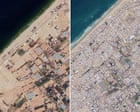
An update to Google Maps has revealed the extent of devastation during the three-year Gaza war and the severity of the continuing humanitarian crisis faced by the territory’s 2.3 million inhabitants.
The images were taken in June this year and show further destruction of homes, businesses, places of worship and infrastructure since a fragile ceasefire came into effect almost 12 months ago.
They show huge tented camps lining much of the shoreline, often within a few metres of the sea. Gaza’s once busy main port, now badly damaged and empty of fishing boats, is surrounded by makeshift accommodation. Any available open space in Gaza City is packed with shacks, tents and huts.
The images also show massive damage to northern towns such as Beit Lahiya and Beit Hanoun, as well as the destruction of places of worship such as the Istiqlal mosque in Khan Younis. Major neighbourhoods in Gaza City such as Jabaliya and Shuja’iya, which were targeted in repeated Israeli offensives, are clearly now uninhabitable.
Swaths of rubble are visible in the south of Gaza, where a wide strip appears to have been cleared by Israeli forces along the border with Egypt. The town of Rafah appears to have been almost entirely reduced to rubble and Tel al-Sultan razed to the ground.
More than 2.1 million displaced people are living in tents and temporary shelters in Gaza, where about 82% of structures – roughly 200,000 buildings – have been damaged, with about two-thirds of those destroyed, according to the UN agency for Palestinian refugees, Unrwa.
A recent UN assessment estimated that the number of destroyed structures across Gaza had increased by 9% since the declaration of a ceasefire in October 2025.
“The estimate of the total amount of rubble in Gaza is 61m tonnes. It is approximately 20 times the amount of rubble generated in all wars across the world over the last 18 years,” Jaco Cilliers, the UN Development Programme’s special representative in Palestine told the Guardian last month. The presence of human remains still buried under the rubble remains one of the most urgent humanitarian problems.
More than 74,000 Palestinians have been killed in Gaza since the start of the war, mostly civilians. The conflict was triggered by a surprise attack by Hamas into Israel in October 2023, in which militants killed about 1,200 people, mostly civilians, and took 251 others hostage.
KioskNews shows a cleaned-up reading view extracted from the publisher’s page — the original always lives on their site, not ours.