Wildlife arrives on time at rewilded chalk grasslands built along HS2 route
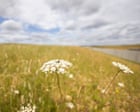
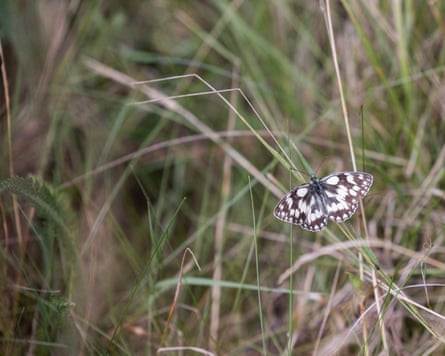
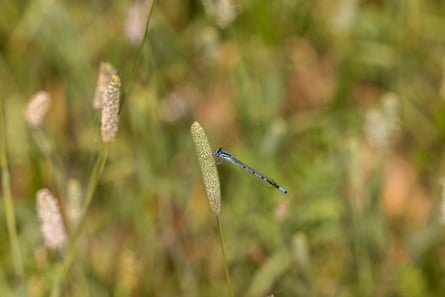
The air is scented with the sweet tang of ladies bedstraw and made musical by skylark and blackcap song. An abundance of marbled white butterflies, small skippers and common blue damselflies dart over the flowering knapweed, yarrow and wild carrot.
That the largest chalk grassland in the Chilterns is full of wildlife may not surprise you. But the fact that it is completely artificial, only four years old and has been built by the much-maligned HS2, may do.
The Western Slopes “rewilding” project is due to open to the public next year on land beside the high-speed railway as it dives under the M25 and into a 10-mile tunnel beneath the Chilterns. The trains may be running late, but the wildlife has already arrived.
A decade ago, this area was a vast wheatfield with precious little biodiversity. Today, as the construction effort winds down, more and more of the 127-hectare site is being turned into wildlife-rich grasslands, wet meadows, ponds and small woods.
It is now one of the largest wildlife habitat creation projects in south-east England, and has already witnessed the arrival of hedgehog clover, which hasn’t been recorded in Hertfordshire since 1878, alongside water voles, lesser emperor dragonflies and pyramidal orchids.
The transformation began when Matt Hobbs, lead ecologist at Jacobs, was invited to take a look at the huge planned HS2 works around the south entrance to the Chilterns tunnel.
“I asked the engineer: ‘What’s coming out of the tunnel?’ When he said ‘chalk’, it was like a lightbulb moment. I thought, I know what I’d like to do with that chalk,” said Hobbs, who has designed and overseen the Western Slopes project for HS2.
Chalk grassland is one of the most wildlife-rich habitats in southern England because a wide range of wildflowers flourish on its thin, nutrient-poor alkaline soils, alongside an array of associated invertebrates, including rare moths and bees.
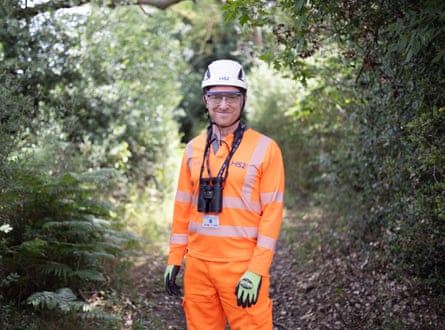
According to Hobbs, the valley slopes could have been expensively restored to arable land by HS2, as much of the land temporarily taken for the huge construction effort will be. “We saw the opportunity to do something different,” he said. “This project is unique. The whole landscape was predicated on what’s the best thing to do with the earthworks and soils. We’re not moving any soils or material off site. Any concrete waste from this site is crushed and used as aggregate under the grasslands.”
Reusing 10m cubic metres of chalk, topsoil and subsoils from the construction effort in the immediate vicinity of the tunnel mouth has also drastically reduced CO2 emissions, and the construction traffic that dumping it elsewhere would have entailed.
According to HS2’s calculations, the wildlife grasslands here could sequester 7% of the carbon impact of the whole high-speed line’s construction, because grassland is much better at storing carbon than regularly-ploughed arable land, which releases carbon every time it is ploughed.
Over the past four years, all the chalk excavated from the tunnel has been sculpted into rolling “downs” on the land above the Colne Valley, creating varying topsoils and a future mosaic of grassland, scrub, woodland and ponds and wet areas.
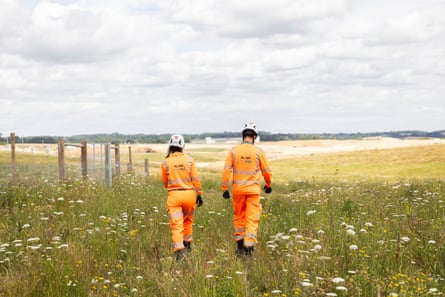
It took the ecologists a bit of effort to retrain the digger drivers who were spreading the chalk over the site. Groundworks teams are trained to leave everything beautifully smooth and neat, whereas the ecologists were seeking topographical variation, with dips, hollows and “untidy” rough areas.
The future vision is a “wood pasture” landscape, inspired by rewilding sites such as Knepp in West Sussex, where a mixture of scrub and wildflower glades are grazed by herbivores.
Four cattle-grids have been installed on roads – believed to be the first in Hertfordshire – to enable free-roaming cattle to graze within four separate compartments.
“They were really key to the project. We wanted to have that Knepp rewilding technique where you have cattle that can move anywhere they want within the site – it’s brilliant for soil health, soil carbon and dung beetles,” said Hobbs.
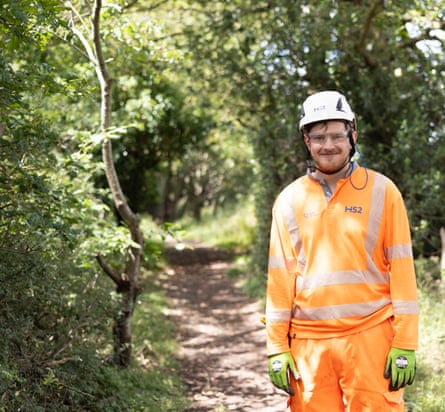
Luke Craner, a senior landscape clerk of works for the HS2 contractor Align, said: “I’m really keen to get livestock grazing sooner rather than later so we can kickstart biological processes. We’ve already got a really good grassy sward establishing. We want natural regeneration to occur, because it’s always much more beneficial for wildlife. We’ve already got loads of hawthorn and quite a few oaks coming up. It’s already going out nicely.”
Later this summer, green hay from other calcareous grassland in the local area will be spread on the Western Slopes to bring in more invertebrates. As ant populations develop, rare butterflies including the Adonis, chalkhill and small blue are likely to arrive, with these species interacting with ant colonies. There is also a mammal shelf built into a culvert beneath the railway, enabling badgers, stoats and other mammals to safely cross the high-speed line.
Some footpaths through the site are set to be opened up in the next 18 months, although the western portion of the site is likely to remain protected from public access to boost the ground-nesting birds – from skylarks to little ringed plover – that have quickly colonised the land.
While HS2 is still under construction, the forthcoming track-building and electrics phase will require a much smaller construction footprint, enabling the nature areas to be expanded.
At the bottom of the slopes, beside the River Colne, nearly five hectares of new wetlands have been established. These pretty ponds have been rapidly colonised by club-rush, water mint and sneezewort, as well as breeding reed warbler and lesser emperor dragonfly.
“We’ve definitely extended the population of kingfishers,” said Craner, who has also recorded new sightings of water vole on a tributary of the Colne. “Water voles are a massively declining species because of habitat loss – we’ve put in habitat that’s good for water voles. They’ve colonised it immediately.”
What Craner has noticed is the changing soundscape. While the roar of the M25 and the clank of ongoing construction is never far away, in certain glades the human din is now overwhelmed by birdsong and insect hum.
“We didn’t have this harmony last year and all of a sudden it’s never silent,” said Craner. “This is our hidden gem.”
KioskNews shows a cleaned-up reading view extracted from the publisher’s page — the original always lives on their site, not ours.