Poland is racing ahead with military spending – but will it help or damage its economic growth story?

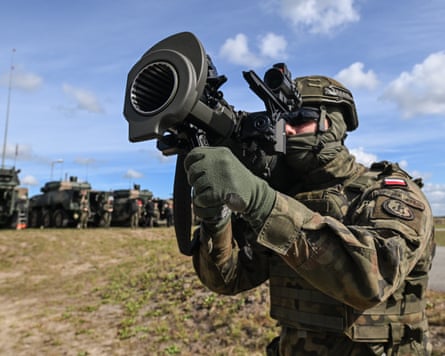
A short distance north from Warsaw along the Vistula river, camouflaged missile launchers roll through the quiet village of Czosnów.
As recently as two years ago, their destination – a hi-tech weapons facility opened this month – had been a cornfield. Now, as Poland drives up defence investment at one of the fastest rates in the developed world, this rural spot has been transformed amid Europe’s response to Russian aggression and US disengagement.
“Everyone has had to move twice as fast to meet the Polish needs,” says Jim Price, the managing director of MBDA Polska, the local subsidiary of the European multinational arms group. Based in the UK, the former Royal Marine says Poland is shifting from importing its weapons to manufacturing them at home.
“When it became clear there is a need to defend Nato’s eastern flank, in the event of a war itself, they needed to be able to do things in the blink of an eye. So we decided to invest in-the country to create a facility. We had to build up our Polish subsidiary – and that means Polish jobs.”
Poland’s defence budget has grown at a blistering pace. Since Vladimir Putin ordered Russian troops into Ukraine almost five years ago, spending as a share of Polish gross domestic product (GDP) has more than doubled from 2.2% to 4.8% this year. In cash terms, this equates to $53bn (£39.8bn), the fourth-highest in the EU after Germany, France and Italy.
Attention in Warsaw is clearly focused on the risk of an imminent Russian test of Nato resolve. However, there is also another motive: growing the economy.
Inside the soundproofed, airlock-style doors enclosing his office in Warsaw, Marcin Bosacki, Poland’s deputy foreign minister, says Russian aggression is heavily influencing the Polish government’s plans for economic development and cooperation with EU and Nato allies.
“[It] is clearly benefiting Polish security; Polish defence, and the Polish economy as well,” he says.
Strengthening economic ties in the pursuit of military readiness would discourage Putin (“a traditional Russian imperialist”) from attacking Nato, Bosacki adds.
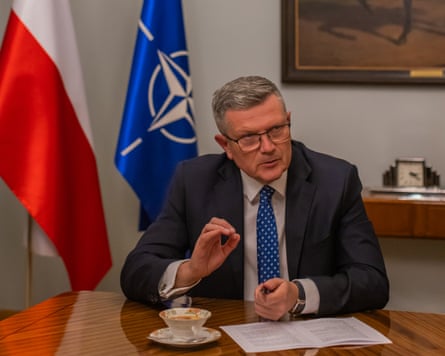
“The only thing which Putin understands is solidarity and power. And so the more we are united and strong, the less likely the outcome of more aggressive Russian provocations against Nato member states is.”
Hope remains for a diplomatic solution. This month, Donald Trump’s envoys Steve Witkoff and Jared Kushner held talks in Moscow with Putin and in Kyiv with the Ukrainian president, Volodymyr Zelenskyy. Next month, further negotiations are scheduled in Abu Dhabi.
However, diplomatic sources believe Russia is unlikely to cede ground – rendering Nato’s demonstrations of military readiness critical.
History shows defence and economics are closely intertwined. Statisticians first devised GDP as a metric in response to the 1930s Great Depression and needs of wartime planning to gauge the capacity of an economy.
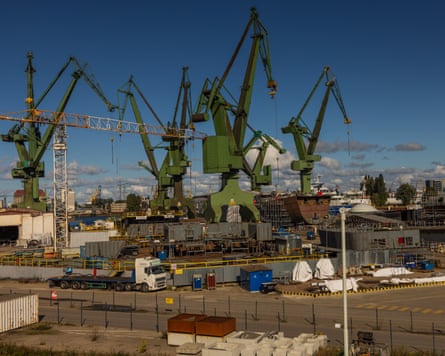
Poland has been through an economic miracle since the Solidarność (solidarity) movement that arose from the Gdańsk shipyard strikes paved the way for its transition from communism almost four decades ago. Living standards have shot up from 40% of the EU average in the mid-1990s to 81% last year.
Joining the EU in 2004 and securing catch-up funds from Brussels – which was spent on new roads, railways, and other productivity-enhancing infrastructure – also helped. Annual output surpassed $1tn (£755bn) last year, with Poland among the fastest-growing EU countries at an annualised rate of 3.9% in the second quarter despite the global headwinds caused by the Iran war.
However, Poland’s defence boom is not cost-free. Nor has economic development helped it avoid political polarisation.
The rising military budget is among the reasons why Poland is predicted to run the biggest fiscal deficit in the EU next year, at 7.1% of GDP. Last week, Moody’s downgraded the country’s long-term sovereign credit rating to the lowest level since 2002, amid an apparent lack of willingness to rebuild fiscal buffers.
Leszek Kąsek, a Warsaw-based economist at ING Bank, said: “This path is not sustainable. You should ask people if Poland can maintain its growth story and whether politicians will be ready to adjust?”
Wedged between larger neighbours it has been subjugated twice within living memory, Poles are uneasy about national security. But despite its economic turnaround under EU membership, and as it secures billions of euros in defence funds from Brussels, support for Eurosceptic politics remains.
In the run-up to the general election next year, the defence of the country, support for Ukraine and EU relations will be highly politically charged.
Outside the foreign ministry in Warsaw, protesters wave placards in a “Poles for peace” nationalist rally, organised by rightwing politicians opposed to the EU and its support for Ukraine.
Inside the building’s marble halls, where the Polish flag appears to be positioned next to those of Nato and the EU at almost every opportunity, Bosacki says divisions over the benefits to Poland of membership to both institutions has emerged for the first time.
after newsletter promotion
This year, Poland’s president, Karol Nawrocki, who has backing from the rightwing Peace and Justice party, attempted to block the Polish prime minister Donald Tusk’s liberal, pro-EU government from accessing €44bn (£38bn) of defence investment loans approved under the bloc’s security action for Europe (Safe) programme.
“I think our right is so eager to regain power they will use anything,” Bosacki says. “Here for the first time, the opposition was [against doing] something which, in my opinion – and the opinion of the majority of Poles – is clearly benefiting Polish security, Polish defence and the Polish economy as well.”
Through Safe, Warsaw secured the largest single disbursement in the loan programme. The government has pledged to channel almost 90% of it to domestic industry – led by Polska Grupa Zbrojeniowa (PGZ), the state-owned defence conglomerate.
However, in the race to build up capacity, the tills are ringing for US-arms manufacturers supplying Patriot missiles, Abrams tanks and F-35 fighter jets.
In March, the International Monetary Fund cautioned that the positive economic spillovers from EU defence investment would not necessarily flow for the governments taking out their chequebooks.
However, Warsaw is doing defence deals with international partners, including the UK, to help develop its domestic manufacturing base at the same time as building military readiness.
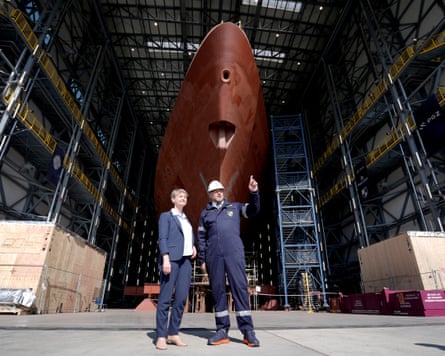
The British defence group Babcock is working with PGZ to help build a fleet of new frigates. Known as the Miecznik, or swordfish, programme, the company has a shipyard at Gdynia on the Baltic coast. The first ship was launched this summer by Tusk.
“It’s a must for Poland, basically, to invest more. But they want to do it in a smart way,” says Andrzej Maciejewski, Babcock’s country director for Poland, who is based in Warsaw.
“We’re addressing this ambition – that these great investments in defence will bring greater value for money and, in the longer run, these capabilities.”
BAE Systems is partnering with the PGZ subsidiary Mesko, which makes ammunition and rockets, to build an artillery plant in Poland’s old southern industrial heartlands near Katowice.
By 2028, Poland plans three new munition factories. During a visit to the Mesko facility in August, Tusk said figures for 2023 showed Poland was capable of producing only 5,000 rounds of 155mm ammunition – a Nato-standard artillery shells. “More is used in one day on the Russian-Ukrainian front,” he said. This year, Poland will have increased production to 30,000 rounds, with a goal of 200,000 a year in the next two years.
This month, Luke Pollard, the UK minister for defence readiness, visited Czosnów for the opening of the MBDA facility. Pollard said it would help support jobs in both countries, including in Bristol, Stevenage and Bolton.
Despite this, Britain is increasing defence investment at a slower pace. The government has committed to increase spending from 2.3% of GDP last year to 3%, but has not spelled out precisely how or when this will be achieved.
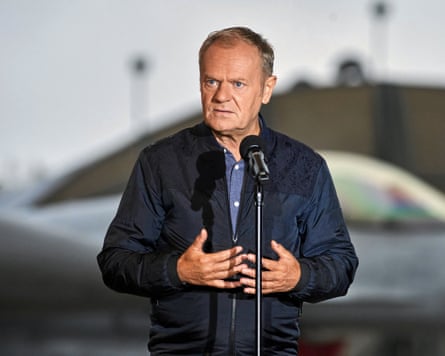
In Poland, there are signs its investment spree is beginning to pay off for local contractors.
Maciej Klemm, the co-founder of Advanced Protection Systems (APS), which builds counter-drone systems in Gdynia, has increased its headcount from about 150 staff to 200 this year.
Amid growing Russian drone incursions into Polish airspace, APS is playing a role in the Warsaw’s $4bn San programme to build an “anti-drone wall” to protect the country’s eastern flank.
“We are spending a lot of money as a nation, and we are almost a poster child for it,” Klemm says. Splitting his time between Poland and the UK, where he still lives with his family after graduating from the University of Bristol in the 2000s, Klemm also sums up Poland’s recent economic history.
“I was moving to Britain at the time there was a big wave of Poles coming over here. Now after Brexit, that wave partly receded and went the other way. Now, companies like ourselves and others are showing we have technical talent; we can build on this, and grow companies in Poland.”
KioskNews shows a cleaned-up reading view extracted from the publisher’s page — the original always lives on their site, not ours.