Trump rolls out the red carpet for Xi as high-stakes summit begins
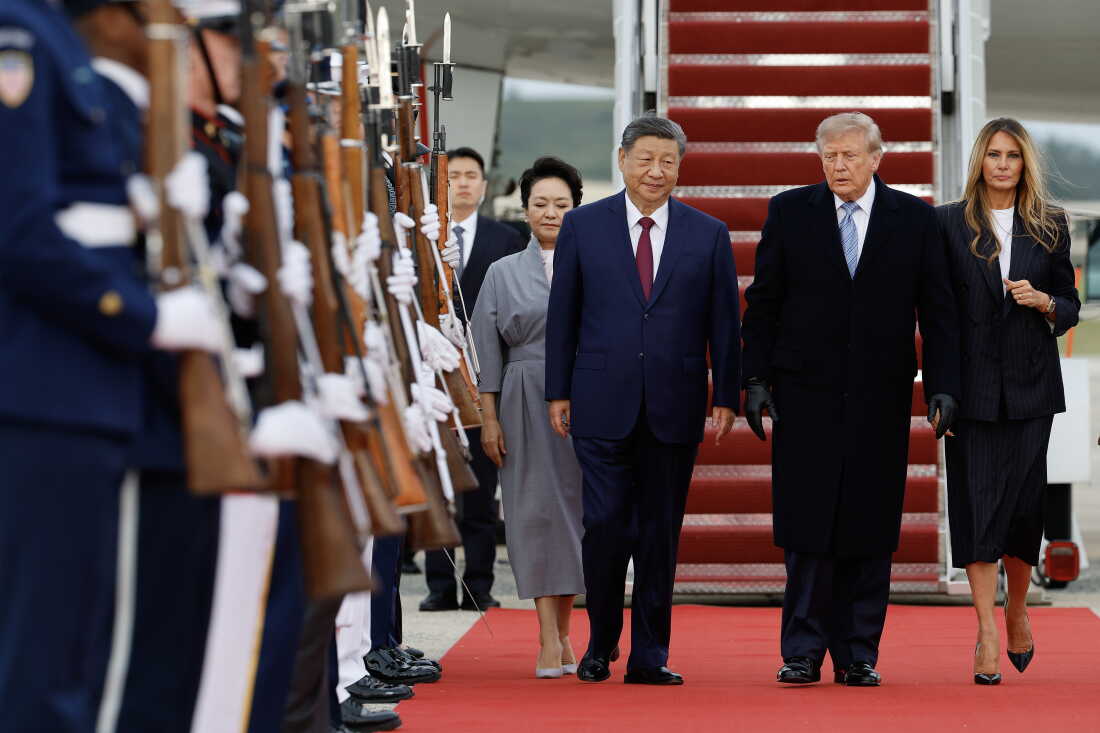
(L-R) First lady of China Peng Liyuan, Chinese President Xi Jinping, U.S. President Donald Trump, and First Lady Melania Trump walk on the red carpet during an arrival ceremony on September 23, 2026, at Joint Base Andrews, Maryland. Chip Somodevilla/Getty hide caption
toggle caption
Chip Somodevilla/Getty
WASHINGTON — President Trump has taken rare measures to ensure that Chinese leader Xi Jinping and his delegation, including Chinese First Lady Peng Liyuan, are hosted with the pomp of the highest order for VIPs making a state visit to Washington.
On Wednesday, Trump personally welcomed Xi at Joint Base Andrews when the Chinese leader landed, with a state arrival ceremony featuring 479 military personnel and a multi-aircraft flyover. Later today, Trump plans to host a state dinner for Xi and Peng that, according to a senior U.S. official, will include American executives including Tesla's Elon Musk, Amazon's Jeff Bezos, Google's Sundar Pichai, and Nvidia's Jensen Huang.
"Trump will show Xi courtesy and respect. The symbolism will account for a large amount of the substance of the visit," said Ryan Haas, Director of the China Center at the Brookings Institution. "The summit is designed to signal that Trump and Xi have a strong relationship, and through that relationship, the two leaders can manage differences within mutually tolerable bounds."
In between the various ceremonies, the two leaders will hold a tightly scheduled day of meetings where Trump and Xi are expected to talk about artificial intelligence, rare earths, trade and geopolitics such as Iran and Taiwan.
On the AI front, Treasury Secretary Scott Bessent said Sunday that Washington and Beijing are discussing ways to warn each other about AI incidents that pose national security risks. AI executives in the U.S. have warned each other in recent weeks to slow down their development of the technology in order to ensure public safety. In a response to Anthropic CEO Dario Amodei's essay titled "We Must Pace the Frontier," a spokesperson for China's government dismissed the proposal as unfair, accusing the call for safety rules as an attempt to hold back Chinese competition.
For its part, China's AI industry is backed by hundreds of billions in state-led funds and a government that has said that AI-powered technology should permeate 90% of China's key industrial sectors by 2030.
Iran on the agenda
Xi's state visit this week comes as the U.S. continues a months-long naval blockade on Iranian ports in the Strait of Hormuz, cutting off an estimated 12% of China's oil imports. China is Iran's largest trading partner, and Trump may ask Xi to play a part in peace talks with Tehran, analysts say.
Nate Swanson, director of the Iran Strategy Project with the Atlantic Council's Scowcroft Middle East Security Initiative, says China could provide an offramp for President Trump.
"I think China can play a role to be a broker or the one that drives parties to consensus and decision," says Swanson, "but I don't know if they can bring it all together and be the driving factor behind it. They have less to lose, but they still have a lot of leverage over the situation."
Last month, the Trump administration intensified economic pressure on Iran by targeting its financial enablers, including Chinese entities. Treasury Secretary Scott Bessent says Washington and Beijing discussed these sanctions during a weekend meeting with Chinese officials, saying Chinese financial authorities "have been very engaged in the process."

China's overall exports increased this year, despite a sharp drop in trade with the United States. STR/AFP via Getty Images/AFP hide caption
toggle caption
STR/AFP via Getty Images/AFP
Trade talks continue
On Wednesday, Bessent said the two countries had agreed to extend a trade truce until January, an announcement Beijing has not officially confirmed.
In Busan last year, Washington and Beijing agreed to scale back hefty tariffs on each other's goods that skyrocketed past 100% in 2025. As part of the deal, China agreed to suspend export controls on rare earth materials crucial for high tech products and to buy American agricultural products, while the U.S. reduced some of its tariffs on Chinese goods.
Despite the détente, both the U.S. and China continue to impose high tariffs on each other's goods. The Congressional Research Service estimates the U.S. average tariff rate on China in July at more than 36% and China's average rate on U.S. goods hovering around 30%. Economists expect Trump and Xi to agree to a one-year extension of the trade truce made in Busan.
KioskNews shows a cleaned-up reading view extracted from the publisher’s page — the original always lives on their site, not ours.