Mumbai skyline disappears into the haze as rain retreats; AQI crosses 100
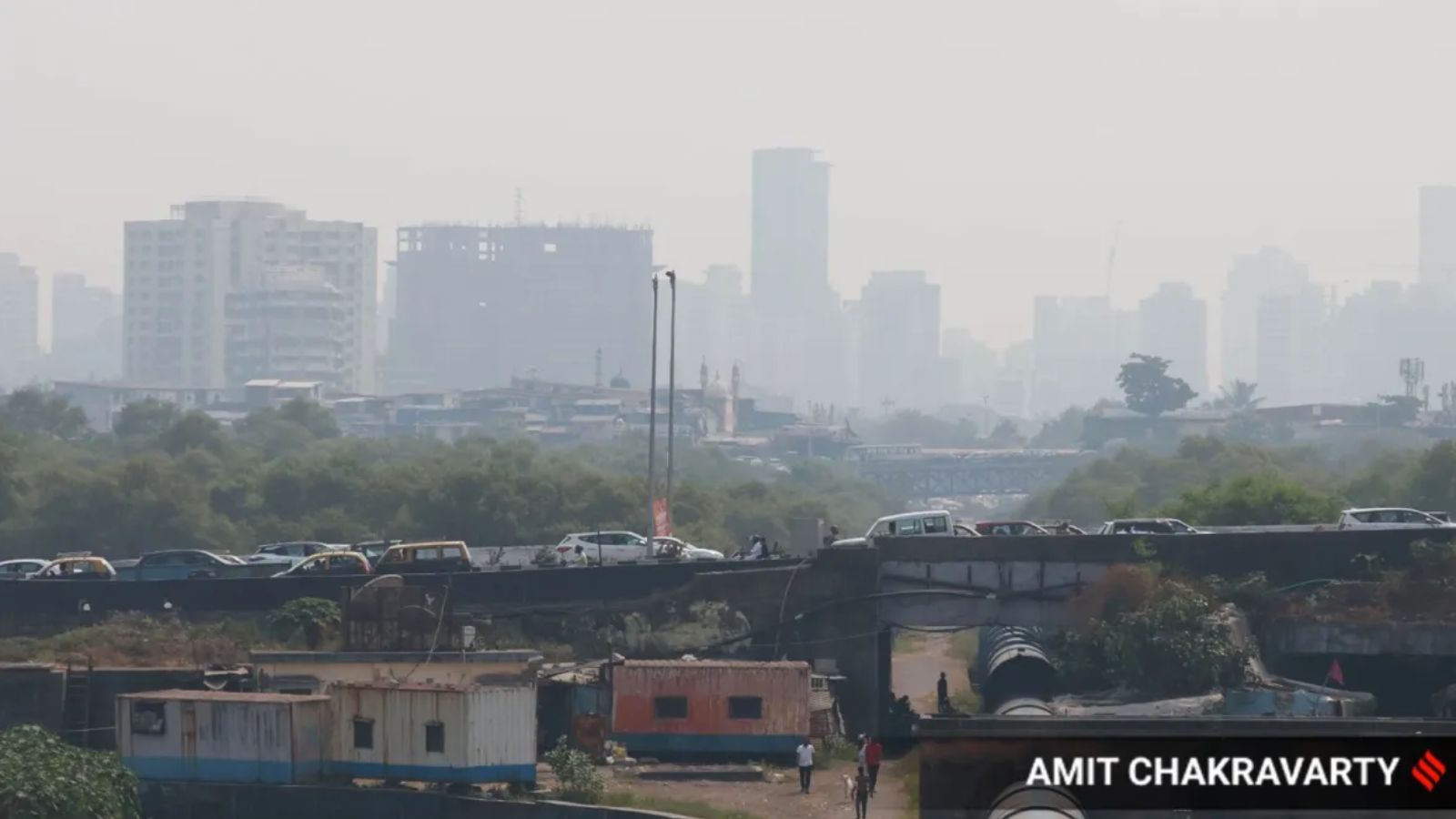
According to CPCB norms, an AQI of 0-50 is ‘good’, 51-100 ‘satisfactory’, 101-200 ‘moderate’, 201-300 ‘poor’, 301-400 ‘very poor’ and above 400 ‘severe’. (File)
With rain activity losing momentum, Mumbai’s air quality deteriorated on Friday, with the city’s Air Quality Index (AQI) crossing 100 for the first time this post-monsoon season as a haze settled over the skyline.
The overall AQI stood at 111 by Friday afternoon, with 10 of the 20 active monitoring stations recording ‘moderate’ air quality, according to Central Pollution Control Board (CPCB) data. Worli recorded the highest AQI at 178, followed by Colaba at 143, Deonar at 141 and Mazgaon at 138. PM2.5 and PM10 were among the prominent pollutants recorded at the stations.
The deterioration comes after four months of relatively satisfactory air quality, with the AQI generally remaining below 100 between June and September. Frequent spells of rain helped wash out dust and suspended pollutants. With rainfall now weakening, experts said changes in wind patterns and drier conditions were also contributing to the rise in pollution.
Experts told The Indian Express that the spike was not due to insufficient rainfall alone. Clockwise winds from the landward direction were also bringing dry air and dust from the north, they said.
The deterioration has prompted the Brihanmumbai Municipal Corporation (BMC) to issue fresh standard operating procedures (SOPs) for tackling pollution at the ward level.
Each civic ward will identify at least 10 pollution hotspots, including major construction and redevelopment sites, infrastructure projects, open waste-burning locations, debris dumping points and areas prone to traffic congestion. An officer will be assigned to each hotspot to monitor air quality and ensure corrective measures are taken.
Ward-level monitoring teams have also been directed to inspect at least two construction sites every day.
Story continues below this ad
“Demolition sites will have to ensure proper barricading, cover debris with tarpaulin or green cloth and undertake continuous misting to suppress dust,” said a civic official.
Developers and contractors will also be responsible for cleaning roads adjoining construction sites. Projects spread over up to 4,000 square metres will have to clean roads up to 100 metres; those between 4,000 and 10,000 square metres, up to 200 metres; and projects exceeding 10,000 square metres, up to 500 metres on both sides.
The BMC’s action plan provides for escalating measures as pollution worsens. If the AQI crosses 200, authorities can undertake intensive cleaning, road washing, water spraying and misting, besides taking stricter action against open waste burning.
If the AQI remains above 300 for three consecutive days, polluting activities within a 2-km radius of the concerned air-quality monitoring station can be ordered to stop.
Story continues below this ad
The civic body will also undertake a post-monsoon clean-up drive during the first two weeks of October to remove sludge, mud and accumulated road dust. The drive will cover major roads, medians, junctions and road edges.
“Roads may also be washed with recycled water or subjected to fine water spraying wherever required,” civic authorities said.
According to CPCB norms, an AQI of 0-50 is ‘good’, 51-100 ‘satisfactory’, 101-200 ‘moderate’, 201-300 ‘poor’, 301-400 ‘very poor’ and above 400 ‘severe’.
© The Indian Express Pvt Ltd

Nayonika Bose is a Senior Correspondent with The Indian Express’ Mumbai bureau. While in the early stages of her career, her focused reporting on local governance and community welfare already demonstrates clear Expertise and Trustworthiness in covering essential civic issues impacting Mumbai's residents. Expertise & Authority (E-E-A-T) Specialized Focus: Nayonika's reporting is dedicated to civic and community issues, providing readers with highly relevant, ground-level information about the functionality and administration of India's largest metropolitan area. Core Coverage Areas: Her articles highlight a strong focus on the fundamental quality of life and public safety in Mumbai, including: Civic Infrastructure: Reports on critical failures and initiatives related to public works, such as the recurring problem of unauthorized building collapses in Navi Mumbai, the construction of new infrastructure projects (like the Dahisar-Bhayandar Link Road and the Mahalaxmi cable-stayed bridge), and the maintenance of essential city services (e.g., manhole cover theft). Urban Governance & Crisis Management: Provides detailed coverage of the Brihanmumbai Municipal Corporation's (BMC) response to major crises, particularly during the monsoon (e.g., heavy rainfall, water cuts, and public health concerns like dengue and malaria) and large-scale public safety incidents (e.g., the hoarding collapse fallout). Community Welfare & Rights: Reports on key social issues, including the financial aid scheme for persons with disabilities, the struggles of Mumbai's hawkers protesting eviction drives, and the dangers faced by workers due to the continuation of manual scavenging in water tanks. Cultural & Heritage Reporting: Covers significant community stories, including the restoration of British-era fountains and the history of institutions like the 126-year-old Chinchpokli cemetery, showing a breadth of interest beyond pure administration. Tweets @nayonikakb ... Read More

Pratip Acharya is a seasoned journalist based in Mumbai reporting for The Indian Express. With a career spanning over a decade, his work demonstrates strong Expertise and Authority in critical urban issues, civic affairs, and electoral politics across Eastern and Western India. Expertise & Authority Current Role: Journalist, The Indian Express (IE), reporting from Mumbai. Core Authority: Pratip's reporting focuses sharply on local democracy and development, specializing in: Urban Governance and Civic Affairs: Providing in-depth analysis of municipal decision-making, city planning, and local infrastructure, essential for informed urban reporting. City Politics and Environment: Covering the political dynamics of Mumbai and surrounding areas, alongside critical environmental challenges impacting the metro region. Electoral Coverage (High-Stakes Experience): He has extensive experience in high-stakes political reporting, having covered major elections, establishing his Trustworthiness in political analysis: National: Lok Sabha elections in 2014 and 2019. State: West Bengal Assembly elections in 2016 and Maharashtra Assembly elections in 2019. Major Assignments (Ground Reporting): Pratip demonstrated commitment during crises by conducting ground reporting throughout the Covid-19 pandemic since its breakout in 2020, offering first-hand accounts and analysis of the public health crisis. Experience Extensive Experience: Starting his career in 2014, Pratip has built his foundation across multiple prominent English dailies: Started at The Times of India in Kolkata (2014). Relocated to Mumbai (2016) and worked with The Free Press Journal and Hindustan Times before joining The Indian Express. Pratip Acharya's diverse experience across major publications, coupled with his specialized focus on the intricate details of urban governance and a track record of covering major electoral and health crises, establishes him as a trusted and authoritative source for news from India's critical metropolitan centres. ... Read More
Stay updated with the latest - Click here to follow us on Instagram
KioskNews shows a cleaned-up reading view extracted from the publisher’s page — the original always lives on their site, not ours.