NUS launches professorship in breast cancer genomics, named after late patient
SINGAPORE – The Yong Loo Lin School of Medicine at the National University of Singapore (NUS Medicine) has launched a professorship to boost research into how genetic, clinical and imaging data can be combined to better predict a woman’s risk of developing breast cancer.
Surgical oncologist Mikael Hartman is the inaugural holder of the Josephine Tan Professorship in Breast Cancer Genomics, which in a move away from tradition is named after a late patient, rather than an exemplary teacher.
The professorship has been created with a donation of undisclosed value from Tony Tan Choon Keat, founding managing director of healthcare group Parkway Holdings, in memory of his late wife Josephine, a breast cancer patient.
“Our ambition is to prevent more breast cancers and detect those we cannot prevent earlier,” said Hartman, who is head of division and senior consultant at the division of general surgery (breast surgery), Department of Surgery, National University Hospital.
“By combining genetic information with breast imaging and clinical risk factors, we aim to identify which women would benefit from earlier or more frequent screening and preventive treatment, and which could safely be screened less often.”
A key research focus will be on integrating genetic information with clinical factors to develop a more comprehensive assessment of individual breast cancer risk.
This includes inherited changes in genes such as BRCA1 and BRCA2, which can substantially increase breast cancer risk, as well as genetic scores (polygenic risk scores), which assess the combined influence of numerous common genetic variants.
When considered alongside family history, breast density, clinical information and previous mammograms, these findings may provide a more detailed understanding of individual risk, said Hartman, who is also a senior consultant at the National University Cancer Institute, Singapore.
The professorship was launched officially on Oct 23 at the Four Seasons Hotel Singapore.
It will build on Hartman’s research, including the BREATHE (Breast Screening Tailored for Her) study, involving 4,592 women aged 35 to 59 in Singapore, which had demonstrated the feasibility and acceptability of personalised breast cancer risk assessment in a multi-ethnic Asian population.
The next step will be to establish how these risk assessments can guide screening and prevention decisions, and evaluate the benefits, potential harms and cost-effectiveness in clinical practice.
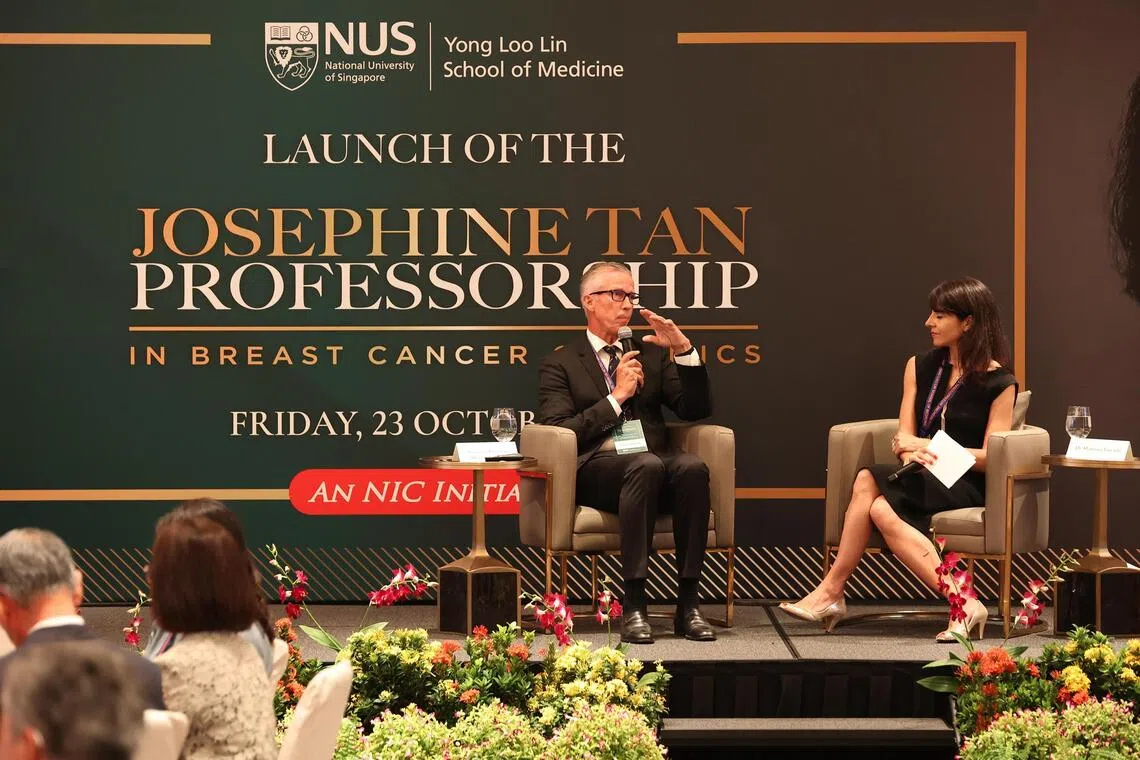
Mikael Hartman and Mariana Losada discussing how genomics can provide a more precise understanding of individual risk.
PHOTO: NUS MEDICINE
Breast cancer is the most common cancer among women in Singapore, accounting for nearly 30% of female cancer diagnoses between 2019 and 2023.
According to the Singapore Cancer Registry Annual Report 2023, there is approximately one in 12 women at risk of developing breast cancer by age 75.
Globally, the disease remains a major health challenge, with an estimated 2.3 million new cases diagnosed in 2023.
Despite advances in detection and treatment of the disease, this figure is projected to exceed 3.5 million annually by 2050, underscoring the growing need for more effective approaches to early detection and prevention.
In Singapore, age remains a key consideration in existing population screening programmes, but advances in genetic research and medical imaging continue to make it increasingly possible to assess a woman’s individual risk more precisely.
Tony Tan said he hoped the professorship will create a lasting legacy that will support advances in breast cancer research and improve the lives of women “for generations to come”.
“Josephine approached life with warmth, courage and an enduring curiosity about the world. It is my hope that this professorship, established in her memory, will inspire the same spirit of curiosity and determination in the pursuit of scientific discoveries.
“If it can contribute to preventing breast cancer and help more women lead longer, healthier lives, it would be a meaningful and lasting tribute to Josephine,” he said.
KioskNews shows a cleaned-up reading view extracted from the publisher’s page — the original always lives on their site, not ours.