Older and stronger: How a couple in their 70s keep each other moving

Samad Sulaiman, 79, grips the back of a chair and slowly raises one leg to the side. He lowers it, steadies himself, then lifts again.
Beside him, his wife of 54 years, Esah Ahmad, matches him rep for rep.
It is a weekday morning at charity organisation Blossom Seeds’ active ageing centre (AAC) in Canberra. Samad and Esah exercise here up to three times a week.
AACs are community-based drop-in centres for seniors to take part in recreational activities, access community health services, build strong social connections and even contribute back through volunteer work.
Two years ago, after knee operations on both legs, Samad relied heavily on a walking stick. He was also unable to walk fast, or far without resting.
Today, Samad is quicker on his feet. “I feel better, more energised,” he says.
He has done what many seniors find difficult: turned knowing into doing.
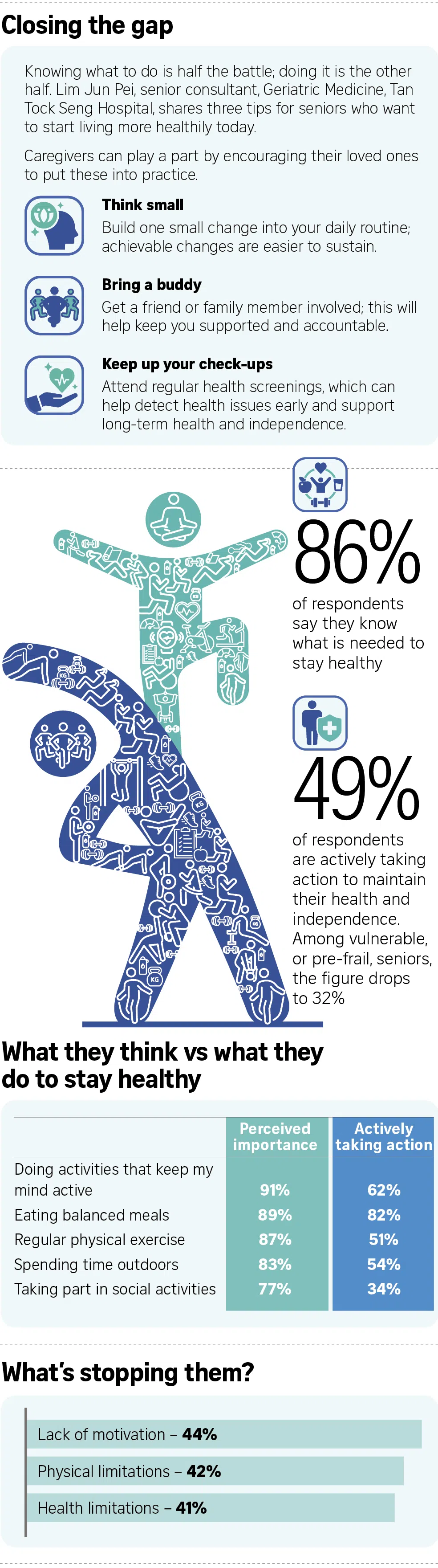
In the survey commissioned by SPH Media and the Agency for Integrated Care (AIC), 86 per cent of respondents said they know what it takes to stay healthy as they age. But only 49 per cent said they are actively taking steps to maintain their health and independence.
Among pre-frail seniors – who are starting to show signs of losing strength, energy and independence – the figure drops to 32 per cent.
Pre-frailty is the early stage of frailty, a condition in which the body becomes less able to cope with and recover from illness, injury or stress.
The survey polled more than 800 respondents in Singapore, comprising people aged 50 and above and caregivers.
Respondents were drawn from the Kantar Profiles Audience Network, with interviews conducted between August and September 2026. Kantar is an independent market research company.
Stronger together
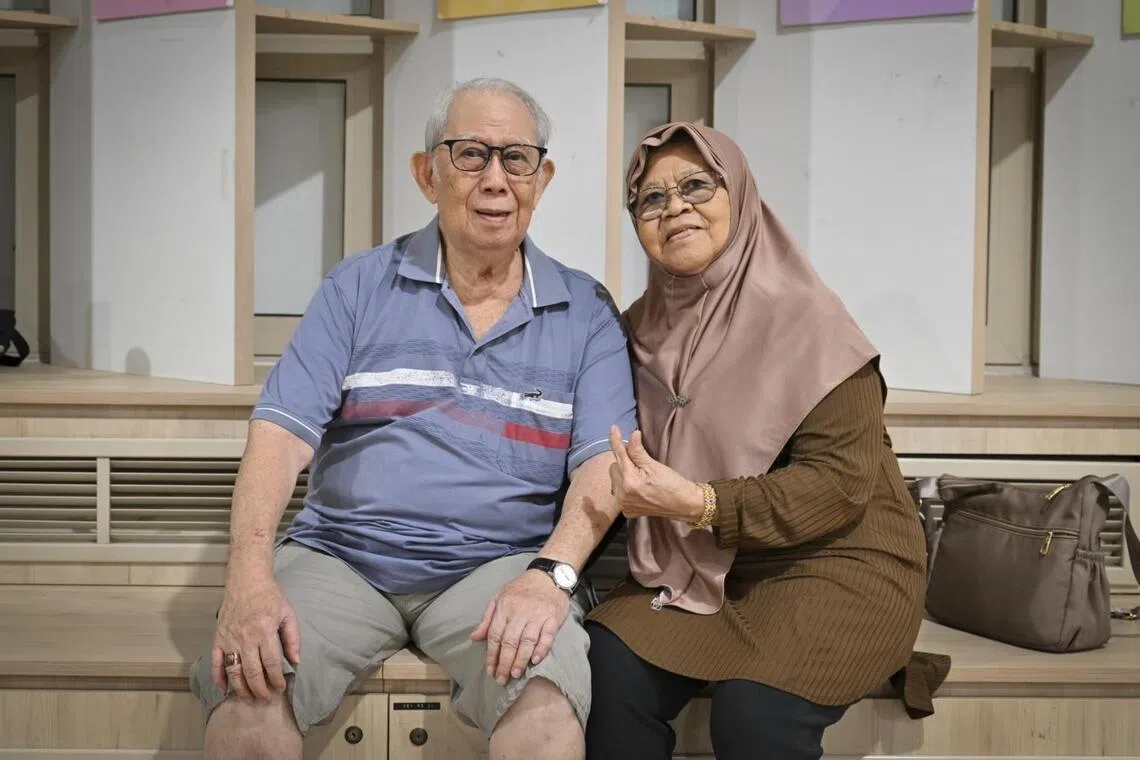
Samad Sulaiman, 79, with his wife Esah Ahmad, 77. The pair live in a one-room public rental flat in Canberra and exercise three times a week in an active ageing centre near their home.
PHOTO: CAROLINE CHIA
Samad’s reason for getting moving is simple. “Because (I) want to be together (with my wife),” he grins.
Esah, 77, joined Blossom Seeds first, in 2023.
She ran a nasi padang stall for a decade before it closed during the Covid-19 pandemic. With her days suddenly empty, she was looking for activities to fill her time.
Samad and Esah live in a one-room public rental flat in Canberra. Their three children, aged between 42 and 53, live with their families.
So when she spotted a poster in the neighbourhood inviting residents to visit Blossom Seed’s AAC, she decided to sign up for activities like chair yoga and seated taiji.
Samad, still recovering from his knee surgeries, had stayed home. Once his legs were strong enough in 2024, Esah brought him along.
Samad joined the inaugural batch of 12 seniors in the 12-week Say No to Frailty (SNTF) programme at Blossom Seeds.
SNTF is designed for seniors aged above 60 who show signs of pre-frailty. Developed by the Singapore Institute of Technology in partnership with public healthcare network Yishun Health and not-for-profit charity TOUCH Community Services, SNTF is run at 27 community-based organisations including AACs.
Once a week, Samad attended two-hour sessions of strength and balance exercises, along with lessons on fall prevention, healthy eating and managing chronic conditions.
Now, exercise is part of the couple’s routine. “If I don’t exercise, my body feels weak,” says Esah.
But not every senior has someone to nudge them along.
When asked what stops them from taking action, survey respondents cited lack of motivation (44 per cent) as the top barrier. This is followed by physical limitations (42 per cent) and health limitations (41 per cent).
The effects of unhealthy habits often take time to show, says Lim Jun Pei, senior consultant in Geriatric Medicine at Tan Tock Seng Hospital.
“There may not be a strong sense of urgency to make changes until health problems begin to emerge,” she explains.
Many health behaviours also get ingrained over decades, Lim adds. This makes new routines hard to adopt later in life.
Motivating men
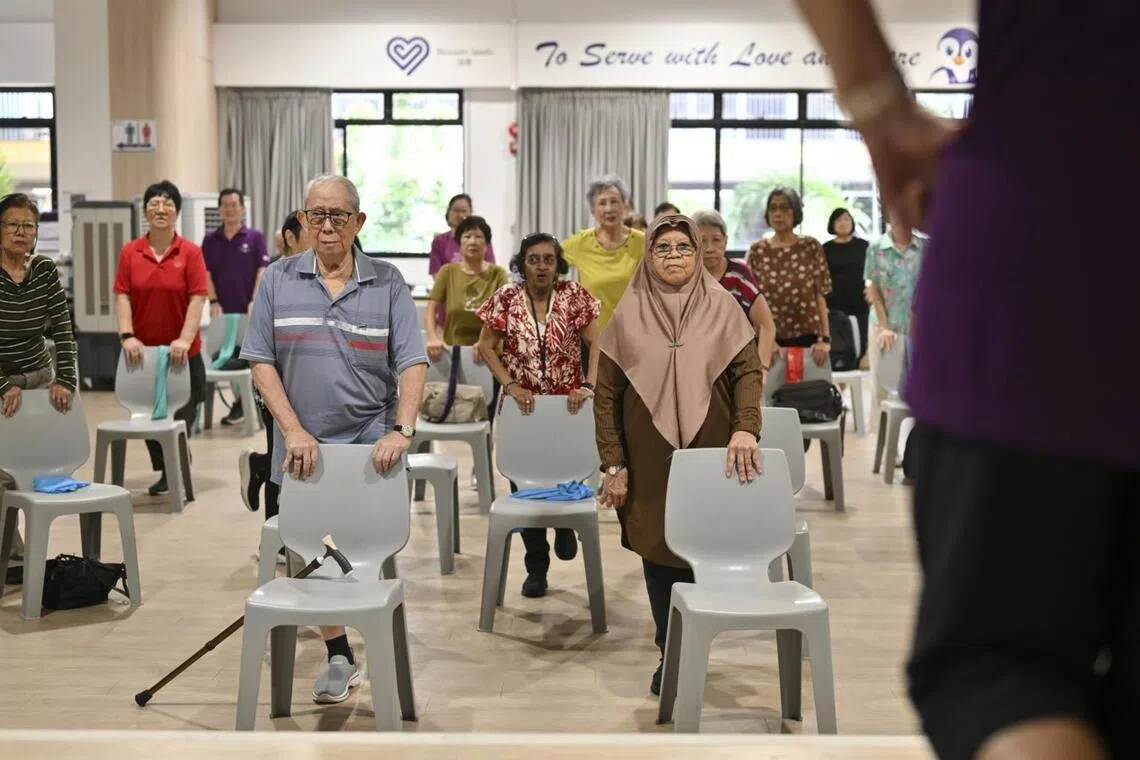
Men make up only about a quarter of the 1,300 seniors who take part in activities at senior care charity Blossom Seeds’ active ageing centre in Canberra.
PHOTO: CAROLINE CHIA
As a regular at Blossom Seeds’ active ageing centre (AAC), Samad Sulaiman is something of an exception.
Men make up only about a quarter of the 1,300 seniors who take part in its activities.
Men tend to be harder to draw into community activities such as singing, dancing or flower arrangement, says Dolly Cheng, director of Active Ageing Division, Agency for Integrated Care.
She explains they may be “more motivated by activities with a clear purpose or shared goal”. These could include volunteering, mentoring, learning new skills or contributing to community projects, Cheng adds.
Samad himself is shy by nature. He goes to the centre mainly to be with his wife Esah Ahmad, 77.
Samad prefers smaller group sessions of about 20 participants. Some activities at Blossom Seeds’ AAC can draw up to 40 seniors per session.
On mornings when Esah cooks for the centre’s communal meals, he stays home or heads out to meet old friends nearby.
That is what he enjoys most. “I meet a friend at a coffee shop, have a drink, then chit-chat,” Samad says.
Some centres are designing activities with men like him in mind.
At Methodist Welfare Services’ AACs, a men-only “Happy Hour” offers games, activities and kopi sessions for older men.
“The goal is not simply participation for participation’s sake,” Cheng says, “but helping seniors find meaningful ways to stay active, connected and engaged.
Act now to age well
Pre-frail seniors are especially hard to move, says Dolly Cheng, director of AIC’s Active Ageing Division.
She explains that they may notice some decline in strength, energy or mobility. But these changes, says Cheng, are “often gradual and may not yet have a significant impact on their daily lives”.
“Some may attribute the changes to normal ageing; others may feel that they can address them later if needed.”
But reaching pre-frail seniors early matters, as it is the stage where intervention can be most effective, Cheng says.
“The pre-frail stage is an important window of opportunity to prevent, delay or even reverse the progression of frailty,” she adds.
Seniors who are at risk, or showing early signs, of frailty can join the Health Promotion Board’s 12-week programme Steady Lah to start building strength.
Launched in August 2023, it is developed in collaboration with the allied health team from Tan Tock Seng Hospital.
Seniors can look forward to progressive strength and balance exercises to improve muscle strength and functional mobility and learn tips on nutrition and falls prevention.
To date, over 370 runs of Steady Lah have been implemented, reaching 8,300 seniors.
Interested seniors can sign up at their nearest AAC.
The early signs of pre-frailty are often subtle, says Lim. They include unintentional weight loss, walking more slowly, feeling less energetic, and withdrawing from activities once enjoyed.
“These changes may sometimes be the first indication of an underlying health issue rather than ‘just getting older’,” Lim explains.
Family members and friends can help, says Cheng, through “simple actions such as checking in on an older neighbour, inviting a friend to join an activity or encouraging someone to participate in community programmes”.
Samad and Esah’s three adult children call every week to check in on their health.
But the couple are happy to be able to manage on their own.
“We got a life for (ourselves),” says Esah. “As long as we are healthy and feel good, (there’s) nothing (for them) to worry about.”
Closing the gap
Knowing what to do is half the battle; doing it is the other half. Lim Jun Pei, senior consultant, Geriatric Medicine, Tan Tock Seng Hospital, shares three tips for seniors who want to start living more healthily today.
Caregivers can play a part by encouraging their loved ones to put these into practice.
Think small: Build one small change into your daily routine; achievable changes are easier to sustain.
Bring a buddy: Get a friend or family member involved; this will help keep you supported and accountable.
Keep up your check-ups: Attend regular health screenings, which can help detect health issues early and support long-term health and independence.
In Perspective is a research-led content programme by SPH Media that combines insight-driven storytelling with expert perspectives on key issues shaping society.
KioskNews shows a cleaned-up reading view extracted from the publisher’s page — the original always lives on their site, not ours.