SpaceX pulls off spaceship ‘catch’
‘HOLY GRAIL’: Crowds broke out in cheers as the spaceship came into view, with the 1977 hit ‘Baby Come Back’ playing on the official livestream of the descent
SpaceX on Saturday pulled off the first-ever “catch” of a spaceship, a technical feat showing the feasibility of fully reusable rockets that would bring affordable spaceflight one step closer to reality.
The Starship emerged from the clouds after surviving the extreme heat of re-entering Earth’s atmosphere, then descended slowly over SpaceX’s south Texas Starbase before slipping smoothly between mechanical “chopstick arms” above Launch Pad 2.
The success marked a milestone in the space industry’s decades-long pursuit of fully reusable rocket systems — a goal that can drastically reduce mission costs and make more frequent launches possible.
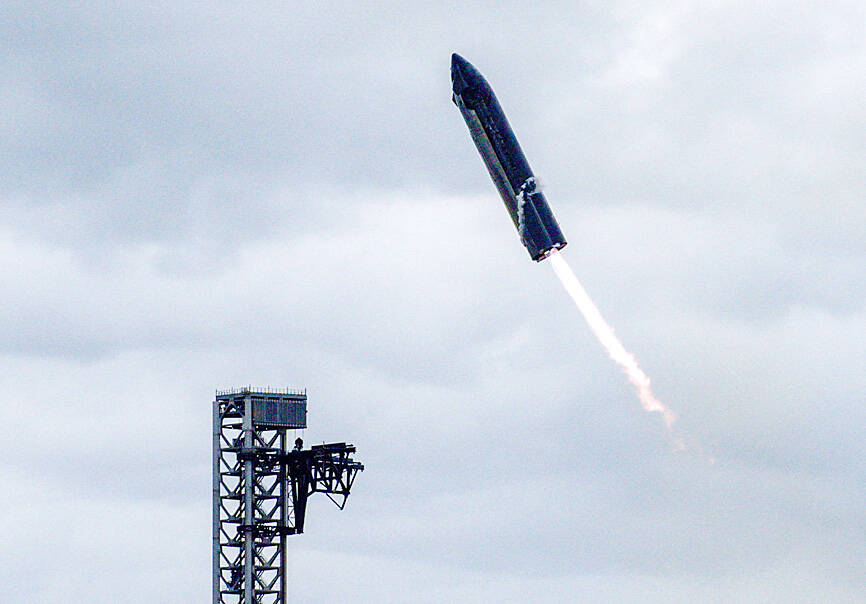
SpaceX Starship 42 returns from orbit to the launch pad on a test flight from the SpaceX launch complex in Starbase, Texas, on Saturday.
Photo: Reuter
“That was the Holy Grail of spaceflight, plummeting through fire to be snatched out of the air by steel. We caught a Starship and now, everything changes,” SpaceX spokesman Dan Huot said.
Crowds outside Starbase broke into ecstatic cheers as the spaceship came into view, with 1977 soft rock hit Baby Come Back serving as the soundtrack of the nerve-racking final descent on SpaceX’s official livestream.
“I really do believe this is the dawn of the space age,” said Dane Walter, 38, a spectator who came from Corpus Christi, Texas. “And truly, I consider it an equivalent moment to the Wright brothers at Kitty Hawk.”
It was the 15th test flight of the world’s biggest and most powerful rocket system. Up until now, spaceships have been single-use items, discarded or destroyed after missions, making each launch an expensive resource-intensive venture.
The Starship spacecraft that gives SpaceX’s rocket system its name orbited Earth 14 times and deployed 26 satellites for the Starlink Internet constellation during its 22-hour journey.
SpaceX had previously captured returning booster rockets three times. However, the “catch” of Starship was more complex because the spaceship fell much faster and from a much higher altitude compared to boosters.
“I hugged ship 42 upon its return,” SpaceX CEO Elon Musk wrote on X about the captured vessel, sharing videos taken from various angles and saying it “looks great.”
Clayton Swope, an aerospace expert at the Center for Strategic and International Studies, called the mission a “huge technical achievement and proves the whole idea of Starship as a fully reusable spaceship can work.”
“Let’s see how quickly they can do it again,” he said.
Georgetown University Center for Security and Emerging Technology analyst Kathleen Curlee hailed the achievement, but said more work needs to be done.
“What SpaceX needs is multiple repeated successes to prove the capability is ready to handle sensitive payloads and missions,” she said.
NASA Administrator Jared Isaacman called the recovery “almost magic.”
The US space agency expects Starship to serve as a lunar lander on its Artemis mission.
“Making more believers by the day...one step closer to” the Moon, Isaacman wrote on X.
KioskNews shows a cleaned-up reading view extracted from the publisher’s page — the original always lives on their site, not ours.