Dead star's two rings of shattered planets offer glimpse of Sun's future

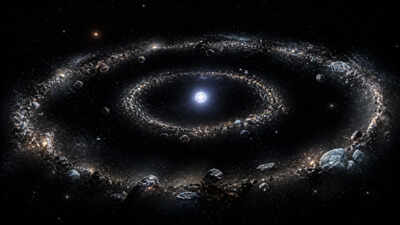
A representative image (credit: Canva AI)
There is a rather innocent idea we, as children, have grown up listening to when it comes to death. When our loved ones pass away, we are often told to look up at the stars and imagine them resting somewhere in the night sky, watching over us from afar.
It is a comforting thought, one that makes the stars seem ubiquitous. So, it is difficult to imagine that even the brightest star in our own Solar System, the Sun, will eventually reach the end of its life. The warmth that reaches our oceans, lights up our Earth and makes life possible will not last forever. If stars, too, have an end, what happens to everything that once revolved around them? What does the death of a star look like for the planets that have spent billions of years in its orbit? Astronomers are therefore looking up for answers of their own: what may survive when our Sun, our star, dies?According to an article published in Nature Astronomy on October 26, 2026, astronomers have identified two distinct gaseous rings of planetary debris around a dead star.
The star in question is called J1328-1450. It is a white dwarf, which is essentially the extremely dense core left behind after a star sheds its outer layers at the end of its life. The researchers believe that smaller planetary bodies may have survived the death of the star and could be responsible for maintaining this unusual structure.
A dead star with an unusual planetary system
To understand why this discovery matters, we need to know what happens when a star reaches the end of its life.
Our Sun currently produces energy through nuclear fusion, a process in which hydrogen is converted into helium. Nearly 5 billion years from now, the Sun will eventually exhaust the hydrogen fuel in its core. As it enters the final stages of its life, it will expand enormously and become a red giant.This expansion can be incredibly destructive, as the Sun will engulf some of the planets and dramatically alter conditions throughout the Solar System.
Eventually, the Sun will shed its outer layers, leaving behind its extremely dense central core. This remnant will then become a white dwarf.This is what astronomers have observed around J1328-1450.Astronomers have discovered debris discs around other white dwarfs before, but J1328-1450 has something that makes it stand out. Instead of a single gaseous disc, the material around this star appears to be organised into two separate, concentric rings, with one positioned farther away from the star than the other.According to an announcement by the European Southern Observatory (ESO), dated October 27, 2026, the discovery was made using the X-shooter instrument on ESO's Very Large Telescope (VLT) in Chile. This instrument allowed researchers to study the light coming from the material surrounding the white dwarf and observe how gas was moving around it.
What could be keeping the two rings apart?
The unusual arrangement has led researchers to consider whether some planetary bodies survived the star's expansion.
These objects, known as planetesimals, are smaller solid bodies that can be remnants of planetary systems. Although they have not been directly observed around J1328-1450, their gravitational influence and interactions with the surrounding dust could help explain the two separate gaseous rings.The researchers have proposed that two such bodies may be involved, with one associated with the inner ring and another with the outer ring.
The smaller object could be only a few kilometres across, while the larger one could potentially reach the size of Pluto or even the Moon.The research also gives clues about the material that once formed the planetary system. But the two rings do not appear to have identical chemical compositions. Magnesium emission has been detected in the inner ring, while the outer ring appears to be significantly depleted of it.
Therefore, planetary bodies are not necessarily chemically uniform throughout. A differentiated rocky planet, for instance, can have different layers, including a crust, mantle and core, each with its own composition.The researchers therefore consider two possibilities: one, that the rings could contain debris from two different planetary bodies that originally had different chemical compositions. Secondly, they could contain material from different layers of the same planetary body.Therefore, these rings hold answers and clues about the possible planetary bodies that existed around the star before its death. So, even when a star dies, a lot remains to be known about the planets that once revolved around it.
KioskNews shows a cleaned-up reading view extracted from the publisher’s page — the original always lives on their site, not ours.