What An Ancient Tamil Way Of Life Can Teach Us About Living With Nature

The recent tragedy in Nepal has once again brought into sharp focus the increasingly fragile relationship between human civilisation and the natural world.
At a time when climate change and rising ocean levels are being recorded at unprecedented levels, Prof Nirmal Selvamony argues that an ancient Tamil philosophy could offer humanity a different way forward.
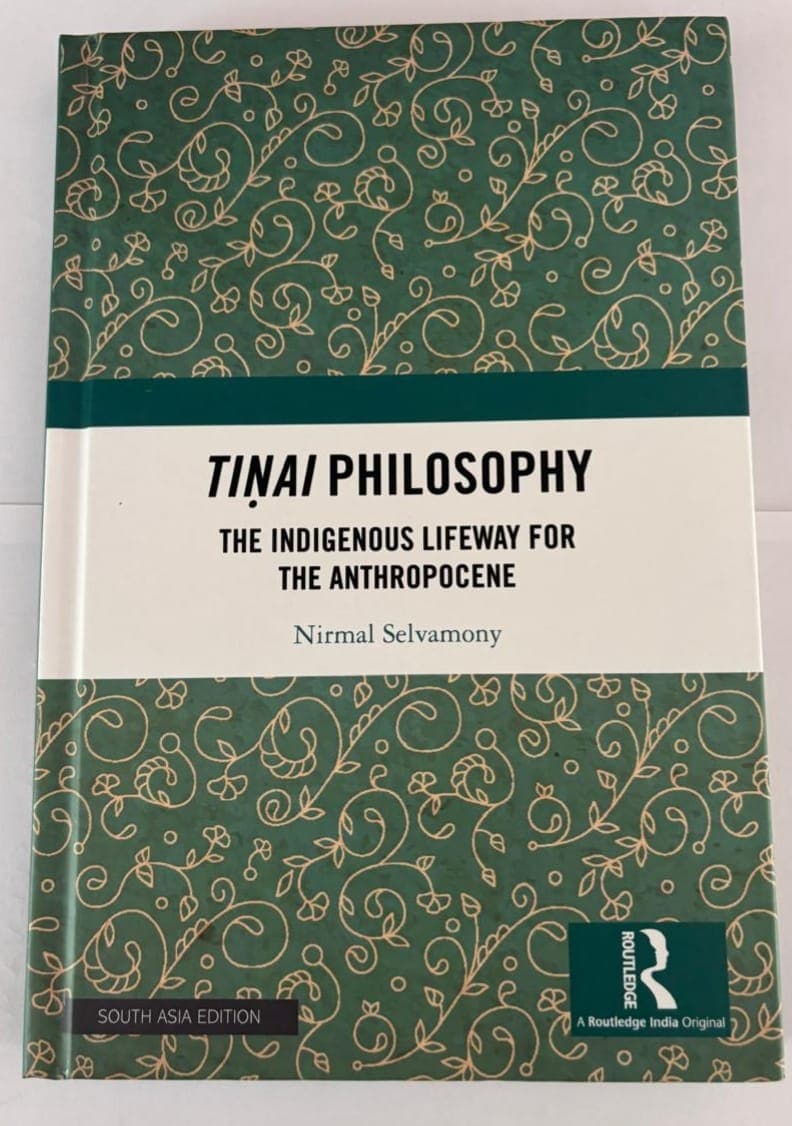
In his book Tinai Philosophy: The Indigenous Lifeway for the Anthropocene, Selvamony explores Tinai as an ancient philosophy and way of life based on harmonious coexistence between humans and all other beings.
He says the need to revisit the philosophy has become particularly urgent in the Anthropocene, an era marked by the enormous impact of human activity on the planet.
"Tinai is an ancient theory on harmonious coexistence," Selvamony says, arguing that the Earth has never witnessed an impact comparable to that produced by industrialisation over such a short period.
He traces the philosophical roots of Tinai to Tholkappiam and early Tamil Sangam literature. According to him, Tinai is not merely a literary classification or a philosophy belonging to one particular religion, but a practical indigenous philosophy that speaks about God without being tied to any religion.
Selvamony also rejects attempts to equate Tinai with Saiva Siddhanta, materialism or other established philosophical systems. He argues that Tinai represents an older indigenous philosophical tradition that was largely neglected after state societies emerged around 10,000 years ago.
He believes humans had lived a Tinai way of life for tens of thousands of years before the emergence of state societies disrupted relationships both among humans and between humans and other beings.
The Industrial Revolution in the 18th century, he says, accelerated this disruption and created what he describes as an increasingly anarchic relationship between humanity and the natural world.
A central concept in his work is Kaatchi, or vision, which he describes as a way of achieving clarity and putting philosophical insight into practice. The core of Tinai philosophy, he says, can be summed up as the soul following an order that sustains harmonious coexistence.
Selvamony cautions against an uncritical embrace of mega-technology, describing technology as the practical arm of science. Technology, he argues, should not be allowed to disrupt the harmony of coexistence.
His answer is not a return to the past, but a new future inspired by an old way of living. To articulate that future, he proposes a modified form of Tinai to move beyond the Anthropocene, calling the new epoch Neotiṇaicene.
"We need a new epoch to have a different kind of relationship between humans and other beings," he says.
Selvamony says his interest in Tinai began early in life through living close to the land and deepened through his study of Tholkappiam and Sangam literature.
He retired in 2018 as Professor and Head of the Department of English Studies and Dean of the School of Social Sciences and Humanities at the Central University of Tamil Nadu. He had earlier taught at Madras Christian College for nearly three decades, where he established an interdisciplinary Ecocriticism programme.
For Selvamony, Tinai is therefore not a philosophy that asks humanity to move backwards. Rather, he believes it could provide a way to move forward - by rediscovering a relationship with the Earth that humans have followed for much longer than the industrial age.
KioskNews shows a cleaned-up reading view extracted from the publisher’s page — the original always lives on their site, not ours.