Everyone hates Oxford Street. Will pedestrianisation save it?
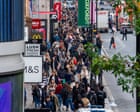
In February, the mayor of London, Sadiq Khan, announced that Britain’s best-known thoroughfare, Oxford Street, would be pedestrianised. To the surprise of every Londoner that I have spoken to in the past few months, it is actually happening. On Monday 26 October, the busiest shopping street in Europe – or, precisely, half of its 1.2-mile stretch – will be closed to traffic, putting an end to several decades of bitter arguments, obstructions and delays. Cars, lorries, vans, taxis, buses, bicycles, ebikes, scooters will be banned. Nothing but pedestrians (and emergency vehicles) will be allowed in.
This change will mark the most remarkable transformation to the streetscape of central London since at least 2003, when Trafalgar Square was turned from a glorified roundabout into one of London’s most recognisable public spaces. It will also form the most visible part of the mayor’s legacy, whether or not Khan runs for a fourth term in 2028. Three years ago, Khan published a memoir and manifesto, Breathe, attributing his asthma to growing up inhaling London’s polluted air. For the mayor, pedestrianising Oxford Street is the culmination of a mission to create a greener city that is oriented around public health, walking and cycling.
Pedestrianisation is one thing; making Oxford Street somewhere anyone actually wants to spend time is another. For weary Londoners and anxious visitors alike, it is a headache in the form of a high street. Its primary associations are crowds, stress, dirt, noise, the tackiest incarnations of consumer capitalism, and crime. At one point during my research I approached a harried police officer in the throng outside Tottenham Court Road tube station and asked if she thought pedestrianisation would be good for Oxford Street, or make her job harder. Both, she said.
This is not to say Oxford Street is an empty, dying high street. At the last count, it receives more than 500,000 visitors every day – equivalent to the population of Edinburgh. It seems reasonable to assume that most of London’s 22 million annual foreign visitors set foot on it at some point. The street generates 5% of the capital’s economic output, and lives in the national imagination the way few others do. “When I was 17, London meant Oxford Street,” sang Everything But the Girl, in their 1988 song of the same name: “It was a little world.” And yet, nobody loves Oxford Street. During the course of writing this article, I haven’t met anyone who will even admit to liking it.
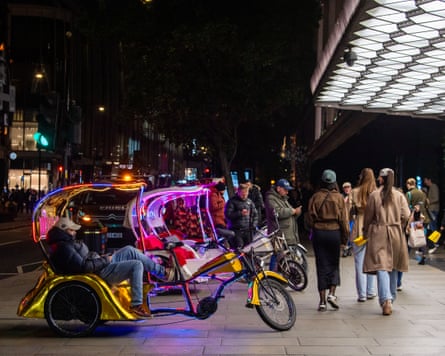
On a Sunday evening in September, I did something I had always carefully avoided doing before and cycled its full length. Even at the end of the weekend, it was overwhelming – with teenagers careening on rented ebikes and gaudy pedicabs parked in the middle of the pavement, blaring music. The pavements were thick with people, in part because the road was still thick with traffic. On another occasion, I watched a late-middle-aged woman perch awkwardly outside Ikea on a narrow black electricity box, in the absence of anywhere else to rest. For most Londoners, Oxford Street is a necessary evil, to be visited with surgical precision before fleeing the scene: a site of crime, grime and perhaps some Christmas shopping. “Who,” wondered the FT’s architecture critic in 2020, “lingers any longer than they have to in London’s worst thoroughfare?”
The grime itself is no joke. In the 1990s, when Oxford Street was known for its huge record shops such as HMV and Virgin Megastore, I remember returning to my south London home on the tube, blowing my nose and seeing a tissue full of jet-black snot. Its narrow streetway and tall buildings on either side create an “urban canyon”, trapping the heavy diesel fumes emanating from its buses and taxis (private car access has been restricted since 1972). In 2014, it was found to have the highest concentration of nitrogen dioxide pollution in the world. In the same year, the crime had become so bad that the United Arab Emirates warned its citizens to avoid the area for their own safety.
Since then it has become better known for its lawbreaking small businesses, where substantial raids have hauled in counterfeit goods and illegal vapes. This decade has seen the rise of mysterious US candy stores and empty souvenir shops that allegedly thrive thanks to tax evasion. Covid and internet shopping hit Oxford Street hard: vacancy levels soared from 4.5% in 2019 to 16.9% by early 2023, and it was often these businesses that filled the gaps. The current Google Street View images of its shopfronts, taken just two years ago, already look like a postcard from the past.
That Oxford Street has been struggling hurts the reputation of London as a whole. This is in tabloid parlance, “the nation’s high street”, home to the flagship branches of iconic department stores alongside global retail brands. Khan’s gamble is that the pedestrianisation can reverse what he conceded in 2024 was a case of “managed decline”, and will flood the street with life again.
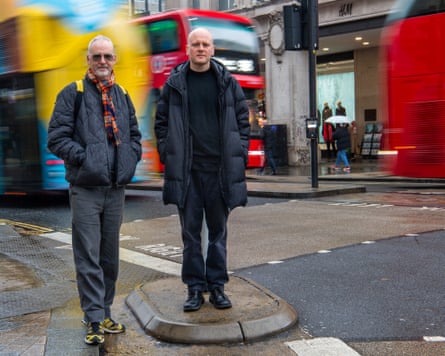
In the offices of East, near London Fields, Julian Lewis and Archie Bashford were seated around a 4ft-long cardboard model of Oxford Street and talking animatedly about bollards. Lewis and his team are public realm architects, devoted not to buildings, but the world beyond them: signage, benches, perches, kerbs, paving, lighting, planters, trees and public art. East have carried out nearly 30 high street redesign projects in as many years, but this is the big one.
The first thing Lewis’s team did after being awarded the contract last year was to dive into the archives. The starting point was a little-known 1932 article in Good Housekeeping by Virginia Woolf. For Woolf, Oxford Street appeared as a “great rolling ribbon … the pebbly bed of a river … washed by a bright stream”. She saw it as gaudy, but also sparkling, thrilling and overwhelming, defined by the restless movement of its messy public. (Her essay also shows us how weird the street has long been – in 1932, it was apparently full of hawkers selling live tortoises.) It was these riverine characteristics that became the starting point for the thousands of material, small-scale design decisions that East are making. The “play of light on surfaces, the subtle reflectivity of a bench or a column” can all help bring out those tendencies, Bashford told me.
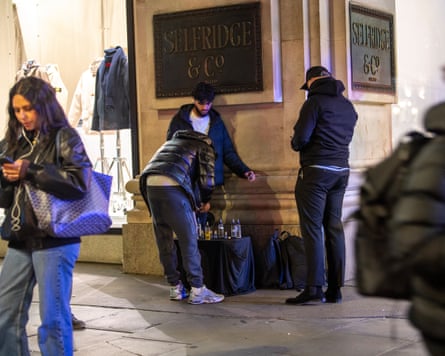
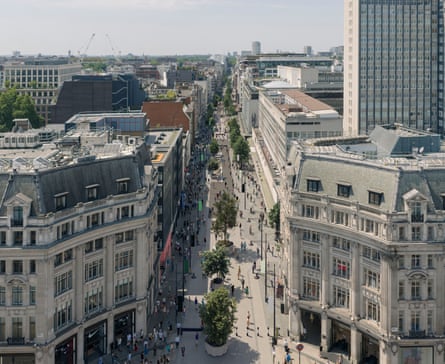
The pedestrianisation happening next week will cover 0.6 miles, stretching westwards from close to the Oxford Circus crossing to Selfridges. (Sadiq Khan has expressed his commitment to eventually pedestrianise all 1.2 miles of the street.) The most noticeable transformation will be how much greener it is becoming. The architects’ plan is to experiment with introducing young trees in pots, alongside new places to sit. They will use the test phase – which will last from next week until spring 2027 – to learn about how people respond to the trees. Will they become meeting points? Rest stops? Landmarks for wayfinding? Ideally they will provide respite, Lewis said, “a refuge from the flow of people, which is the river analogy again – maybe that’s optimistic, but instilling some relative calm”.
The pedestrianised zone’s edges will be marked by bollards. Lewis has strong opinions on this subject, and speaks about bollards as if they were people. “Bollards are generally horrible things,” he told me. Too often they seem “apologetic”, he said. “A misaligned, plasticky reflective strip [on a bollard] sends the message: ‘Sorry, I didn’t really mean to be here, but I need to let you know there are some vehicles nearby.’ Instead, they should be saying: ‘I’m happy to be here, because I’m doing a job.’”
An abundance of considerations go into designing the right kind of bollard, including security, maintenance, aesthetics, accessibility, climate, foot traffic, crowd flow and civic pride. Oxford Street’s bollards have to be exactly 1.2 metres apart, for reasons of HVM – hostile vehicle mitigation – but they also need to be helpful and use “the existing language of the street”. They will be made of ductile iron, because it is more resilient than cast iron: it’s springy, and doesn’t crack when you hit it. They are also matt, because shiny bollards are too flashy, and detract from the ambience. “They’re very sophisticated,” Lewis said, and he meant it.
One of the project’s primary ambitions is to better integrate Oxford Street with its neighbours. It is surrounded by four areas with strikingly different identities: Soho, Fitzrovia, Mayfair and Marylebone. “There’s this slightly numb connection to Oxford Street itself, like: where the hell is Oxford Street? It might as well not be there, with regard to the relationship with these incredible centres,” Lewis said. “People want to go to Soho. They want to go to Marylebone. People live in Fitzrovia. Oxford Street does not have a place yet, it’s a non-spatial space, which is unbelievable given how famous it is.”
This is where landscape architecture and design comes in. The noun the architects use over and over is “invitation” – how do you encourage people to do the unthinkable, and linger in the newly pedestrianised space, and move freely in and out of it? The built environment has to invite them to do so. One innovation Lewis’s team wants to explore is outdoor public dining – not outdoor tables for restaurants, because there are barely any on Oxford Street, but continental-style tables to sit and eat whatever you want; takeaway food bought in Soho, or a packed lunch you made at home. “The idea of sitting there having sandwiches at a picnic bench, next to a shop in which you can buy a Prada handbag, is a fantastic kind of paradox,” Lewis said with a smile. “And it’s also very London.”
To understand where the idea of pedestrianising Oxford Street came from, you need to acquaint yourself with the work of a Danish urban planner called Jan Gehl. In 2003, when Ken Livingstone was mayor of London, Gehl was asked to spend 18 months researching the flaws in London’s streetscape, and in June 2004 he produced a 120-page report entitled Towards a Fine City for People. Gehl thought there was a huge amount of work to be done. “London comes only after Moscow in the contempt the city planners show for pedestrians,” he said that year. “You never see any children on London streets – what have you done with them all?” The answer is that they have been increasingly shut indoors: driven everywhere in cars or not trusted to play outside – compared both with earlier generations of Londoners, and with most other children across Europe.
Gehl wanted to transform the capital into one of the world’s most walking-friendly cities by 2015. But with the 2004 mayoral election taking place the same month, the radical edges of the final report that was published by Livingstone’s City Hall were sanded down. Gehl’s full recommendations were confined to a “secret document”, distributed to the capital’s decision-makers but never published. Among other things, it recommended the full pedestrianisation of Oxford Street. It has taken 22 years for that dream to be realised. “I see some signs of improvement in London,” Gehl told me recently on a video call from his home in Copenhagen, “but for God’s sake, the tempo and the amount of change have not been impressive.”
Gehl, who is 90, has long sought to turn cities into places that put the people that live there first. His motto is “the city at eye level, and at 5km/hour” – walking pace. Life Between Buildings, his first book, from 1971, was a challenge to the orthodoxy that had shaped postwar urban planning. Rather than judging the city principally by its buildings, its roads or the efficiency of its layout, Gehl asked planners to pay attention to what people actually did in public: where they walked, where they stopped, whether they met, talked or sat down to watch the world go by. These values are now finally at the centre of so much city planning – and it is no coincidence that his organisation Gehl Studio was appointed by City Hall to advise East on Oxford Street’s transformation.
For Gehl, city halls across the world should be looking to Australia. Sydney, Perth, Melbourne and Adelaide have moved dramatically towards pedestrianisation and light rail – they are “more ambitious, daring and faster in making decisions” than their peers in the UK. In Sydney, Gehl said, the rapid transformation of the equivalent of Oxford Street, George Street, is improving the atmosphere in the city around it. With ageing populations, “the end of the shopping era” for cities, and the need to reduce fossil fuel consumption, his once-radical ideas are becoming common sense. “If I am looking back at my professional career, it’s been one big struggle to reclaim public spaces from cars, which in the 1960s filled all of the streets and all the squares – they filled every possible place. We have spent many decades reconquering cities for their citizens.”
What we know as Oxford Street, which has been a street for the best part of two millennia, has always been a stage for the evolving society around it. It was previously called Tyburn Road, and for six centuries formed the processional path to the infamous Tyburn Tree, the gallows at what is now Marble Arch. Thronging crowds would line the route on hanging days, making for a rather different participatory public spectacle than that provided by its window-shopping era.
The evolution of West End neighbourhoods brought stables, barns, abattoirs and breweries, fortifications, countless pubs and coaching inns, and eventually department stores, theatres and music halls. Oxford Street has long been a centre not just of commerce, but culture and social life. Howard Carter gave his first public lecture about the discovery of Tutankhamun’s tomb at the New Oxford Theatre in 1923, and the most famous punk gigs in history – featuring the Sex Pistols, the Clash, Buzzcocks and more – took place at the (still running, still pleasingly dingy) 100 Club in 1976. Oxford Street’s long list of fallen pubs – the Hog in the Pound, the Jolly Trooper, the Man Loaded with Mischief – today leaves just one survivor, the Flying Horse. At 6pm on a Tuesday in late September, the atmosphere inside the latter was surprisingly gentle and convivial; the dark wood panelling and Victorian fittings offering a calming refuge from the rush-hour chaos outside.
There have been many experiments in recent decades to bring social life back to Oxford Street: tweaks to crossings, traffic restrictions and pavements, and, largely to accommodate more shopping, from 2005 to 2012, one single traffic-free day in the run-up to Christmas called Very Important Pedestrians Day.
One thing everyone agrees on is that a dramatic transformation is long overdue. By the time Khan replaced Boris Johnson as mayor in 2016, London had fallen behind cities such as Paris, Barcelona and Berlin when it came to infrastructure for cyclists and pedestrians, and measures to curb car numbers. Then, the systemic shocks of the pandemic, and an electorate voting ever more to the left (and more Green), offered Khan the opportunity and the mandate to catch up.
There are two big structural changes sweeping through the great cities of western Europe that have also shaped Khan’s ability to finally get this done. The first is that the motorcar is no longer king in the modern city. The second is that shopping has been displaced. Even though Oxford Street remains a river bobbing with more than 20 flagship stores, maximal spending is no longer the only consideration. In the age of same-day delivery, out-of-town fulfilment centres, and peer-to-peer secondhand marketplaces such as Vinted, what should replace shopping at the heart of the modern city?
This week, I walked down Oxford Street with Nabeel Khan, CEO of the Oxford Street Development Corporation (OSDC). His earliest experience of Oxford Street was going to HMV to buy his first CD: 2Pac’s Me Against the World. Today, he is the man in charge of making pedestrianisation happen.
after newsletter promotion
On our walk, the first signs of change were visible: the concrete bases of the new bollards were in place and the old wooden planters – “really poorly designed”, in Khan’s view – had had their dying shrubs removed. Outside the flagship UK store of the US shoe brand Vans, which styles itself as not merely a skateboarding attire shop, but “a space to express yourself” and a “cultural hub”, Khan spoke with gusto about the so-called experience economy.
In city centres post-Covid, there is “this desire, particularly among young people, for human connection,” he said, gesturing through the open concertina doors of the Vans shop, where a full drum kit, guitar and amps had been set up, facing out on to the street. “When you can buy almost anything you want, what’s the one thing that you can’t buy? That proximity to someone else and having that human experience.”
Given that everyone agrees Oxford Street needs overhauling, why has this taken so long? “The West End doesn’t have a single owner,” Khan said. “There are two local authorities, a transport authority, a strategic authority, five business improvement districts, hundreds of businesses and some major landowners.” The maestro trying to conduct this unruly orchestra is now the OSDC, which was created by the mayor. While reporting this story, I noticed the OSDC sought to keep an iron grip on press coverage. Perhaps this is because the local politics around Oxford Street have been fiercely contested for so long.
In fact, angst over vehicle traffic on Oxford Street is about as old as London’s mayor. In 1971, when Sadiq Khan was a baby, so many pedestrians were spilling from overcrowded pavements into the road and being hit by cars that an Oxford Street Action Committee was formed. During one protest calling for cars to be banned, 22 people were arrested. The Greater London Council introduced the first ban of private cars (between 7am and 7pm) the following year, marking the beginning of 50 years of gradual traffic restrictions.
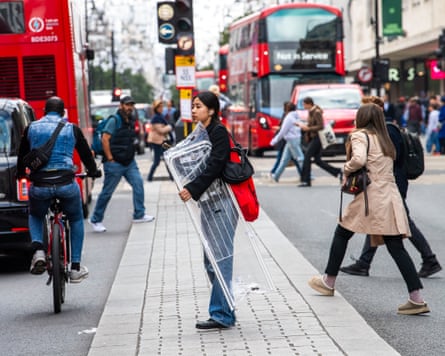
Full pedestrianisation has faced decades of opposition and obstruction, primarily from the Conservative-run Westminster council – continuing when Labour took it over from 2022 to 2026 – but also from taxi drivers, disabled access groups, local residents, smaller traders and local neighbourhood groups such as the Soho Society and Mayfair Forum. The latter worry that plans to reroute buses, delivery lorries and taxis into quiet conservation areas surrounding the street will “destroy” those areas, as Tim Lord of the Soho Society put it. Accessibility advocates and the Licensed Taxi Drivers’ Association argue that pedestrianisation will create a transport desert for older people and disabled visitors. (In a statement, the OSDC admitted that journeys to Oxford Street will change for some, but said that accessibility has been at the “heart” of the planning process. Bus stops, it said, will be no more than about 200 metres from the pedestrianised area; it added that the street furniture was designed with input from specialist disabled groups.)
Khan’s predecessors tried, and failed, to transform Oxford Street. As mayor, Boris Johnson called pedestrianisation the “Schleswig-Holstein question of London traffic”, referring to the infamously complicated 19th-century German constitutional debate, because “everybody in abstract would love to do [it]” until they look at the “actual economic impact”. But by 2016, the tipping point had been reached – all the major mayoral candidates that year proposed pedestrianising it in principle, and when Khan won, he pledged that it would be completed by 2020. For a brief period, City Hall, Transport for London (TfL) and Westminster council appeared to be pulling in the same direction. Polling in 2018 and 2024 has shown about two-thirds of Londoners support the idea.
But the political fight over Oxford Street has often been less about how it is transformed than who gets to decide. In 2018, local opposition to Khan’s pedestrianisation plan crystallised into the creation of Capo, the Campaign Against Pedestrianisation of Oxford Street, which stood three candidates in 2018’s local elections, winning more than 1,000 votes between them. Spooked by this, Nickie Aiken, the council’s Conservative leader, used the backlash to nix the plan. Khan was furious, calling Westminster’s withdrawal “a betrayal” and claiming that £8m of public money had been wasted by the scheme’s collapse.
A decade and a pandemic later, it is finally happening because the planning authority is now held by the OSDC, which was established by the mayor’s office. The Better Oxford Street campaign, a coalition of local opponents to pedestrianisation, called this transfer of power a display of “jaw-dropping audacity” by the mayor, with the OSDC superseding the council “and its democratically elected representatives”.
As Jan Gehl observed to me, compared with some city halls around the world, London mayors have limited power. They can’t raise taxes (or introduce rent caps, legislate or control health services), which makes urban change that much harder to achieve. One thing that is under the mayor’s remit though is TfL: after he got the latter to agree to reroute their buses around the street, and with the OSDC up and running, Khan was finally in the driving seat.
What happens next week is just the beginning. The first half of Oxford Street will close to traffic on Monday – but the pedestrianisation process that follows will stretch on for well over a year.
The people behind the project are anxious that the initial testing phase is not misunderstood as a permanent project that has been built cheaply, or half heartedly. The testing process will involve a lot of people standing around with clipboards and measuring things, observing the different ways and places that pedestrians dwell. Even the picnic benches they are installing will be engaging in data collection, thanks to a “beacon”, a sensor recessed into the seat, that will measure how many people sit down, for how long, and the ambient temperature at the time.
There are other problems to navigate. On my first “site visit” to Oxford Street with East’s Archie Bashford, he showed me an example of how not to do public-realm architecture. We were on a little side street behind Oxford Circus station. There stood three vast steel plant pots, each hosting a leafless, skeletal young tree. The soil base was crisscrossed with a lattice of slats, the gaps completely stuffed with cigarette butts. The planters had become giant ash trays, which presumably hadn’t done much for the dying trees. At the root of this miserable scene were security concerns, Bashford explained – the designers had wanted to keep the soil out of reach. I was confused. “Some planters,” Lewis later explained, “are quite conducive to hiding things.” Such as knives.
This might sound like Metropolitan police hyperbole. But the knife threat is not just a scare story: weapons hidden by organised crime groups are often found in “soft landscape”, usually soil, for easy extraction and future use, removing the danger of being caught in possession.
There is a delicate balance to be struck between public safety and a more sociable public realm. The social optimist’s view is that you minimise crime in the public realm not by making it so miserable that nobody wants to visit in the first place, but by overwhelming the minority of people behaving badly with people who are behaving well. The architects at East hope that some forms of crime, such as drug dealing, will become harder, for the simple reason that it will be more visible. “Sometimes you do have to mitigate [criminal activity],” Lewis said, “but I think it’s more successful in the long term to provide an infrastructure that supports social activity, and invites it.”
Another concern is that the new Oxford Street becomes something rather more mundane: a successfully pedestrianised but ultimately disappointing place. An open-air shopping mall, a tourist trap, a hyperbranded open-air events venue, or an empty corridor after closing time. Some observers worry it could acquire some of the same problems that Barcelona’s La Rambla is still tackling. In recent decades the Catalan boulevard has been a tawdry sacrifice to tourists, largely abandoned by local residents. In an effort to avoid that outcome, there has been a great deal of communication between Barcelona and London. Barcelona’s city hall is keenly watching Oxford Street, Nabeel Khan told me, and East’s architects have visited Barcelona to procure their data-gathering seating.
What would success look like in two years’ time, I asked Khan, as we lingered outside Selfridges, occasionally apologising as we sidestepped passersby. “Of course there’s an economic side,” he said. “We want to see retail doing well, we want to see the return of flagship stores. We want to see more people spending time and coming back to Oxford Street: not just first-time visitors, but return visitors.” It should also form the first stage of a wider transformation of London’s entire West End, he added. “We want to see Marylebone benefit from this, we want to see Soho benefit from this. We want to show people that this is how the heart of a global city should feel, should look, should be experienced. That will be success.”
Archie Bashford believes the change in atmosphere will be profound: “Even if we were doing nothing else, and they just shut the street, it would feel amazing and transgressive.” In just a few weeks’ time, visitors will be able to look up at Oxford Street’s glittering Christmas lights without worrying about being run over. People don’t tend to look up on Oxford Street, I’ve noticed, because they can’t – they’d be mown down.
But it turns out, if you gaze above shop-window height, that Oxford Street has a rich architectural history, stretching across styles and centuries, from the modernist Barbara Hepworth statue on the side of John Lewis to the imposing 18th-century Pantheon that hosts Marks & Spencer. It is worth your time to linger, even beyond the fundamental human right to sit down, have a sandwich and breathe some clean air.
KioskNews shows a cleaned-up reading view extracted from the publisher’s page — the original always lives on their site, not ours.