New recruits are joining the military in big numbers, but not for reason Hegseth says
By lunchtime at a northern Virginia high school, the hallway outside the cafeteria buzzed with students finishing homework, joking with friends and playing video games.
Off to the side, Tech Sgt. Omar Herrera, an Air Force recruiter, had arranged his table with the standard fare of glossy brochures, foam model fighter jets and Air and Space Force-branded water bottles students could earn with a round of pushups.
The scene was strikingly low-key, almost at odds with the life-altering decision many of the teenagers wandering past his table were weighing. When they stopped, Herrera answered questions and explained the Air Force's job opportunities with an encyclopedic knowledge of making a career out of the military, which he was passionate about and eager to share.
By the time Herrera met with dozens of prospective recruits, much of the Air Force's annual recruitment quota was already complete. The recruiting business is good after years of shortfalls.
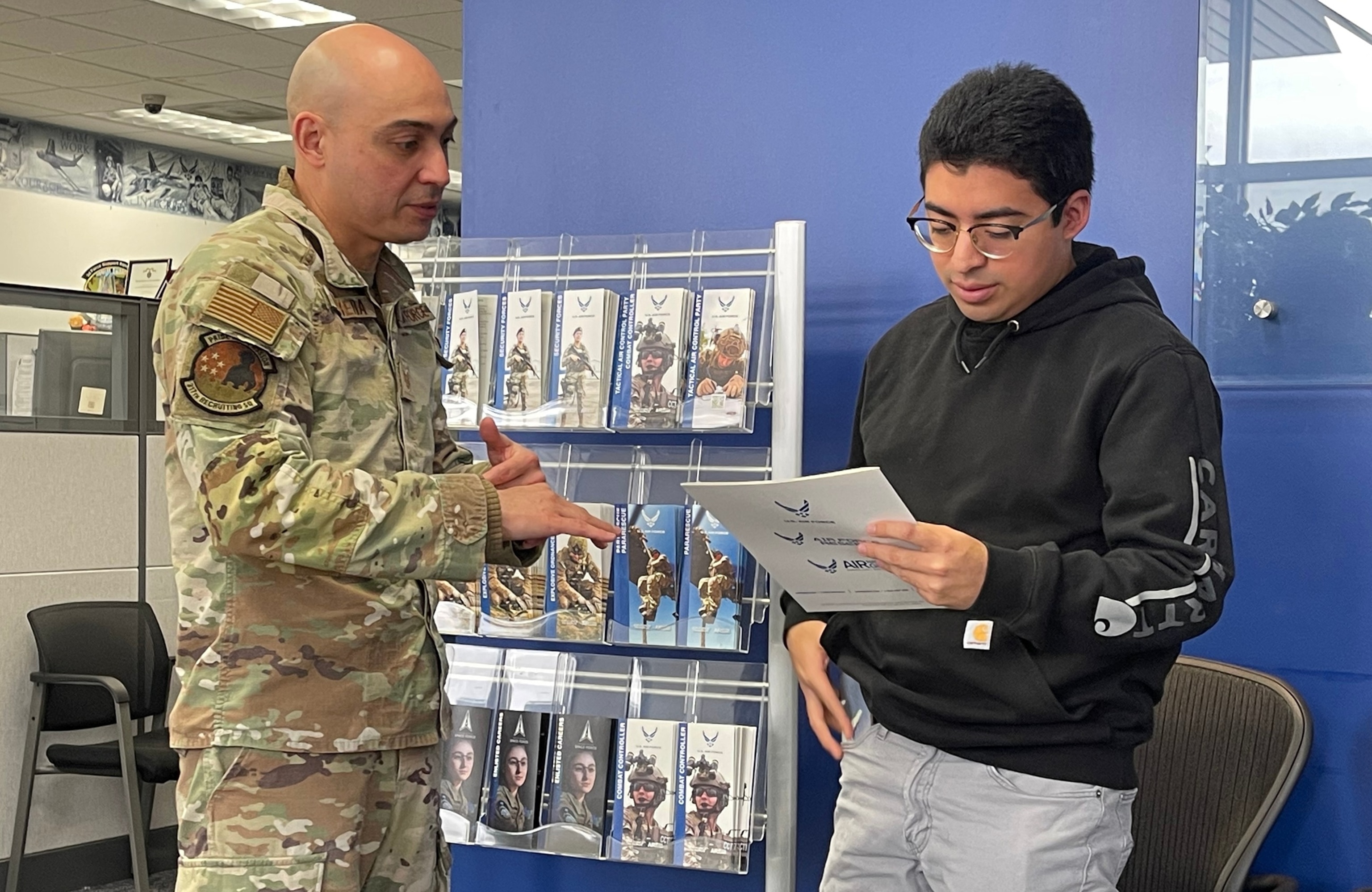
Tech Sgt. Omar Herrera goes over Air Force career opportunities with a potential recruit.
Steven Beynon/ABC News
Defense Secretary Pete Hegseth, an Army National Guard veteran, has repeatedly elevated military recruiting successes into the marquee achievement of his tenure and folded recruiting, long treated as an apolitical function of the military, into a broader culture-war proxy.
In remarks to roughly two dozen of the military's top recruiters at the Pentagon in December, Hegseth framed improved enlistment numbers as a reflection of confidence in the administration.
"You can talk about polls, you can talk about money, but men and women willing to serve and put on the uniform is a reflection of the belief they have in civilian leadership and military leadership," he told them.
Pentagon spokesperson Sean Parnell, in a statement to ABC News, shared that same sentiment, adding that, "Americans everywhere are prouder than ever to serve in our unmatched military that prioritizes lethality, merit, and protecting our nation from those who seek to harm it."
Yet the military has been selling effectively the same proposition since the U.S. abandoned the draft and fully transitioned to an all-volunteer force in 1973: job stability and benefits, with a sense of adventure to sweeten the deal. What has changed, however, is the politics surrounding that bargain.
The military’s recruiting rebound is real, but the reasons behind it are far less political than Hegseth's framing suggests. ABC News interviewed nearly 40 recruits and prospective recruits at different stages of enlistment, along with two dozen recruiters across the military and current and former defense officials, and found young Americans are still largely making the same calculation that has driven enlistment for decades: steady pay, education benefits, job training and a direct path to the middle class.
The Pentagon's own data backs that up too, with financial compensation and benefits ranking as a top reason for joining the military.
The recruitment turnaround also began before President Donald Trump returned to office and has been aided by changes under former President Joe Biden to how the Pentagon finds and qualifies recruits. Yet Hegseth has increasingly cast those gains as a referendum on his leadership and conservative overhaul of the military, even as the force depends more heavily on women, minorities and recruits from Democratic-leaning cities -- populations some defense officials worry the Trump administration's culture war could alienate.
To Herrera, the Air Force is a phenomenal product that speaks for itself, and every recruit is an opportunity to make the force even better.
"I don't do sales, I hate sales. I was that kid who couldn't sell a candy bar," Herrera said. "I'm approaching this as more of a mentor."
The students' ambitions varied, but even in this affluent suburb outside of Washington D.C., with access to one of the country's strongest job markets, the conversations kept circling back to careers and economic security.
One potential recruit was preparing to graduate and was interested in becoming a diesel mechanic in the military. Another asked what it takes to be a military lawyer.
One young woman saw military service as a way to pay for college while continuing a family tradition following her father's career in the Army. According to Pentagon data, some 80% of recruits each year have a family member who served in the military, which is why defense officials have long half jokingly referred to the armed services as "a family business."
Beyond career opportunities, recruiters said they tend to hear the same questions from prospective recruits. For some, the prospect of war carries an undeniable appeal -- not because of the violence itself, but because combat has long been viewed as a proving ground and a source of bona fides that can shape a career in the military and after for decades.
Others are just as deliberate about avoiding the front lines, gravitating toward technical or support specialties where the likelihood of direct combat is lower, but translating those skills to a civilian job may be smoother. For most of those who spoke with ABC News, joining the military is a series of career decisions rather than approval or disapproval about the administration in power.
Among the recruits and prospective recruits interviewed, only two said they knew what a secretary of defense is, and neither could identify who currently holds the position. One recruit who had recently graduated basic training only vaguely recalled Hegseth's name. For many junior service members, the Pentagon's senior leadership has historically been largely removed from their day-to-day concerns.
Despite the ongoing war with Iran, recruiters interviewed said the conflict has rarely surfaced in conversations with applicants. Some cautioned that a prolonged war, especially one marred by a steady stream of American casualties and little visible progress, could eventually weigh on recruiting at the margins.
Women considering enlistment are generally more likely to ask practical questions about pregnancy policies, hygiene and whether barracks were coed, recruiters and women currently serving explained.
One Army recruiter recalled the only applicant who mentioned current events wanted to know whether recently released UFO videos were real.
Recruiting woes
During a Cabinet meeting at Camp David in July, Hegseth told reporters that a recruiting turnaround began "on Election Day 2024," tying a rebound from COVID-19-era lows directly to Trump's return to power.
Yet the military's recruiting recovery was already underway. The services met their active-duty fiscal 2024 recruiting goals by Sept. 30 -- more than a month before Election Day. Recruiting was so successful that year, the Army grew its capacity for how many recruits it is able to send to basic training to get a surge of enlistments into the force following its post-pandemic recovery.
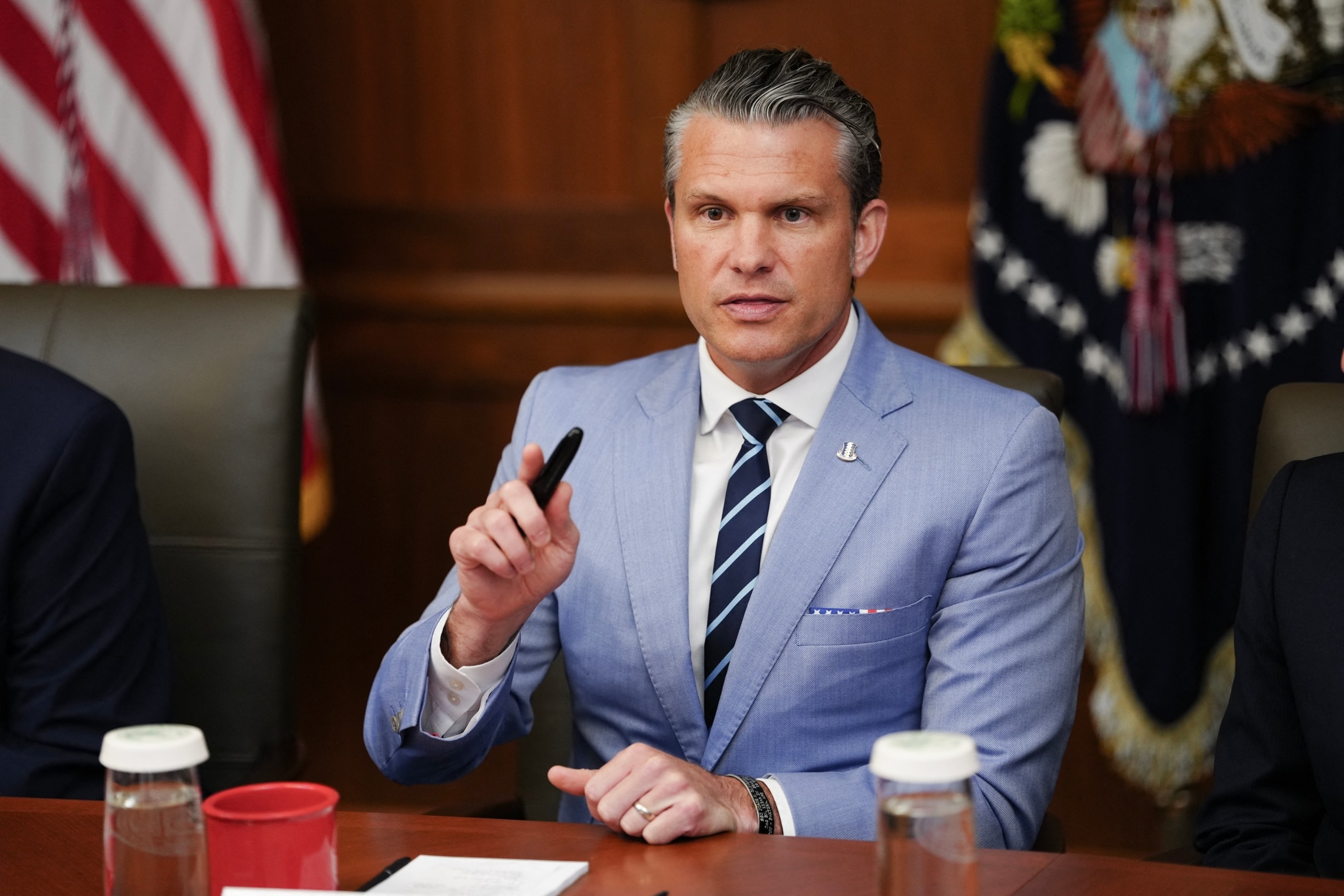
Secretary of Defense Pete Hegseth speaks during a Cabinet meeting hosted by US President Donald Trump at Camp David in Maryland, July 31, 2026.
Aaron Schwartz/AFP via Getty Images
The Army, the military's largest branch and by far its biggest recruiting challenge, hit its fiscal 2026 goal, signing 61,500 active-duty soldiers before a Sept. 30 deadline this year. The Navy also met its target with 45,000 sailors, while the Air Force recruited nearly 33,000 airmen.
The Marine Corps is also on track to meet its recruiting goal this year, according to officials, having largely sidestepped the deeper struggles facing the other services. Its smaller size means it needs far fewer new recruits each year, typically bringing in about 30,000 Marines annually. Space Force, a branch still in its infancy, brought in 730 new recruits this year.
This year's recruiting numbers mark the third straight year every active duty military service has met its recruiting goal, a remarkable turnaround from the recruiting bumps that started to manifest in the late 2010s and fully materialized during the COVID-19 pandemic. In 2022, the Army brought in just under 45,000 new recruits when it needed 60,000, while the other branches also endured some of their worst recruiting years in decades.
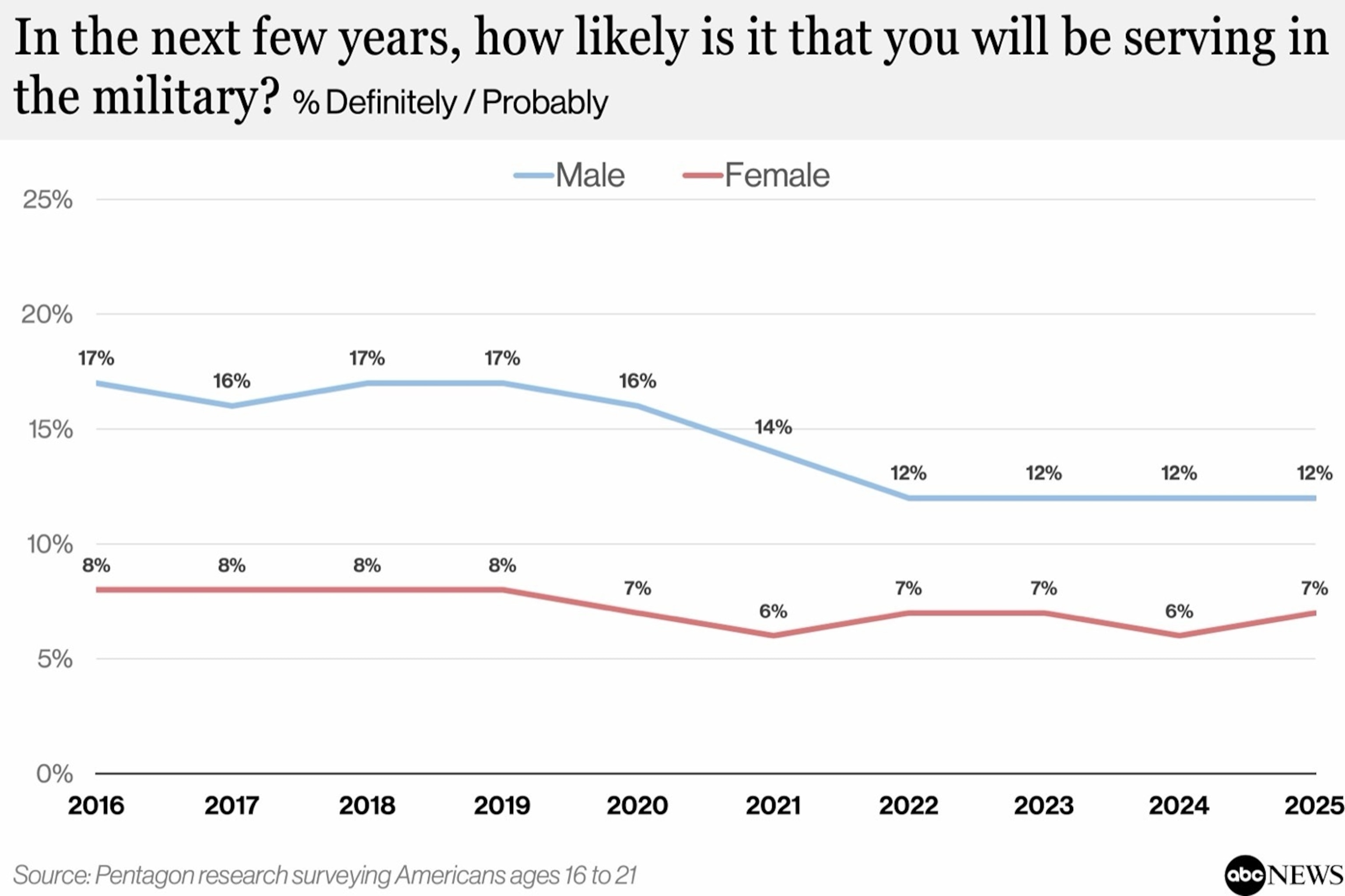
Military service likelihood
The Pentagon
It's the economy
Military service still offers one of the country's most robust benefits packages with college tuition, generous home loans, retirement savings and a pension for 20 years of service. For many, it marks one of the most direct paths to the middle class. Pentagon data consistently shows pay, education benefits and career opportunities are the primary reasons young Americans enlist.
Khaleed Ajadn, 24, a potential recruit and Nigerian green card holder, studied medicine in the Caribbean and now works as a medical assistant at a civilian clinic in the U.S.
"The end goal for me is to be a doctor in the Air Force," he said. "I just want to be in the military. I want to take care of people."
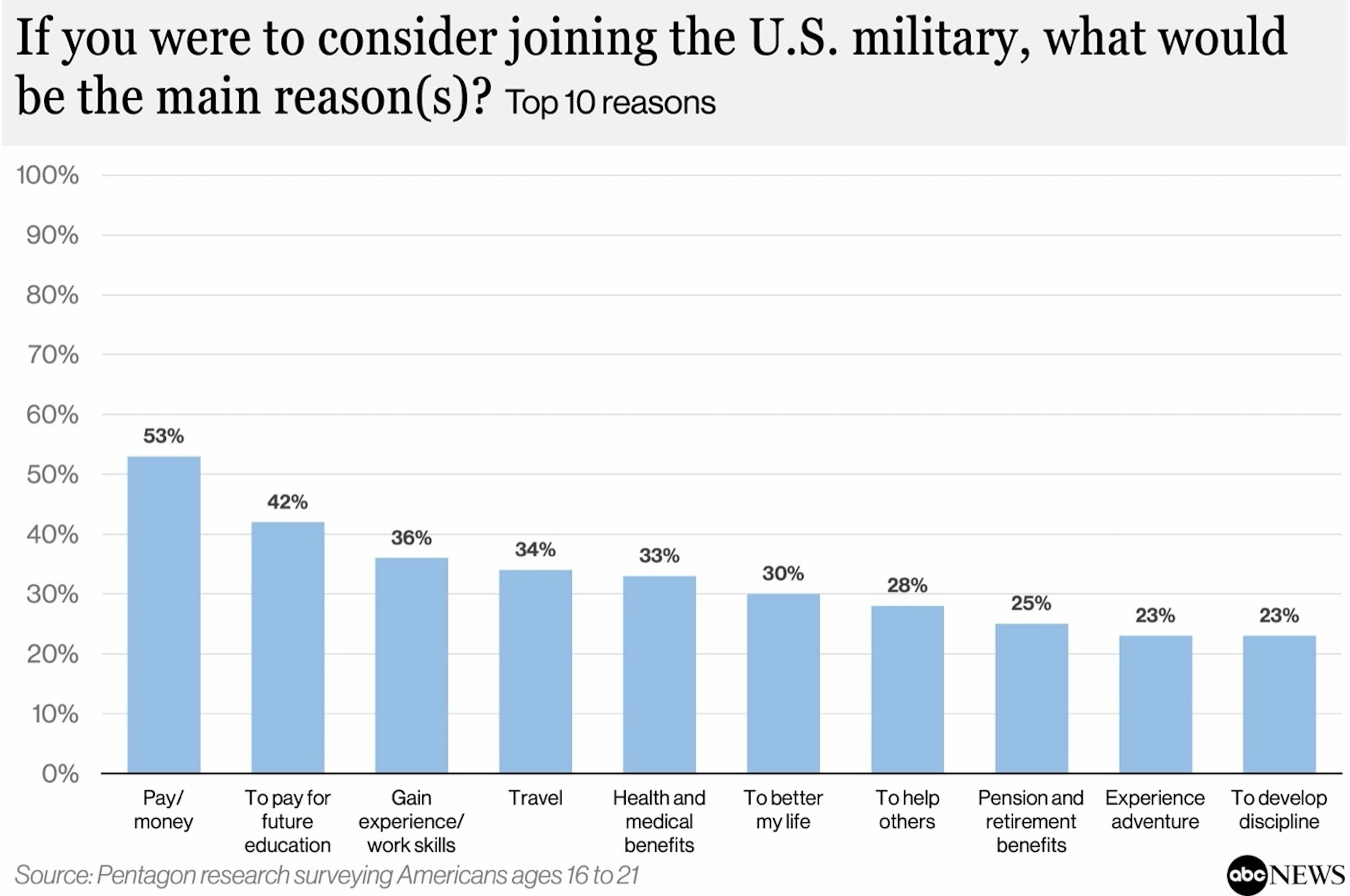
Main reasons for military service
The Pentagon
Others join as a response to a shifting economy. The propensity to serve, per the Pentagon's own survey data, broadly aligns with federal data tracking the youth unemployment rate.
"I was really hoping to be an artist, but then AI came along and I needed to find something more practical," Layla Gerstman, 18, said as she prepared to take the military's SAT-style aptitude test, which determines eligibility for enlistment and qualifies recruits for specific jobs.
Historically, the strongest predictor of a recruiting boom has been a weak economy. The 2008 financial crisis, the deepest economic downturn since the Great Depression, saw the Army enlist about 80,500 active-duty recruits. It marked the best recruiting year since the immediate aftermath of the Sept. 11, 2001, terror attack and after years of struggling to fill the ranks as the Iraq War became increasingly unpopular and bloody. Just a few years earlier, in 2005, the service had missed essentially the same recruiting target by 6,600 soldiers.
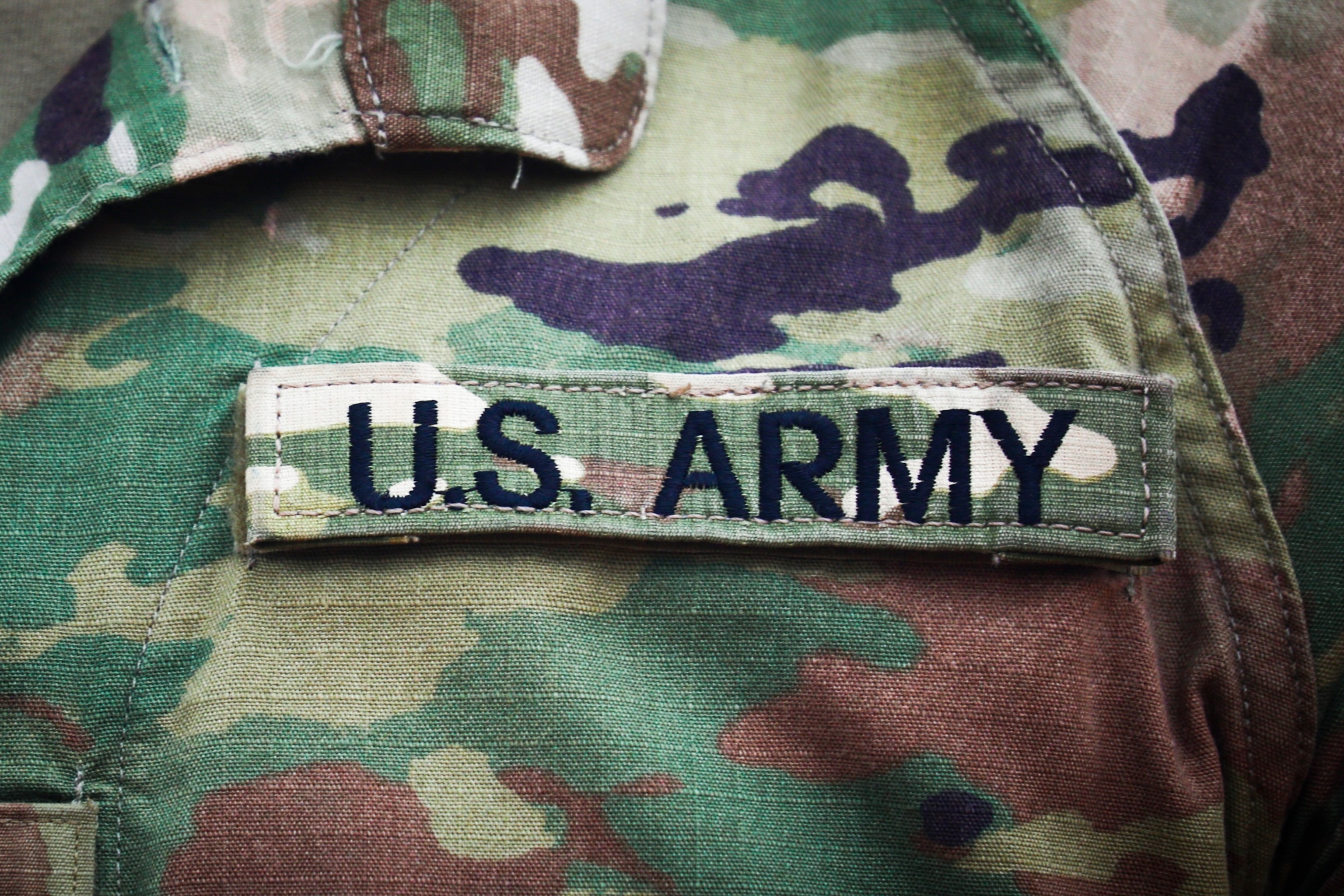
U.S Army badge is seen on a uniform of American soldier who attends a ceremony at the Kosciuszko Mound in Krakow, Poland, Aug. 4, 2020.
Beata Zawrzel/NurPhoto via Getty Images
Why recruiting became political
The Pentagon is emerging from the yearslong recruiting slump that followed the COVID-19 pandemic, easing one of the military's most persistent political headaches that drew bipartisan anxiety on Capitol Hill.
Hegseth's rhetoric has also fueled concerns about the Pentagon's ability to recruit and retain an increasingly diverse force.
Current and former defense officials interviewed pointed to comments they say echo Christian nationalism, including rhetoric that at times casts the military’s role in the world through the lens of divine intervention.
They also pointed to Hegseth’s long-standing skepticism of women serving in some military roles, particularly combat units. In his 2024 book, "The War on Warriors," Hegseth drew a distinction between the roles of mothers and fathers, writing that fathers encourage children to take risks while mothers are more protective.
"We need moms," Hegseth wrote. "But not in the military, especially in combat units."
Meanwhile, the Pentagon has rolled back shaving exemptions for troops with pseudofolliculitis barbae, or razor bumps, a condition that disproportionately affects Black men and that the military has accommodated for decades. Those accommodations trace back in part to Vietnam War-era recommendations aimed at removing barriers for Black service members. The move is part of a greater effort, which have been framed by the Pentagon as a means to restore discipline.
The Pentagon has also pulled recruiting resources from events aimed at specific demographics. Last year, the services abandoned recruiting efforts at a prestigious Black engineering event in Baltimore, where recruiters had historically sought candidates with high-demand technical skills. The Army also ended its partnership with Ashley Hall, an all-girls preparatory school in Charleston, South Carolina, for its annual "Introduce a Girl to Engineering Day," Military.com reported. Both efforts targeted science and engineering talent, fields where the military has long struggled to fill critical jobs because of steep academic requirements.
Taken together, current and former officials interviewed say, those positions could narrow the military's recruiting pool while pushing some troops already in uniform to reconsider staying.
Alex Wagner, who served as assistant secretary of the Air Force for manpower and reserve affairs during the Biden administration, argued recruiting has remained remarkably insulated from those political battles.
"It's curious to me that, so far, it seems the moral rot from Hegseth's office hasn't metastasized to the recruiting side," he said. "The people in charge of recruiting are really focused every day on, 'How do we bring in the most talented force to protect the American people?' That's an honorable goal, and when that's your mission, politics doesn't figure into it."
The recruiting pool itself has also changed. In recent years, the Army shifted more of its recruiting effort into large Democratic-leaning cities after traditional recruiting strongholds in the South, rural America and the suburbs could no longer produce enough qualified volunteers.
The South in particular faces higher rates of obesity and other health challenges that have further reduced the pool of eligible recruits and contributed to higher injury rates during basic training, according to service data.
In recent years, the force has become more diverse, with women and racial minorities making up a growing share of recruits.
Since 2013, male enlistments in the Army have fallen by roughly 35%, dropping from about 58,000 recruits to 37,700 in 2023, according to Army data. Female enlistments, by contrast, have remained relatively steady at around 10,000 recruits a year.
The racial makeup of recruits has changed as well.
The number of white recruits in the Army fell by nearly 40% between 2018 and 2023, according to Army data. No other major demographic group experienced a comparable sustained decline. More than a quarter of recruits across the services are Black or Hispanic.
The armed services have also become more secular.
Christianity, long embedded in military life through the chaplain corps and its role in supporting morale, has played a less prominent role as the services have invested heavily in traditional mental health resources such as therapists, marriage counselors and suicide prevention efforts -- arenas that historically have largely fallen under the umbrella of the military's clergy.
All of those slow-moving cultural shifts came to a head in 2021, when in the Army's effort to broaden its appeal, it released an ad featuring a female soldier in the service and raised by two mothers in San Francisco, which immediately drew the ire of conservative pundits and lawmakers who argued the military had become politicized and "woke."
Hegseth had embraced the argument that the military had drifted too far to the political left well before he was tapped to lead the Pentagon. Last year, he summoned hundreds of the military's most senior officials to an unprecedented gathering in Quantico, Virginia, where he bluntly laid out his new cultural mandate, falsely suggesting women have been erroneously promoted to fit nonexistent gender quotas.
"For too long, we've promoted too many uniformed leaders for the wrong reasons, based on their race, based on gender quotas, based on historic so-called firsts," Hegseth said. "No more identity months, DEI offices, dudes in dresses. No more climate change worship, no more division, distraction or gender delusions."
The services did not have any quotas associated with gender and promotions or makeup of the force.
Eligibility crisis
Defense officials have long warned that America's obesity epidemic is a national security problem, shrinking the pool of young people eligible to serve -- which has translated to reductions in recruitment.
The services have different body weight requirements based on age and gender. The Pentagon estimates roughly 75% of Americans ages 17 to 24 are ineligible to serve, and has been that way for a long time, with obesity and failure to meet academic standards among the leading reasons.
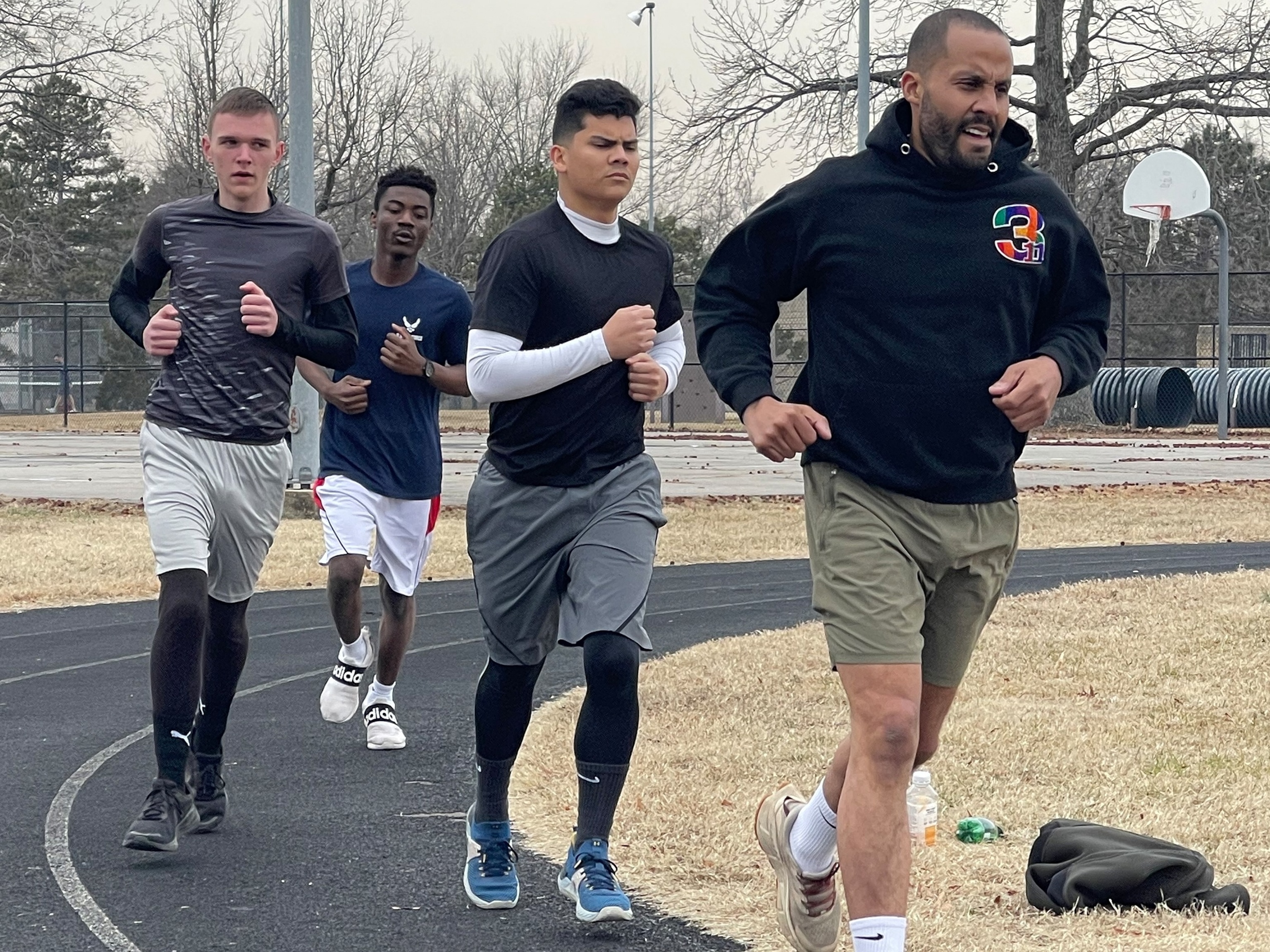
New Air Force recruits conducting a fitness test to qualify them to try out for special operations.
Steven Beynon/ABC News
The Army's most significant response has been the Future Soldier Preparatory Course, a pre-basic training program primarily at Fort Jackson, South Carolina, for recruits who narrowly miss academic or body-fat standards. The Navy has since adopted a similar model.
"This was a group of young Americans who had already decided they wanted to join the military. They just needed some extra help meeting the standards," said Christine Wormuth, who served as Army secretary during the Biden administration and oversaw the program's creation. "The hardest thing is finding people who have the propensity to serve. We had this entire pool of people who wanted to do it."
Wormuth said Army leaders were adamant that the initiative not become a backdoor way of lowering enlistment standards. The military has tried that before, from World War II literacy programs to Defense Secretary Robert McNamara's controversial Project 100,000 during the Vietnam War, which admitted recruits who failed academic entrance standards and ultimately suffered disproportionately high casualty rates.
"We felt strongly that lowering standards was not the way to go," Wormuth said.
Another major hurdle has been medical screening. The 2017 rollout of Military Health System Genesis, the Pentagon's electronic health records system, gave screeners legal, unprecedented access to applicants' medical histories often flagging minor injuries, childhood diagnoses or old prescriptions without their full context and triggering lengthy additional reviews.
One particularly stubborn bottleneck automatically sent recruits who wore glasses for screening for rare disqualifying eye conditions, a requirement officials eventually scrapped. The Pentagon has since sought to speed up the process through streamlined reviews and a surge of medical personnel, including Army Reservists sent to help staff screening clinics.
Who is born to serve?
Hegseth has aggressively moved to reshape the military's senior ranks, removing or sidelining more than two dozen senior officers, without explanation, including a number of women and minorities. While those moves appear to have had little impact on young Americans walking into recruiting stations, they have rattled the upper ranks, with multiple senior officers describing needing to keep a low profile.
"Women look at the firings and the statements from the secretary and decide there is not a good career path ahead of them," said Brenda Sue Fulton, a West Point graduate, longtime military diversity advocate and former assistant secretary of Veterans Affairs for public and intergovernmental affairs.
"The same thing with Black men and women," she added. "They're looking at the chain of command, which has become much more male and much whiter over the past few months, and thinking there's no place for them here."
Military service has long been cast as the highest form of public service. But from the nation’s earliest days, the military has also been a battleground over a more fundamental question: who gets to serve, and who gets the privilege of risking their life for the country.
Those fights stretch back to the nation’s founding, when property and social standing helped determine who could become an officer in the Continental Army and Indigenous troops were afforded limited roles. In the generations since, similar battles have played out over the service of Black Americans, women and LGBTQ+ Americans.
A growing question among defense experts and across the military's recruiting enterprise is whether Hegseth's partisan rhetoric built upon cultural grievances is shrinking the military's appeal.
"Here in Washington D.C., we're consumed by these things," Wagner, formerly of the Air Force, said. "But if it doesn't directly impact your life, it doesn't come up."
KioskNews shows a cleaned-up reading view extracted from the publisher’s page — the original always lives on their site, not ours.