Winner of Invertebrate of the Year 2026 crowned – and it is the size of a grain of rice
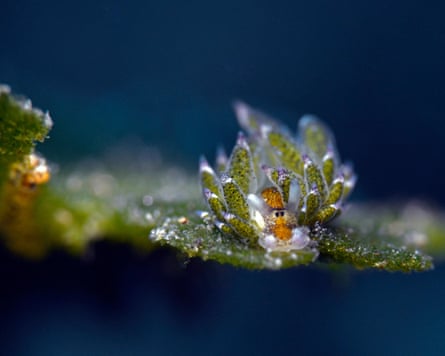
A neon green solar-powered slug that lives underwater is the winner of the increasingly popular Invertebrate of the Year competition run by the Guardian.
The leaf sheep, Costasiella kuroshimae, triumphed in the global ballot after hundreds of thousands of readers around the world read about and shared their appreciation for the spineless creatures who make up the majority of animal life on Earth.
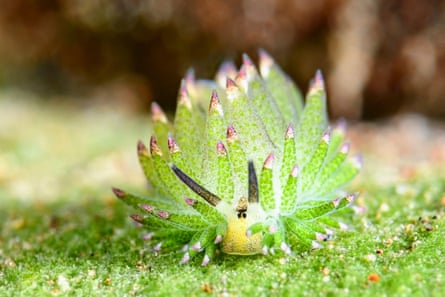
Announcing the winner, the broadcaster and environmental campaigner Chris Packham said: “It’s very, very beautiful but also very smart too. It harvests photosynthetic material from the algae it feeds upon and builds its own solar panels.”
In a much closer contest than previous years – when the tardigrade and the common earthworm won with popular landslides – the beady-eyed, charming leaf sheep fought off strong competition from the world’s largest bumblebee, the moscardón, Bombus dahlbomii, which finished second. This giant ginger bumblebee is increasingly threatened in its native Patagonia because of invasive bumblebee species introduced by humans in recent decades.
In third place was the horseshoe crab, a remarkable arthropod that pre-dates the dinosaurs and contains blue blood, closely followed by the common woodlouse.
Although worms have historically polled very strongly in the competition, bringing up the rear in 10th place on this year’s shortlist was the astonishing bootlace worm, one of the longest animals in the world.
The competition was launched three years ago to celebrate overlooked and often derided invertebrates, who number at least 1.7m species – about 97% of all animals – with probably millions more still to be discovered and described by science. Without the unpaid labour of wild invertebrates who pollinate crucial crops, filter water, recycle waste, clean up pollution and add fertility to soils, human life on Earth would quickly perish.
after newsletter promotion
This year, several thousand spineless candidates nominated by Guardian readers, including everyone from scientists to children, were whittled down to a shortlist of 10.
As each candidate was announced during a two-week fiesta of invertebrate appreciation, experts offered their perspectives with Erica McAlister extolling the importance – and beauty – of flies, the wildlife photographer Dara Ojo revealing the joys of macro photography, and Connor Butler pointing out how there is no “other” in the natural world: we are all part of the same living systems.
The leaf sheep, which lives in tropical waters around Japan, Indonesia and the Philippines, was only first described by science in 1993. Since then, it has become increasingly celebrated in human culture thanks to advances in underwater macro photography that have revealed its remarkably cute appearance, which has inspired at least one Pokémon character.
KioskNews shows a cleaned-up reading view extracted from the publisher’s page — the original always lives on their site, not ours.