Latest polls show Brad Bradford catching up with Olivia Chow in Toronto mayoral race
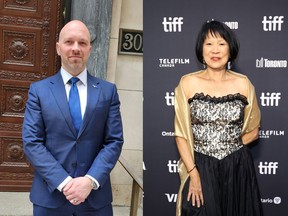
The Toronto mayoral election is now just over a month away, and the latest polls show Councillor Brad Bradford closing the gap with Mayor Olivia Chow after a drop in her support.
Sign In or Create an Account
A recent Liaison Strategies survey shows Chow currently leading Bradford by seven points, down from her 11-point lead in early September. She receives support from 47 per cent of voters, compared to 50 per cent earlier in the month, while Bradford’s share of support has increased from 39 per cent to 40 per cent.
This picture varies, however, across different parts of the city. The Liaison Strategies data reveals that the most competitive areas in Toronto are North York and Scarborough, where Chow leads Bradford 46 per cent to 41 per cent and 46 per cent to 43 per cent respectively.
Those are much closer results than Etobicoke, where Bradford leads 54 per cent to 33 per cent, or Downtown, where Chow leads 60 per cent to 27 per cent.
Meanwhile, there is also a sharp age divide among younger age groups. Bradford has 47 per cent among decided and leaning voters aged 18 to 34, compared with 41 per cent for Chow. Among those aged 35 to 49, however, Chow leads 57 per cent to 33 per cent.
Despite Chow’s smaller cushion compared to previous polls, David Valentin, principal at Liaison Strategies, said the latest survey results are “not enough to establish a new trend.”
“Bradford has gained some ground without overtaking the mayor,” he said.
Though Valentin doesn’t make suggestions about the reasons for the closing gap between Chow and Bradford, the survey did ask voters about the issues that matter most to them in the mayoral race.
Cost of living came first at 23 per cent, followed by housing affordability at 19 per cent, crime and public safety at 17 per cent, and traffic and congestion at 13 per cent. Together, cost of living and housing account for 42 per cent of responses.
Meanwhile, the latest Mainstreet Research survey also reveals what it calls “a tighter race” post-Labour Day and following the first mayoral debate, which took place on Sept. 14.
Among those surveyed, 38.8 per cent said they would vote for Chow, while 31.4 per cent said they would vote for Bradford. But 13.5 per cent said they might change their vote before election day and 16.8 per cent remain undecided.
In contrast to Valentin’s assessment, Quito Maggi, president & CEO of Mainstreet Research, said the latter two figures make the Toronto mayoral race “too close to call.”
Elsewhere, Chris Alexander, who was once Canada’s ambassador to Afghanistan and an immigration minister under former prime minister Stephen Harper, comes in third in both polls, with 10 per cent support in the Liaison Strategies survey and 8 per cent support according to Mainstreet Research.
Alexander joined the mayoral race on July 29 and, at the time, Valentin noted this might pose a problem for Bradford, because he “no longer has the centre-right lane entirely to himself.”
However, Alexander’s support remains unchanged from the previous Liaison strategies survey.
Instead, Valentin suggests Bradford’s main challenge lies in his personal approval ratings. Though the share of voters who view him favourably has increased from 31 per cent to 33 per cent, so has the share who view him unfavourably, which is now 37 per cent, up from 34 per cent.
It comes as the share unfamiliar with him has fallen from 24 per cent to 19 per cent, with another 11 per cent unsure.
Meanwhile, the latest polls coincide with Ontario Premier Doug Ford appearing to endorse Chow last week, before taking back his comments a day later.
At a press event in North York on Sept. 17, a reporter asked Ford for his thoughts on the mayoral race, to which he responded that he had “a phenomenal relationship” with Chow. “We’re going to continue supporting the mayor. She’s doing an incredible job,” he said. “So, read between the lines.”
The Bradford campaign, having positioned itself as the conservative alternative to the left-wing Chow, later released a statement to the media which said “of course the premier endorsed Olivia Chow” because “she’s the easiest negotiation he has ever had.” It went on to say that she “handed over on a silver platter” things she had vowed to oppose.
Then, on the evening of Sept. 18, the Premier’s Office released a statement of its own, which read: “We would like to clarify that Premier Ford did not endorse Olivia Chow and will not endorse any candidate in the Toronto mayoral race.”
Ford explained during an appearance on Newstalk 1010 the following morning that “read between the lines” was meant as a message to say, “we’re going to work things out” and “get through this.”
“When I endorse someone, which I’m not, you come out and fully endorse them. You don’t say, ‘read between the lines,'” he said.
Liaison surveyed a random sample of Toronto residents from September 19 to September 20, 2026, and the resulting data was weighted to match targets based on the 2021 Census. For the total sample, the margin of error is +/- 3.1 percentage points, 19 times out of 20.
The Mainstreet Research poll was conducted between September 14 and 17, 2026 and also has a margin of error of +/- 3.1 per cent, 19 times out of 20.
Our website is the place for the latest breaking news, exclusive scoops, longreads and provocative commentary. Please bookmark nationalpost.com and sign up for our politics newsletter, First Reading, here.
Join the Conversation
This website uses cookies to personalize your content (including ads), and allows us to analyze our traffic. Read more about cookies here. By continuing to use our site, you agree to our Terms of Use and Privacy Policy.
KioskNews shows a cleaned-up reading view extracted from the publisher’s page — the original always lives on their site, not ours.