‘We want little boys to go and young men to return’: Scotch College’s bold vision for the next generation
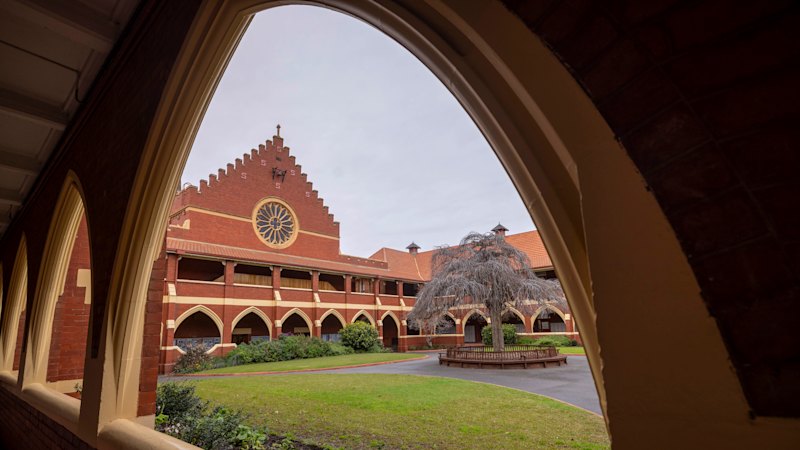
Jason Potoi Andrew can still remember arriving at Scotch College for the first time. It was 1984, and he was touring the school that his father, David, had graduated from two decades earlier.
The pair were soon approached by Ron “Chesty” Bond, a revered classics teacher and vice principal who worked at the school for close to four decades and was a favourite among generations of boys who gave him a nickname that stuck for life.
“He came up to Dad and said, ‘Oh, David Andrew, I remember you. I taught you Latin’,” he says. “It was a nice moment.”
It’s an example of what Scotch alumni, known as Old Boys, like to call the cardinal thread – an intangible link named after the distinctive shade of red in the school’s blazer and tartan that links the past with the present.
While outsiders might see it as a network founded on privilege, entitlement and affluence, for Potoi Andrew, connections aren’t made in boardrooms or clubs, but rather in interactions like the one his dad shared with “Chesty” Bond.
“I wouldn’t say that going to Scotch has smoothed a path because things have changed a lot,” he says. “You’ve got to prove yourself.”
Potoi Andrew’s sons Maximus and Austin had their names put down at birth, and became third-generation “Scotchies” when they ultimately joined the school. Again, the cardinal thread played its part.
“I knew maybe two people when I started,” Maximus says. “But knowing that my dad came here, and my grandpa also came here, it was easy to find friends.”
Austin’s entry was similarly linked to his Scotch heritage, but he credits playing percussion in the school’s military band, an arm of the 142-year-old cadet corps, as his cardinal connection.
“You learn more about the school and its history in cadets,” he says. “Things like what we did during World War I and about key figures like [General Sir John] Monash.”
Having started at the school as an 11-year-old before graduating equal dux in 1881, Monash is a favoured son of Scotch. His bust, left breast laden with military medals, is displayed at reception, while Principal Dr Scott Marsh has a smaller version in his office.
Other references to the school’s history and legacy are scattered across the 27-hectare Hawthorn campus, one of four owned by the college.
The $32 million science centre is named after former student and governor-general Sir Zelman Cowen while a plaque on the Cardinal Pavilion rowing shed on the banks of the Yarra River states it was opened by former school vice captain and later Liberal Party leader, Andrew Peacock.
“The boys are aware they are part of something incredibly special,” Marsh says.
“They are part of a school that has made incredible contributions to Australia and beyond.”
Scotch does like to talk, modestly if possible, about its high-flying graduates. They include a prime minister, eight premiers, three governors-general and four High Court justices. And that’s before you get to collegians who have headed the navy, defence force, Reserve Bank, the Australian Security Intelligence Organisation, and universities, including Oxford.
The college’s full-time archivist Paul Mishura says alumni have received more top Order of Australia honours than any other school in Australia, and more than 70 Old Boys have been knighted.
When asked where the school sees itself in the Melbourne private school hierarchy, Marsh says with a pause, “Well, because we value humility, we don’t like to say.”
Moments later, he’s back on message.
“We like to talk about how we develop good men of good character who will go and shape a better future,” Marsh says. “That’s what we like to talk about.”
Scotch’s strategic plan, developed over more than two years and released last year, frames the school as an institution focused on instilling character and fostering boys who aim high but keep their feet on the ground.
At the most recent Young Old Boys of Scotch College (or YOBS) annual dinner in June, the school’s oldest Old Boy, 110-year-old Bill Morgan, spoke via a recorded message.
The 1935 school captain, who played rugby for Victoria alongside Edward ‘Weary’ Dunlop, urged the YOBS to remember the lessons that went beyond the curriculum.
“Give thanks to the teachers who helped create your character,” Morgan stressed.
The school’s strategic plan also outlines a desire to look past the “narrow goal of attaining an ATAR” because, it says, there is more to school than preparing students for university. (Though an honour board with the names of 31 Rhodes Scholars hangs to the right of the altar in the Memorial Hall.)
Scotch’s median VCE study score has remained above the statewide median of 30 throughout the past decade, recording a high of 36 in 2017. For the past three years, it has sat on 34.
Last year, three students achieved a perfect ATAR of 99.95, with 36 students recording an ATAR of 99 or above and a further 80 students scoring 95 or above.
“We’re selective in that you’ve got to be able to afford over $40,000 for fees. Yes, I accept that. People always criticise me when I don’t say that. But academically we’re not selective at all,” Marsh says.
Growing up with Melbourne
Founded by Scottish-born Presbyterian minister James Forbes in 1851 – the same year gold was discovered in Victoria and just 15 years after the foundation of Melbourne – Scotch College is the state’s oldest secondary college.
“We’re selective in that you’ve got to be able to afford over $40,000 for fees... But academically we’re not selective at all.”
Principal Dr Scott Marsh
Its history has risen and fallen as the city cycled through boom and bust. Mass migration triggered by the gold rush grew the school and the city, with migrants who could travel unassisted being largely educated and literate. Scottish Presbyterians, in particular, prized literacy because you couldn’t be a good Christian if you couldn’t read the Bible.
“Right from the beginning you’ve got a mindset in Melbourne that if you’re middle class, you don’t go to state schools,” retired Melbourne University sociologist emeritus professor Janet McCalman says.
But when the 1890s and 1930s depressions hammered Melbourne, Scotch enrolments were hit too, according to McCalman’s book, Journeyings, on Melbourne’s middle class.
However, while not as pronounced now, McCalman says ‘being Scotch’ was a currency that was traded and treasured even when times were tough.
Initially built in East Melbourne on land gifted to the Presbyterian church by government, Scotch was known as the Melbourne Academy until 1855 and colloquially by some as “the green door school”. It was small and existed without a motto, coat of arms or uniform.
“There was no need to distinguish the school from others because there was no interschool sport at that time,” Mishura says.
There was however a game played in 1858 between Scotch and its nemesis Melbourne Grammar which is considered the first recorded AFL match.
The game spanned three consecutive Saturdays and ended in a draw, with each side kicking one goal. Officiating was a Scotch chemistry and natural sciences teacher John Macadam – after whom the macadamia nut is named.
Between 1916 and 1926, Scotch moved to its Hawthorn hilltop. When the school bought the property, it was understood to be 20.64 hectares – but it ultimately turned out to be 27 hectares. The boundaries have since contracted to the south and expanded to the north.
The school’s footprint extended northwards after the college bought all 12 houses on Morrison Street, with some demolished and others used as the school’s museum and Old Boys’ Association headquarters.
To the south, a narrow strip of land next to three of Scotch’s five ovals was compulsorily acquired in 2008 when CityLink was widened.
In 2013, the then-Napthine government paid $5.4 million for the sliver of land, valued at just over $1 million by Victoria’s Valuer-General.
Old Boy and former state Liberal Party MP David Kemp headed the taskforce to ensure the school got what it considered fair compensation, a campaign that included Supreme Court legal action initiated by Scotch.
Scotch was again in the headlines in 2015 when it revealed former students had suffered abuse on school grounds. Several historical claims were settled, most involving sexual abuse dating back to the 1950s and 1960s. Earlier this year, one former student launched legal action over allegations of abuse that occurred during a school camp on Phillip Island in the 1970s.
More recently, the school attracted attention over a controversial decision to invite an anti-abortion activist to speak to year 11 students, for which Marsh apologised.
A measure of a school’s socio-educational advantage is known as the ICSEA score which is calculated using parents’ occupation and level of education attainment – as well as the remoteness of the school and the percentage of Indigenous students, which for Scotch is 1 per cent.
Data from Australia’s curriculum and assessment authority shows that an ICSEA score of 1000 is the national average score. At Scotch, it is 1188, with just over three-quarters of families in the top quarter of socio-educational advantage.
Like all schools, Scotch receives state and federal government funding. The most recent data shows that in 2024 it received $6.83 million from the federal government, while the state government provided $1.99 million.
The active network of Old Boys and current families can also raise sizable funds at short notice.
When Cyclone Fina hit Tiwi College, Scotch’s partner school on Melville Island, last November, the remote boarding school of 77 students was left with flooded boarding houses and classrooms with collapsed ceilings and shattered windows.
Within 24 hours, Scotch had raised $522,000.
“It’s a very generous, humble community, despite the labels that are thrown at it,” Marsh says.
The school’s foundation, which oversees fundraising, scholarships, infrastructure spending and programs generated from bequests and donations, spent more than $2.4 million on scholarships and bursaries last year alone.
And with a surplus of almost $4.9 million, it can afford to dream big.
Speaking at a gathering earlier this year, president and Old Boy Paul Aberdeen pondered what future contributions the foundation could make to the school, which turns 175 this year.
“It’s fun to dream, isn’t it?” he mused.
“We could be talking about new grandstands and sporting facilities. New buildings. Finally bringing the Hambledon Road area to life after patiently buying up those 25 houses over the years.
“We’re even dreaming about new institutes and facilities you’d normally only find at a university.”
The Hambledon Road houses Aberdeen referred to are residential properties to the north of the school that have been purchased over decades and are key to ambitious expansion plans the school has for its main campus.
Another two properties on Fordholm Road, purchased in 2004 and 2022 for a combined $5.65 million, have already been repurposed. The homes were demolished, and the land is now a staff car park.
The school is also poised to sign a $60 million deal to buy a property just down the hill on Glenferrie Road, Kooyong, from Vision Australia – an acquisition all the more satisfying because Scotch outbid long-term rival and neighbour St Kevin’s College.
The deal comes three years after Scotch bought Fairhaven, a 175-hectare waterfront property bordering a UNESCO biosphere reserve in Mallacoota. It will become Scotch’s third outdoor education campus after an 80-hectare Healesville plot and a sizable beachfront property at Cowes on Phillip Island.
Like its Hawthorn headquarters, the Healesville and Cowes boundaries have expanded over decades with the purchase of neighbouring properties.
However, Fairhaven will be the centrepiece. According to Aberdeen, it will be Scotch’s answer to Geelong Grammar’s prized Timbertop campus – but with an ocean view.
“It’s where we want little boys to go and young men to return,” Marsh says.
“I think in our society we have an epidemic of 20, 30, 40, even 50-year-old little boys; men who haven’t taken on the responsibility of being a man.”
Marsh was there last year when a pilot group of year 9 students visited and, as a man whose Christmas holidays are spent camping with his family, it made an impression on him.
“Out of the 23 or 24 boys we had there, I think only three or four had ever been in a tent,” he says.
Having led the school since 2023, Scotch College is not a world Marsh was born into. Where his alma mater had one school oval, Scotch currently has five.
Arriving as both a runner-up and an outsider, his name was in the leadership mix when the 17-member college council appointed Matthew Leeds as the school’s 10th principal.
But before Leeds could take up the post, a whistleblower revealed a complaint alleging misconduct was made against him in 2017 at his former school, Geelong Grammar. Two separate investigations by Geelong Grammar and the Victorian Institute of Teaching did not substantiate the claims made against Leeds.
KioskNews shows a cleaned-up reading view extracted from the publisher’s page — the original always lives on their site, not ours.