The 8 wars Trump claims to have ‘settled’ in his last-minute Nobel Peace Prize pitch
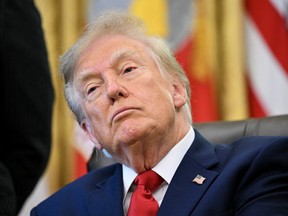
South African lawyer Navi Pillay was awarded the Nobel Peace Prize on Friday, despite a last-minute pitch from U.S. President Donald Trump.
Sign In or Create an Account
“I don’t know what their decision is going to be. They have a reputation for maybe not giving it to people like me,” Trump told reporters in the Oval Office on Wednesday when asked about the accolade. “I settled eight wars … I did things that nobody else has ever done. I’m not bragging, I’m just telling you the facts,” he added, claiming to have saved “millions of lives.”
It’s not the first time the U.S. president has touted his role in settling eight wars. In fact, he’s mentioned the figure several times before. But what are those wars? Did they really end? And, if they did, is it thanks to Trump? Here are the facts.

Get a dash of perspective along with the trending news of the day in a very readable format.
By signing up you consent to receive the above newsletter from Postmedia Network Inc.
A welcome email is on its way. If you don't see it, please check your junk folder.
The next issue of NP Posted will soon be in your inbox.
We encountered an issue signing you up. Please try again
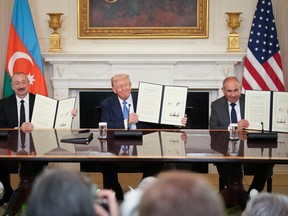
The two former Soviet republics and Trump signed a provisional peace agreement at the White House on Aug. 8, 2025. But movements towards implementing the deal have been halting.
On the anniversary of the signing of the joint declaration, U.S. Secretary of State Marco Rubio released a press statement reaffirming Washington’s commitment to realizing the deal. Azerbaijan’s president, Ilham Aliyev, wrote an open letter to Trump praising the U.S. president’s role in bringing about “a turning point in the pursuit of lasting peace” in the region.
But, in July this year, Azerbaijan said it will not sign a final deal unless Armenia changes its constitution, specifically its reference to a Soviet-era document calling for the reunification of Armenia and Nagorno-Karabakh, a region Azerbaijan took control of in 2023.
Cambodia and Thailand
Cambodia and Thailand agreed to a ceasefire in July 2025, following a five-day military conflict, after efforts by Malaysia, the U.S. and China to bring both sides to the table. Trump said he would not conclude trade deals with them until the conflict ended.
A few months later, in October, the leaders of Thailand and Cambodia signed an enhanced ceasefire deal in the presence of Trump. Then, in December, a new ceasefire deal that Trump wasn’t involved in was reached after widespread fighting resumed earlier that month.
Trump announced a peace agreement between the two African nations in June 2025, which was signed by the countries’ foreign ministers in Washington and required Rwandan troops to withdraw from eastern Congo within 90 days.
In December, the leaders of the DRC and Rwanda gathered in Washington to affirm commitments to the Trump-backed deal, but the deal hasn’t been implemented and the fighting has continued.
Since then, representatives of the U.S., the DRC and Rwanda have met in Washington in March and in Geneva, Switzerland, in July in attempts to further implement and reaffirm commitment to the peace agreement. But the conflict is far from over, with M23 rebels continuing to hold territory in Congo.

This conflict is one the Trump administration dealt with in his first term, though it’s not technically a war, just a period of heightened tensions.
The Grand Ethiopian Renaissance Dam on the Blue Nile has caused friction between the two countries because of Egypt’s worries about its water supply, for which it relies on the Nile. Sudan is also affected.
The U.S. president facilitated talks between Ethiopia, Egypt, and Sudan in Washington in 2019 and 2020, but negotiations stalled and no agreement was signed — though Trump has claimed on several occasions that his intervention helped stabilize the situation.
Tensions have persisted between these two countries since Kosovo declared independence in 2008 until this day, and no official peace deal has been signed.
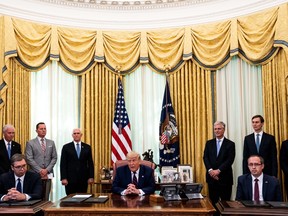
In his first term as president, Trump negotiated a wide-ranging deal in 2020 between the countries, but much of what was agreed on was never carried out.
Plus, it was never technically a war, so it also wasn’t technically a peace deal. Though Kosovo’s former president Vjosa Osmani did previously say that Donald Trump helped prevent further escalation in the Serbia-Kosovo region, the then Serbian president, Aleksandar Vucic, denied that any escalation had been looming.
Trump has claimed that a ceasefire brokered between India and Pakistan in May 2025 was down to the U.S., after several days of cross-border strikes marked the worst regional fighting between the two nuclear-armed nations in decades.
But while Pakistan’s government thanked Trump for his involvement, India downplayed the U.S. president’s claims, saying the two countries came to the agreement without external help.
Meanwhile, Pakistan Prime Minister Shehbaz Sharif nominated Trump for the Nobel Peace Prize for the second year in a row on Friday, writing in a social media post: “(Trump’s) timely intervention helped bring Pakistan and India back from the brink and secure a ceasefire, that is holding till today.”
President Donald Trump played a historic role in advancing peace in South Asia. His timely intervention helped bring Pakistan and India back from the brink and secure a ceasefire, that is holding till today.— Shehbaz Sharif (@CMShehbaz) October 9, 2026In recognition of his outstanding contribution, Pakistan had nominated…
On June 23, 2025, Trump announced a peace deal between Iran and Israel following 12 days of military conflict. Though shaky, the ceasefire ultimately held until a new war broke out following a joint US-Israeli attack on Iran in February.
In June, Washington and Iran signed a ceasefire agreement that quickly broke down over control of the Strait of Hormuz, and in September Trump rejected Iran’s seven-day ceasefire proposal.
More recently, the U.S. president said in a Truth Social post that his administration will not launch an attack on Iran before November’s mid-term elections.
At the White House on Wednesday, Trump claimed: “I’ve stopped maybe the total obliteration of the world because Iran will never have a nuclear weapon.”
The U.S. administration did help to broker a ceasefire that came into effect in October last year, but while it ended large-scale hostilities, violence in the region has continued.
Elsewhere, Trump has made it clear that he hopes to play a part in ending the Russia-Ukraine war. While speaking to press at the White House in July, he said an end to the conflict is “getting closer than people realize.”
He said he had held a “good call” with Putin on the Fourth of July holiday, “And President Zelenskiy actually wants it to end now. And we’re going to be going to NATO, and we’re going to be talking about it, and I think we’re going to get it,” he added. “I think we’re going to get it ended. It’s been a terrible situation.”
Our website is the place for the latest breaking news, exclusive scoops, longreads and provocative commentary. Please bookmark nationalpost.com and sign up for our newsletters here.
Join the Conversation
This website uses cookies to personalize your content (including ads), and allows us to analyze our traffic. Read more about cookies here. By continuing to use our site, you agree to our Terms of Use and Privacy Policy.
KioskNews shows a cleaned-up reading view extracted from the publisher’s page — the original always lives on their site, not ours.