From dancing in villages to multi-crore enterprise: The story of Garba in Gujarat
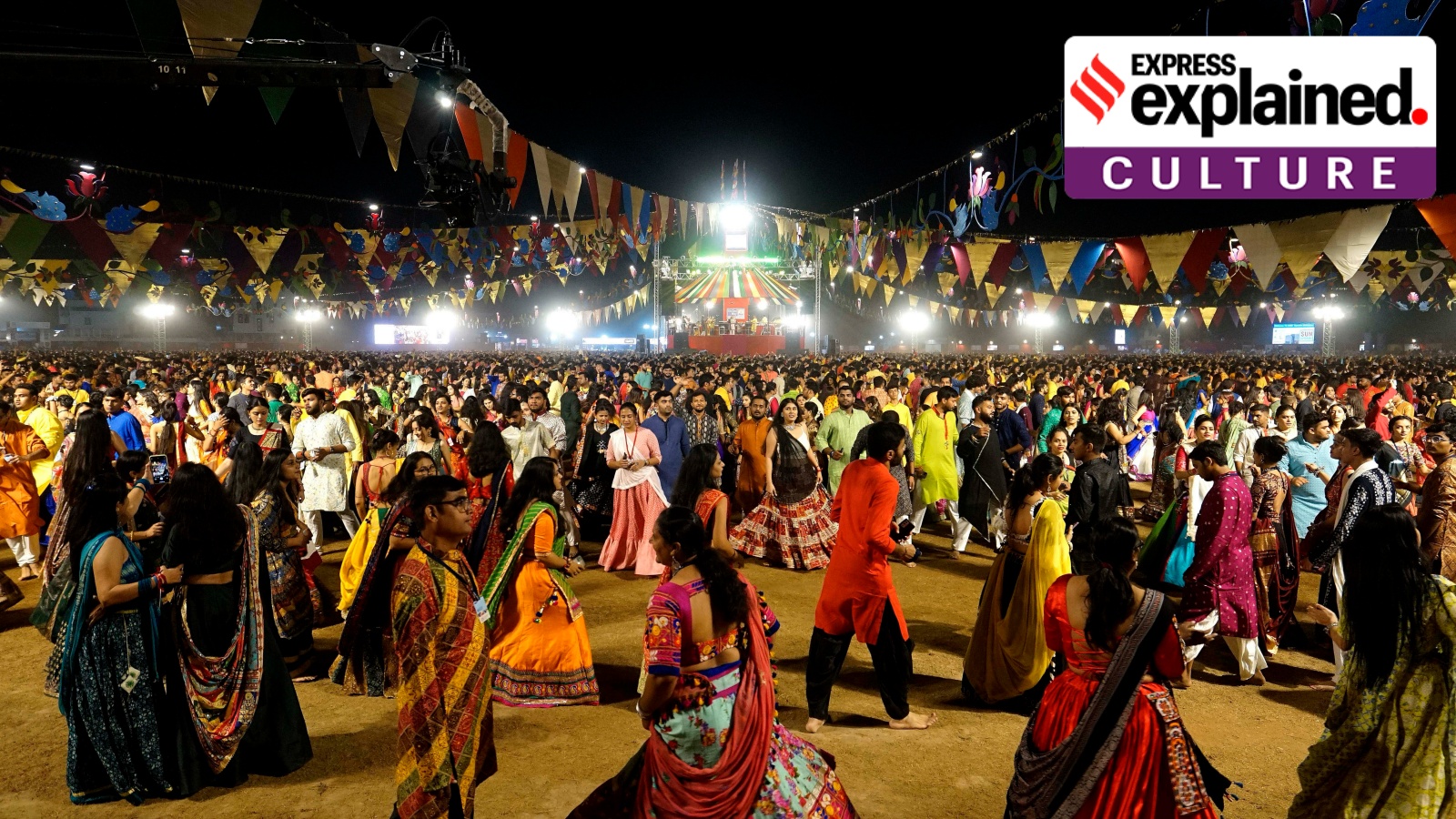
The nine nights of the Navratri festival, marked by dancing the Garba outdoors to welcome the Goddess Ambe Maa, began in Gujarat on Sunday (October 11). The state government has not announced any curbs on the closing time this year.
What is the Garba, how did the tradition of community dancing emerge and evolve, and why has it become such a massive cultural phenomenon in Gujarat?
Garba in Gujarat, which was inscribed on the Representative List of the Intangible Cultural Heritage of Humanity by UNESCO in December 2023, is the devotional ritual dance that was once performed only by women in their homes and in temple courtyards during the nine nights of Navratri.
Over the past few decades, however, Garba has crossed geographical and cultural boundaries and is celebrated across India and in many parts of the world where the Gujarati diaspora resides. People from many communities apart from Gujaratis are invited to and participate in the festivities.
In Gujarat itself, Navratri is a multi-crore economic phenomenon that has been taking new forms every season. There are theme-based Navratri nights; there has been a resurgence of the traditional form of ‘mandli’ and ‘sheri’ Garba, “sustainable and eco- friendly” Garbas, as well as separate Garba events dedicated to pet dogs and cats and their human parents.
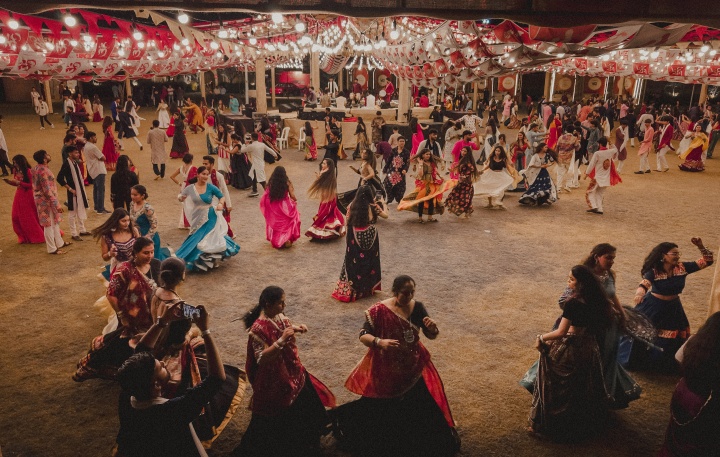 Social groups, Yuvak Mandals, apartment complexes, event planners, and clubs in cities all organise Garba nights. (Express photo)
The dancing happens in venues from open grounds to humongous air-conditioned domes. There are celebrations in the villages and in large public spaces, along with elaborate orchestra support, highly paid singers and entertainers, the latest sound and light systems, and theme-based decorations.
Garba enthusiasts go to great lengths to prepare themselves for the celebrations – the latest rage is fast and quick cosmetic therapies such as the use of glutathione supplements that are commonly believed to boost the immune system and improve overall health, and carbon laser peel (or “Hollywood peel”) treatment – which is a quick, non-invasive way to deep-cleanse and exfoliate the skin using liquid carbon and laser technology.
Story continues below this ad
While Garba can be performed at any celebration or happy occasion such as social events, community gatherings, and weddings, the Navratri Garba is Gujarat’s true community celebration – a festival in which people from all walks of life are involved in conceptualising, planning, organising, and participating in the event.
“From villages and small towns in the desert area of Kutch and North Gujarat to the villages and towns that lie along its long coastline; from the larger cities like Surat, Vadodara, and Ahmedabad, to smaller cities like Bhavnagar and Jamnagar, Garba is celebrated everywhere with equal joy and devotion. The performative and visual celebration of Garba takes place within homes and temple courtyards, public spaces in villages, urban squares, streets, and large open grounds. Garba thus becomes an all-encompassing participatory community event,” says the dossier submitted to UNESCO.
Social groups, Yuvak Mandals, apartment complexes, event planners, and clubs in cities all organise Garba nights. The accompanying musicians can range from a single dholi (drummer) to large musical ensembles. Poets and writers of traditional and contemporary Garba songs are part of the Garba events.
Accompanied by the traditional dhol and other musical instruments, the dancers move in a circle, with their movements starting and ending with them facing the inside of the circle. Each dancer spins around their own axis without physical contact with others, while continuing to maintain the larger circle.
Story continues below this ad
Starting with slow circular movements and gentle clapping, the tempo builds up to a frenzied whirling. Some forms of Garba and Raas are ‘Maniaro Raas’ or ‘Kanabi Raas’, ‘Vinchhudo’, ‘Dandiya Nritya’, ‘Kahalya’, ‘Hudo’, ‘Tippani’, ‘Gop Raas’ and ‘Mer Raas’. Styles of executing dandiya steps include Dodhiyu, Simple Five, Simple Seven, Popatiyu, Trikoniya (in which hand movements form an imaginary triangle), Lehree, Three Claps, Butterfly, Hudo, and Two Claps.
There are also some unusual forms, like men dressing as women to perform Garba.
‘Sadu Mata ni Pol’ in Ahmedabad’s walled city has a tradition called ‘Saduma Garba’, which is said to be more than two centuries old. Here, on the eighth night of Navratri, men from the Barot community dress in sarees and bangles to perform Garba as an act of penance, appealing to Sadu Mata to lift a curse. The folklore is that Barot men had failed to protect a woman named Saduben from a Mughal nobleman, which led to the death of her child. Saduben committed sati, and cursed the men, saying their future generations would be cowards.
How Garba as a tradition started and evolved
Professor Parul Shah, former Dean and Head (Dance), at the Faculty of Performing Arts, Maharaja Sayajirao University of Baroda in Vadodara, said the word ‘Garbo’ or ‘Garba’ comes from the Sanskrit word ‘Garbhdeep’, which refers to an earthen pot with circular holes, and is popularly known as ‘Garbo’.
Story continues below this ad
“There isn’t a clear date for the beginning of Garba, but the celebration is associated with both the dynasties that ruled Gujarat and with the peasantry and agricultural classes. Singing and dancing with the flute and other musical instruments as part of dance forms like Garba, Garbi, and Raas, and variations such as dandia or the ‘stick raas’, is believed to date back to the age of Lord Krishna,” Shah said.
“Then, with the establishment of Shaktipeeth Ambaji around 700 years ago, people started worshipping through the Garba of Mataji. The earthen pot is a symbol of the human body, and the lamp inside signifies the divine soul. The festival is dedicated to the worship of the feminine energy or Shakti,” Shah, who was among the experts who prepared the dossier for the nomination for the UNESCO designation, said.
“Women would do the sthapana (installation) of Mataji in the chowk of their village temple, do aarti, and dance the Garba,” Shah said. In Ahmedabad, Garba started from the pols (close-knit residential clusters) of the walled city and streets such as Relief Road, Astodia, and Gheekantha, where it got its name of ‘sheri garba’, she said. “As the traffic on these busy roads eased after 10 at night, residents of the area would gather for Garba, singing and dancing.”
The antiquity of the Garba songs is difficult to establish precisely, Shah said. In the 20th century, the Garbas were mainly those that had been passed down through the generations of women in families or communities, she said.
Story continues below this ad
The knowledge and skills of Garba were transmitted both orally and in a documented form. “The oral tradition was transmitted across generations both in urban and rural areas by practice, performance, imitation, and observation. It is believed that the movements and music are transmitted to the womb when a mother-to-be dances the Garba, this is called Garbh-Sanskar,” the UNESCO dossier says.
The community of artisans who craft Garba objects also pass on their skills orally and through practice. The knowledge of traditional music and instruments is passed on through visual, aural, and kinetic experiences.
Ghazal singer Atul Brahmbhatt, whose father Jitu Bhagat started the Sri Jitu Bhagat Satsang Mandali in Ahmedabad in 1949, told The Indian Express that his father was initially criticised for participating in an activity that was traditionally the preserve of women. “But today, men participate as enthusiastically as women,” he said.
Atul said Jitu was influenced by the Vallabh and Dhola brothers who are credited with having written the 118-paragraph ‘Anand no Garbo’, which is sung even today. “My father himself wrote hundreds of Garbas, some of which continue to be popular. He would walk to Ambaji on every Bhadra Poonam with 15-20 new Garbas and sing at the temple. Since there was no recording, devotees would memorise them and go back to their villages and sing them,” Atul said.
Story continues below this ad
He recalled that his father never took a penny from anyone for Garba – “He would teach us that Garba should be only about devotion, with no expectation.”
Changing Garba events: contested trends
The Garba events in Ahmedabad have long moved out of the pols to the Sarkhej Gandhinagar Highway, the S P Ring Road, and now even to the remote outskirts of the city. Its growth and evolution are a reflection of the innate qualities of Garba, Prof Shah said.
“Garba has been redefined by every generation through the adoption of new performative styles, contemporary lyrics, and changing fashion trends, while keeping the circle of feminine energy or Shakti intact. It remains a living tradition, and the inherent structural strength and sustained continuity of Garba is proof of its willingness to continuously change, adapt, and renew to suit the times,” she said.
Garba has remained vibrant, evolving, and alive in Gujarat even during periods of turbulence such as the Covid-19 pandemic. “It has retained its ritual, social, and celebratory flavour through changes in movement styles, music, lyrics, decor, costumes, and crafts, which signify a constant process of creative evolution,” Shah said.
Story continues below this ad
However, some old-timers who see Garba as essentially an expression of devotion are put off by the modern commercial dimensions that the celebration has acquired in recent years. “I would not go to a Garba today even for free,” Brahmbhatt said. It mostly only reflects a professional approach for money these days, and resembles a fashion parade in terms of looks and vibe.”
Indeed, even among the younger generations, an increasing inclination is sometimes seen towards the more traditional forms of Garba – which is reflected in part in the recent popularity of the ‘sheri’ and ‘mandli’ Garba.
With the latest cosmetic technologies, the usual facials and body scrubs have been replaced by therapies such as glutathione IVs, HIFU (High-Intensity Focused Ultrasound) and carbon peeling for the “instant” glow. “These therapies have been gaining in popularity for some time now, but the demand for them has increased manifold during Navratri, especially among younger people,” a popular dermatologist in Ahmedabad said.
Then there is the increasingly visible presence of communal elements who have in recent years sought to associate themselves with Navratri, claiming to keep a ‘check’ on the participants.
Story continues below this ad
“Earlier, it was self-disciplined; there would be no nuisance or misbehaviour. People from all religions and communities would donate and support the garba in the old city of Ahmedabad. There was no tension; only social harmony,” Atul Brahmbhatt said.
Big bucks: A multi-crore celebration
The Navratri Garba celebrations involve a very large number of people in a massive economic enterprise – from the owners of the party plots, the planners of the event, choreographers, and providers of sound and light systems, to those involved in the food industry, and the artisanal community of potters, blacksmiths, and carpenters who create the ritual objects associated with Garba, including the earthen pots and canopy (mandavadi). Then there is the cloth and jewellery industry, which is deeply invested in the Garba economy.
In big cities like Ahmedabad and Surat, the Garba fervour begins months ahead of Navratri. Huge boards come up every year, announcing the commencement of Garba classes. Many schools and universities offer professional courses in dance and music, costume and ornament design, landscape planning, and sound and light design, which contribute to Garba creations.
Various departments of the Gujarat government provide logistical support in creating the public spaces for Garba performances during the nine nights of Navaratri. Since the entire state participates in the festivities, special emphasis is put on proper traffic management and safety.
Since 2003, the state government has been organising the Vibrant Navratri program at the GMDC ground in Ahmedabad.
KioskNews shows a cleaned-up reading view extracted from the publisher’s page — the original always lives on their site, not ours.